


Colorectal cancer carcinogenesis: a review of mechanisms
- PMID: 27144067
- PMCID: PMC4850121
- DOI: 10.28092/j.issn.2095-3941.2015.0103
Colorectal cancer carcinogenesis: a review of mechanisms
Abstract
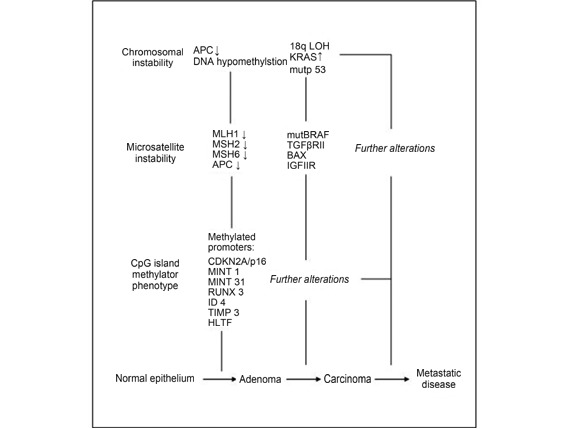
Colorectal cancer (CRC) is the second most common cancer in women and the third most common in men globally. CRC arises from one or a combination of chromosomal instability, CpG island methylator phenotype, and microsatellite instability. Genetic instability is usually caused by aneuploidy and loss of heterozygosity. Mutations in the tumor suppressor or cell cycle genes may also lead to cellular transformation. Similarly, epigenetic and/or genetic alterations resulting in impaired cellular pathways, such as DNA repair mechanism, may lead to microsatellite instability and mutator phenotype. Non-coding RNAs, more importantly microRNAs and long non-coding RNAs have also been implicated at various CRC stages. Understanding the specific mechanisms of tumorigenesis and the underlying genetic and epigenetic traits is critical in comprehending the disease phenotype. This paper reviews these mechanisms along with the roles of various non-coding RNAs in CRCs.
Keywords: Colorectal cancer; chromosomal instability; microsatellite instability; non-coding RNA mismatch repair.
Figures
References
-
-
Fearon ER, Vogelstein B. A genetic model for colorectal tumorigenesis. Cell. 1990; 61 : 759-67.
-
-
- East JE, Saunders BP, Jass JR. Sporadic and syndromic hyperplastic polyps and serrated adenomas of the colon: classification, molecular genetics, natural history, and clinical management. Gastroenterol Clin North Am. 2008;37:25�6. - PubMed
LinkOut - more resources
Full Text Sources
Other Literature Sources