Clinical Efficacy of Electroneurography in Acute Facial Paralysis
- PMID: 27144227
- PMCID: PMC4853888
- DOI: 10.7874/jao.2016.20.1.8
Clinical Efficacy of Electroneurography in Acute Facial Paralysis
Abstract
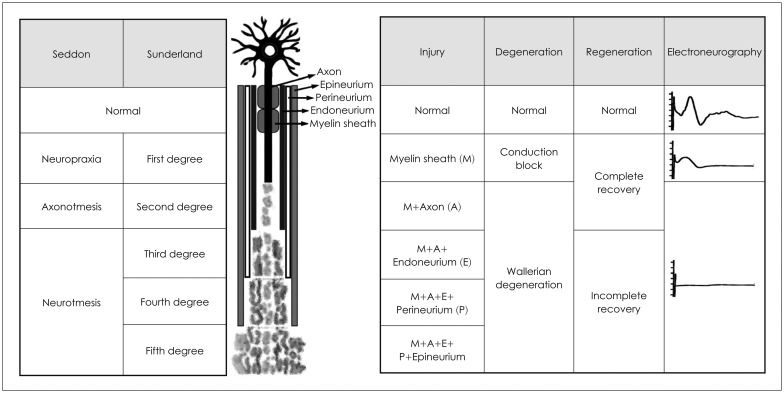
The estimated incidence of acute facial paralysis is approximately 30 patients per 100000 populations annually. Facial paralysis is an extremely frightening situation and gives extreme stress to patients because obvious disfiguring face may cause significant functional, aesthetic, and psychological disturbances. For stressful patients with acute facial paralysis, it is very important for clinicians to answer the questions like whether or not their facial function will return to normal, how much of their facial function will be recovered, and how long this is going to take. It is also important for clinicians to treat the psychological aspects by adequately explaining the prognosis, in addition to providing the appropriate medical treatment. For decades, clinicians have used various electrophysiologic tests, including the nerve excitability test, the maximal stimulation test, electroneurography, and electromyography. In particular, electroneurography is the only objective measure that is useful in early stage of acute facial paralysis. In this review article, we first discuss the pathophysiology of injured peripheral nerve. And then, we describe about various electrophysiologic tests and discuss the electroneurography extensively.
Keywords: Acute facial paralysis; Electromyography; Electroneurography; Electrophysiological test.
Conflict of interest statement
Figures
References
-
- Mattox DE. Clinical disorders of the facial nerve. In: Flint PW, Haughey BH, Lund VJ, Niparko JK, Richardson MA, Robbins KT, et al., editors. Cummings Otolaryngology: Head & Neck Surgery. 6th ed. Philadelphia, PA: Elsevier Science Health Science; 2014. pp. 2617–2628.
-
- Linstrom CJ. Objective facial motion analysis in patients with facial nerve dysfunction. Laryngoscope. 2002;112(7 Pt 1):1129–1147. - PubMed
-
- Neely JG, Wang KX, Shapland CA, Sehizadeh A, Wang A. Computerized objective measurement of facial motion: normal variation and test-retest reliability. Otol Neurotol. 2010;31:1488–1492. - PubMed
-
- Frey M, Tzou CH, Michaelidou M, Pona I, Hold A, Placheta E, et al. 3D video analysis of facial movements. Facial Plast Surg Clin North Am. 2011;19:639–646. viii. - PubMed
-
- Hadlock TA, Urban LS. Toward a universal, automated facial measurement tool in facial reanimation. Arch Facial Plast Surg. 2012;14:277–282. - PubMed
Publication types
LinkOut - more resources
Full Text Sources
Other Literature Sources