. 2016 Apr 30;21(5):578.
doi: 10.3390/molecules21050578.

Synthesis of Thiazolo[5,4-f]quinazolin-9(8H)-ones as Multi-Target Directed Ligands of Ser/Thr Kinases

Affiliations

Synthesis of Thiazolo[5,4-f]quinazolin-9(8H)-ones as Multi-Target Directed Ligands of Ser/Thr Kinases

Damien Hédou et al. Molecules. .

Abstract

A library of thirty novel thiazolo[5,4-f]quinazolin-9(8H)-one derivatives belonging to four series designated as 12, 13, 14 and 15 was efficiently prepared, helped by microwave-assisted technology when required. The efficient multistep synthesis of methyl 6-amino-2-cyano- benzo[d]thiazole-7-carboxylate (1) has been reinvestigated and performed on a multigram scale. The inhibitory potency of the final products against five kinases involved in Alzheimer's disease was evaluated. This study demonstrates that some molecules of the 12 and 13 series described in this paper are particularly promising for the development of new multi-target inhibitors of kinases.

Keywords: CDK5; CK1; CLK1; DYRK1A.; GSK-3; microwave-assisted synthesis; multi-target-directed ligand; protein kinases; thiazolo[5,4-f]quinazolin-9(8H)-ones.


Conflict of interest statement

The authors declare no conflict of interest.

Figures
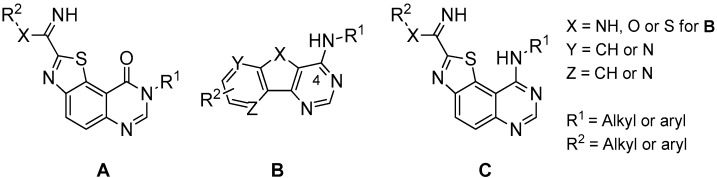
Figure 1
Figure 1
General formulae A, B and C of previously described kinase inhibitors [6,7,8,9,10,11,12,13,14].
Figure 2
Figure 2
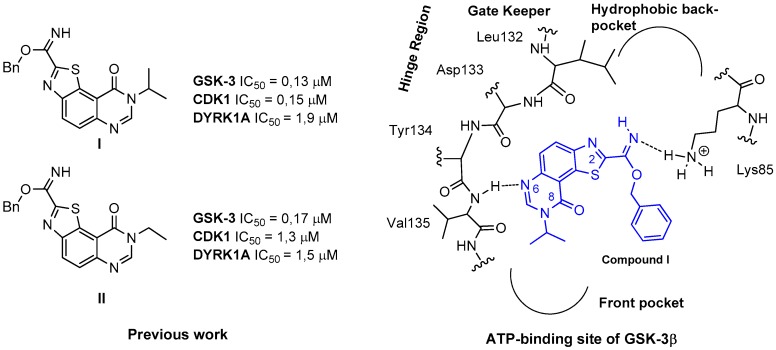
Schematic representation of the proposed binding mode of compound I in the ATP-binding site of GSK-3β.
Figure 3
Figure 3
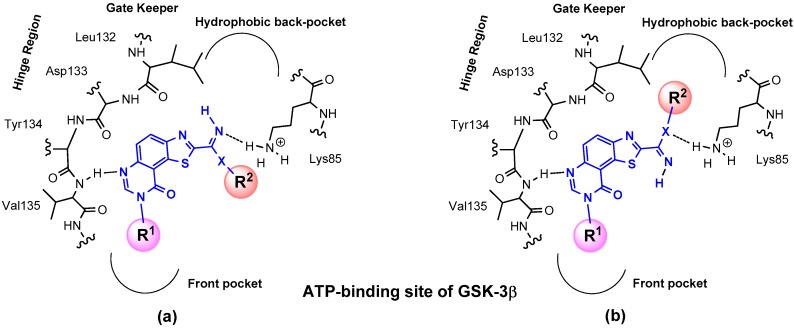
Suggested position of envisioned molecules in the targeted binding sites (example of the ATP-binding site of GSK-3β: (a) cis- spatial position of R1 and R2 or (b) trans-spatial position of R1 and R2.
Scheme 1
Scheme 1
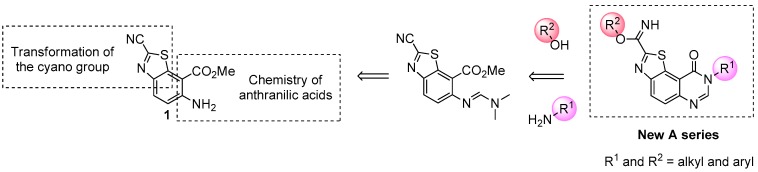
Envisioned transformations of 1 for synthesis of novel compounds of series A.
Scheme 2
Scheme 2
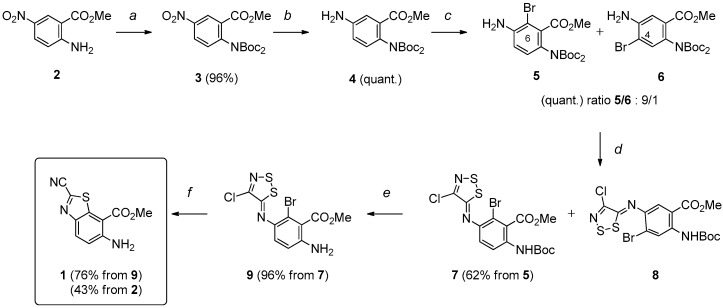
Multistep synthesis of the key benzothiazole 1. Reagents and conditions: (a) Boc2O (2.3 equiv), DMAP (1.0 equiv), Et3N (1.0 equiv), THF, r.t., 5 h; (b) HCO2NH4 (5.0 equiv), Pd/C (10%), EtOH, 78 °C (μw), 15 min; (c) NBS (1.0 equiv), DMF, −10 °C, 3 h; (d) Appel salt (1.2 equiv), Py. (2.3 equiv), CH2Cl2, r.t., 3 h; (e) TFA, CH2Cl2, r.t., 2 h; (f) CuI (1.0 equiv), Py., 115 °C (μw), 30 min.
Scheme 3
Scheme 3
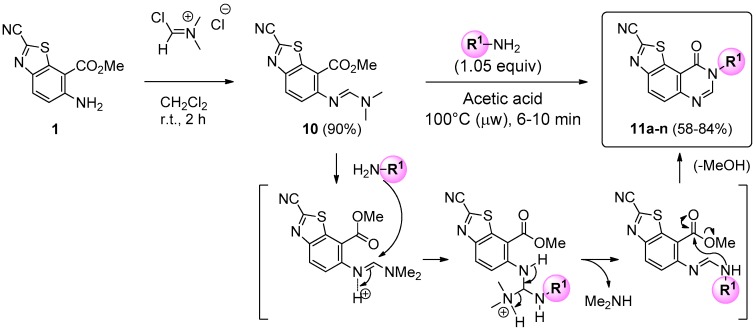
Synthesis of series 11 compounds and suggested mechanism of cyclization after attack of the primary amine. For yields see Table 1.
Scheme 4
Scheme 4
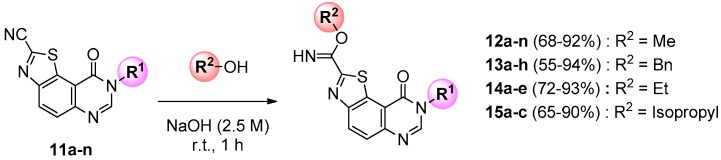
General synthesis of carbimidates 12, 13, 14 and 15 from 11 series (for yields see Table 2).
Scheme 5
Scheme 5
Structures of the lead compounds (nanomolar IC50 values) identified in this study.

References

    1. Martin L., Latypova X., Wilson C.M., Magnaudeix A., Perrin M.-L., Terro F. Tau protein kinases: Involvement in Alzheimer’s disease. Ageing Res. Rev. 2013;12:289–309. doi: 10.1016/j.arr.2012.06.003. - DOI - PubMed
    1. Flajolet M., He G., Heiman M., Lin A., Nairn A.C., Greengard P. Regulation of Alzheimer’s disease amyloid-β formation by casein kinase I. Proc. Nat. Acad. Sci. USA. 2007;104:4159–4164. doi: 10.1073/pnas.0611236104. - DOI - PMC - PubMed
    1. Weinmann H., Metternich R. Drug discovery process for kinase Inhibitors. ChemBioChem. 2005;6:455–459. doi: 10.1002/cbic.200500034. this paper is the editorial of a special issue “Kinases in drug discovery”. Chem. Biol. Chem. 2005;6:453–574.

    1. Wu P., Nielsen T.E., Clausen M.H. Small-molecule kinase inhibitors: an analysis of FDA-approved drugs. Drug Discovery Today. 2016;21:5–10. doi: 10.1016/j.drudis.2015.07.008. - DOI - PubMed
    1. Wu P., Nielsen T.E., Clausen M.H. FDA-approved small-molecule kinase inhibitors. Trends Pharmacol. Sci. 2015;36:422–439. doi: 10.1016/j.tips.2015.04.005. - DOI - PubMed

MeSH terms