Randomized Controlled Trial
. 2016 Jul 5;23(7):564-75.
doi: 10.1128/CVI.00665-15. Print 2016 Jul.

Clinical Trial of an Oral Live Shigella sonnei Vaccine Candidate, WRSS1, in Thai Adults

Affiliations
Randomized Controlled Trial

Clinical Trial of an Oral Live Shigella sonnei Vaccine Candidate, WRSS1, in Thai Adults

Punnee Pitisuttithum et al. Clin Vaccine Immunol. .

Abstract

Live attenuated Shigella sonnei vaccine candidate WRSS1, previously tested in U.S. and Israeli volunteers, was evaluated in a population of adult Thai volunteers in which the organism is endemic. In a randomized placebo-controlled, double-blind design, inpatient participants received a single oral dose of 1.6 × 10(4) CFU of WRSS1. The vaccine was generally well tolerated, with equal numbers of vaccinees and placebo controls showing mild symptoms. Only 3 of 13 vaccinees (23%) had culture-positive stools, while a total of 9 vaccinees were positive by PCR. Lack of vaccine shedding in volunteers correlated with lack of clinical symptoms and immune responses, just as the duration of fecal shedding correlated directly with stronger immune responses. Two months following immunization, 10 vaccinees and 10 newly recruited naive controls received a challenge dose of 1,670 CFU of virulent S. sonnei strain 53G. This dose had previously demonstrated a 75% attack rate for dysentery in Thai volunteers. However, in this study the attack rate for dysentery in naive controls after challenge was 20%. Based on clinical record summaries, 3 vaccinees and 5 naive controls experienced clinically relevant illness (diarrhea/dysentery/fever/shigellosis), and a 40% vaccine efficacy was calculated. When these data are compared to those for the performance of this vaccine candidate in more naive populations, it is clear that a single oral dose of WRSS1 at 10(4) CFU failed to achieve its full potential in a population in which the organism is endemic. Higher doses and/or repeated immunizations may contribute to improved vaccine shedding and consequent elevation of protective immune responses in a population in which the organism is endemic. (The study has been registered at ClinicalTrials.gov under registration no. NCT01080716.).


Figures

FIG 1
FIG 1
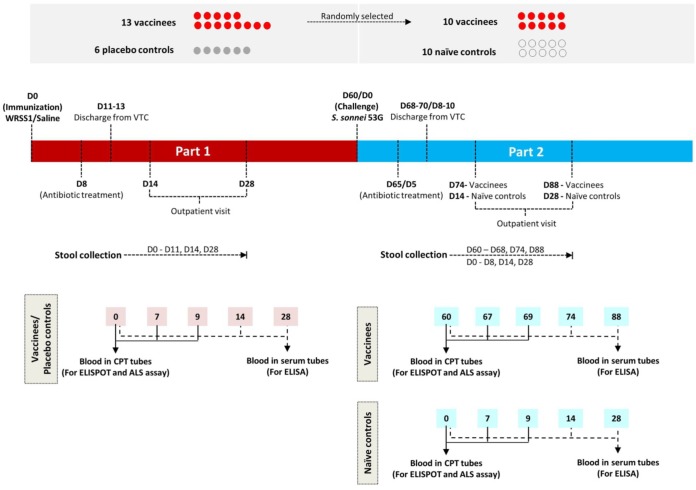
Study outline for oral live S. sonnei vaccine candidate WRSS1 immunization and wild-type S. sonnei 53G challenge of Thai adults.
FIG 2
FIG 2
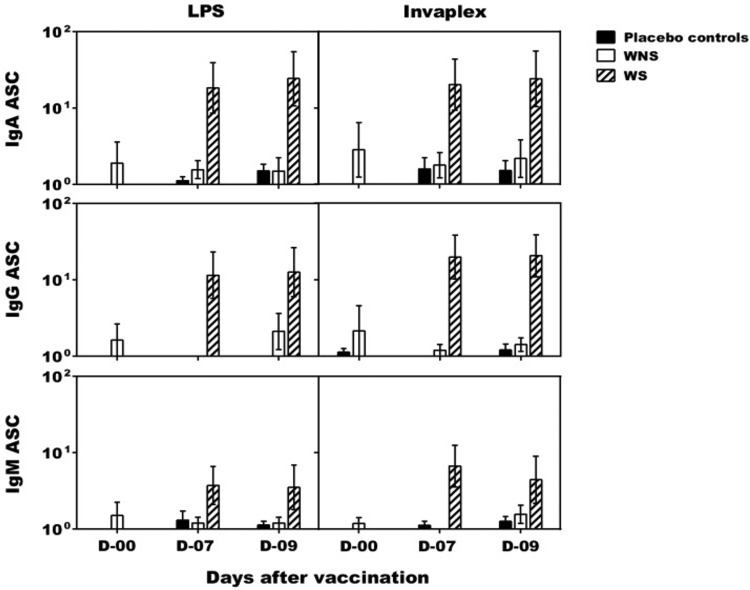
S. sonnei antigen-specific antibody-secreting cell (ASC) counts after oral live S. sonnei vaccine candidate WRSS1 immunization. IgA, IgG, and IgM ASC counts (GMN ± SE) in 13 vaccinees and 6 placebo controls were determined on study days 0, 7, and 9 by ELISPOT assay. Vaccinees were subdivided into WRSS1 shedders (WS) (hatched bar; n = 9) and WRSS1 nonshedders (WNS) (white bar; n = 4). ASC counts in placebo controls (n = 6) are shown as a black bar. Statistical differences between WS and placebo groups were assessed using the Mann-Whitney test: P = 0.002 for both LPS- and INV-specific IgA ASC and P = 0.009 for both LPS- and INV-specific IgG ASC. In addition, a statistical difference between WS and WNS groups was assessed using the Mann-Whitney test: P = 0.006 for both LPS- and INV-specific IgA ASC.
FIG 3
FIG 3
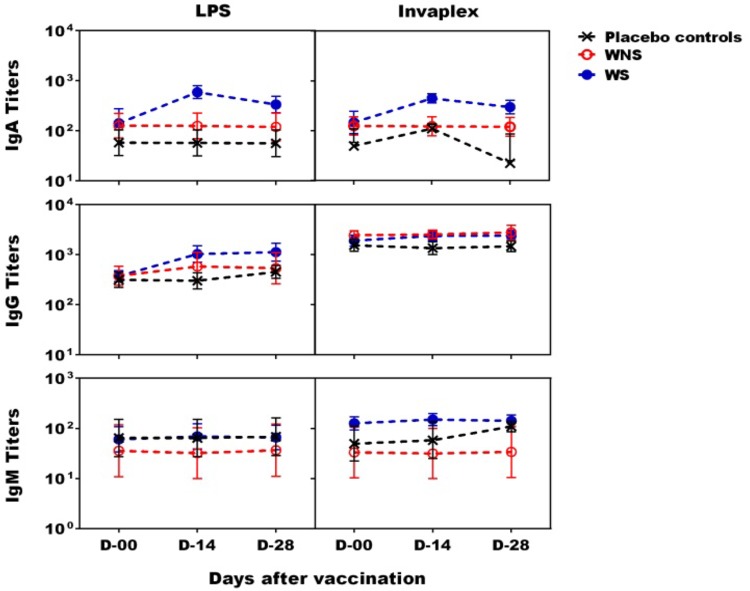
S. sonnei antigen-specific serum antibody titers after oral live S. sonnei vaccine candidate WRSS1 immunization. Serum IgA, IgG, and IgM antibody titers (GMT ± SE) were measured by ELISA for 13 vaccinees and 6 placebo controls on study days 0, 14, and 28. Vaccinees were subdivided into WRSS1 shedder (WS) (blue dotted line; n = 9) and WRSS1 nonshedder (WNS) (red dotted line; n = 4) groups. Responses of placebo controls (n = 6) are shown as black dotted lines. A statistical differences between WS and the placebo groups was assessed using the Mann-Whitney test: P = 0.001 for both LPS- and INV-specific IgA titers.
FIG 4
FIG 4
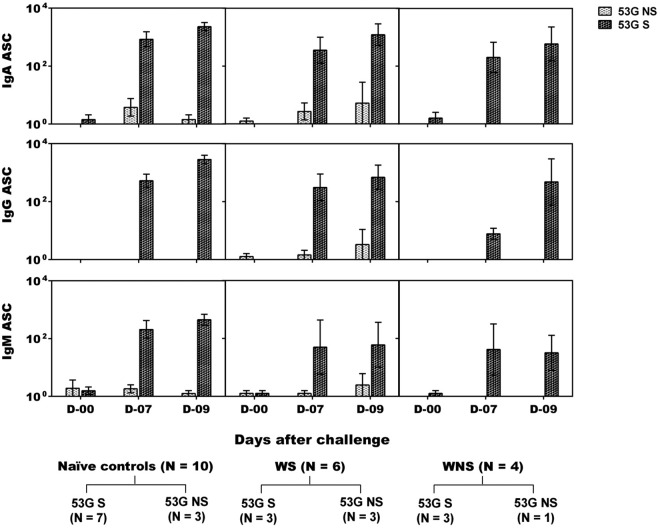
S. sonnei LPS-specific ASC counts in oral live S. sonnei vaccine candidate WRSS1-immunized vaccinees and control volunteers after wild-type S. sonnei 53G challenge. IgA, IgG, and IgM ASC counts (GMN ± SE) were determined on study days 0, 7, and 9 for naive controls (n = 10) and on study days 0 (60), 7 (67), and 9 (69) for WRSS1-immunized vaccinees (n = 10) after 53G challenge. Ten vaccinees were subdivided into WRSS1 shedders (WS) (n = 6) and WRSS1 nonshedders (WNS) (n = 4). Within each group, 53G shedders (53G S) and 53G nonshedders (53G NS) are represented as dark spotted bars and light spotted bars, respectively.
FIG 5
FIG 5
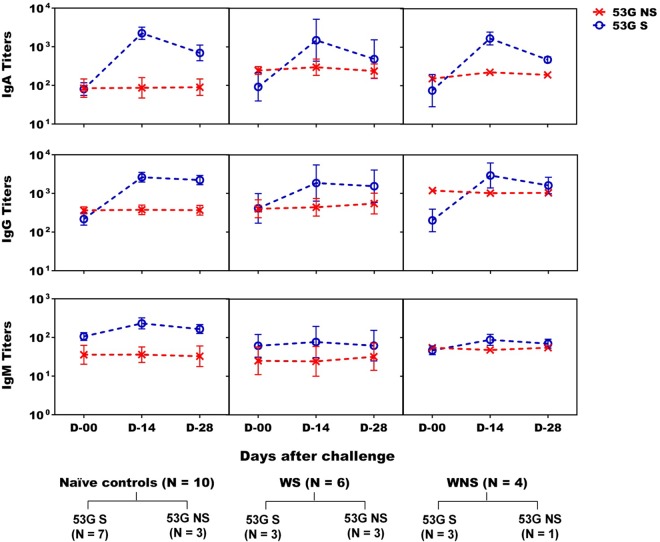
S. sonnei LPS-specific serum antibody titers in oral live S. sonnei vaccine candidate WRSS1-immunized vaccinees and control volunteers after wild-type S. sonnei 53G challenge. Serum IgA, IgG, and IgM antibody titers (GMT ± SE) were measured on study days 0, 14, and 28 for naive controls (n = 10) and on study days 0 (60), 14 (74), and 28 (88) for WRSS1-immunized vaccinees (n = 10) after 53G challenge. Ten vaccinees were subdivided into WRSS1 shedder (WS) (n = 6) and WRSS1 nonshedder (WNS) (n = 4) groups. Within each group, 53G shedders (53G S) and 53G nonshedders (53G NS) are represented as blue dotted lines and red dotted lines, respectively.

References

    1. Echeverria P, Sethabutr O, Serichantalergs O, Lexomboon U, Tamura K. 1992. Shigella and enteroinvasive Escherichia coli infections in households of children with dysentery in Bangkok. J Infect Dis 165:144–147. doi:10.1093/infdis/165.1.144. - DOI - PubMed
    1. Levine MM, Kotloff KL, Nataro JP, Muhsen K. 2012. The global enteric multicenter study (GEMS): impetus, rationale, and genesis. Clin Infect Dis 55:S215–S224. doi:10.1093/cid/cis761. - DOI - PMC - PubMed
    1. Lolekha S, Vibulbandhitkit S, Poonyarit P. 1991. Response to antimicrobial therapy for shigellosis in Thailand. Rev Infect Dis 13(Suppl 4):S342–S346. doi:10.1093/clinids/13.Supplement_4.S342. - DOI - PubMed
    1. von Seidlein L, Kim DR, Ali M, Lee H, Wang X, Thiem VD, Canh do G, Chaicumpa W, Agtini MD, Hossain A, Bhutta ZA, Mason C, Sethabutr O, Talukder K, Nair GB, Deen JL, Kotloff K, Clemens J. 2006. A multicentre study of Shigella diarrhoea in six Asian countries: disease burden, clinical manifestations, and microbiology. PLoS Med 3:e353. doi:10.1371/journal.pmed.0030353. - DOI - PMC - PubMed
    1. Chompook P, Todd J, Wheeler JG, von Seidlein L, Clemens J, Chaicumpa W. 2006. Risk factors for shigellosis in Thailand. Int J Infect Dis 10:425–433. doi:10.1016/j.ijid.2006.05.011. - DOI - PubMed

Publication types

Associated data

LinkOut - more resources