


Morphometric discrimination of two sympatric sibling species in the Palaearctic region, Culicoides obsoletus Meigen and C. scoticus Downes & Kettle (Diptera: Ceratopogonidae), vectors of bluetongue and Schmallenberg viruses
- PMID: 27146157
- PMCID: PMC4857416
- DOI: 10.1186/s13071-016-1520-7
Morphometric discrimination of two sympatric sibling species in the Palaearctic region, Culicoides obsoletus Meigen and C. scoticus Downes & Kettle (Diptera: Ceratopogonidae), vectors of bluetongue and Schmallenberg viruses
Abstract
Background: Some Palaearctic biting midge species (subgenus Avaritia) have been implicated as vectors of bluetongue virus in northern Europe. Separation of two species (C. obsoletus and C. scoticus) is considered difficult morphologically and, often, these female specimens are grouped in entomological studies. However, species-specific identification is desirable to understand their life history characteristics, assess their roles in disease transmission or measure their abundance during arboviral outbreaks. This study aims to investigate whether morphometric identification techniques can be applied to female C. obsoletus and C. scoticus individuals trapped at different geographical regions and time periods during the vector season.
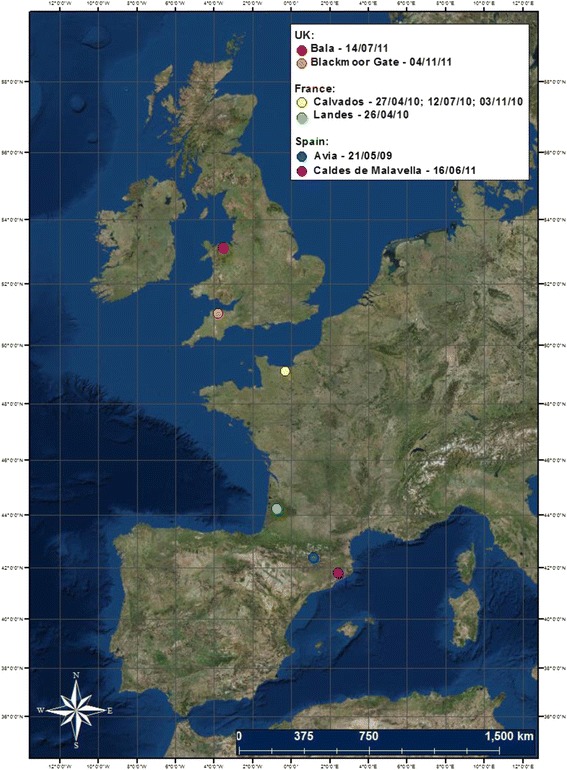
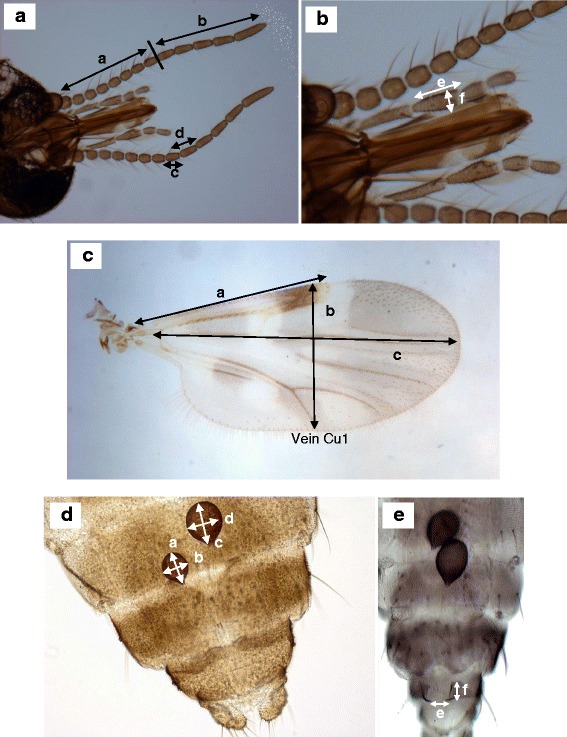
Methods: C. obsoletus and C. scoticus were collected using light-suction traps from the UK, France and Spain, with two geographical locations sampled per country. A total of 759 C. obsoletus/C. scoticus individuals were identified using a molecular assay based on the cytochrome c oxidase subunit I gene. Fifteen morphometric measurements were taken from the head, wings and abdomen of slide-mounted specimens, and ratios calculated between these measurements. Multivariate analyses explored whether a combination of morphometric variables could lead to accurate species identification. Finally, Culicoides spp. collected in France at the start, middle and end of the adult vector season were compared, to determine whether seasonal variation exists in any of the morphometric measurements.
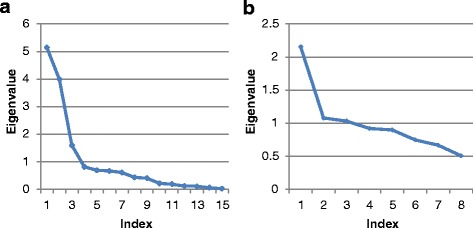
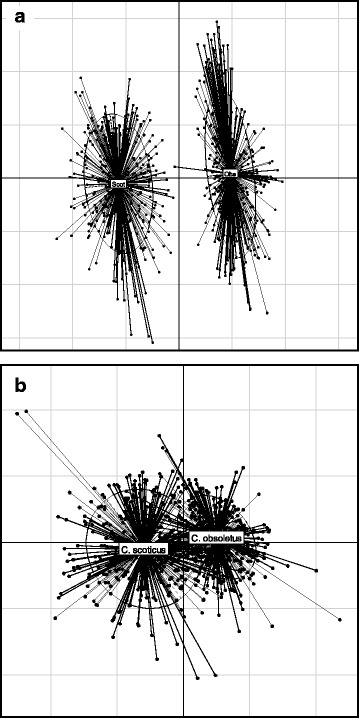
Results: The principal component analyses revealed that abdominal characteristics: length and width of the smaller and larger spermathecae, and the length of the chitinous plates and width between them, are the most reliable morphometric characteristics to differentiate between the species. Seasonal variation in the size of each species was observed for head and wing measurements, but not abdominal measurements. Geographical variation in the size of Culicoides spp. was also observed and is likely to be related to temperature at the trapping sites, with smaller individuals trapped at more southern latitudes.
Conclusions: Our results suggest that female C. obsoletus and C. scoticus individuals can be separated under a stereomicroscope using abdominal measurements. Although we show the length and width of the spermathecae can be used to differentiate between the species, this can be time-consuming, so we recommend undertaking this using standardized subsampling of catches.
Keywords: Arbovirus; BTV; Bluetongue virus; Culicoides obsoletus; Culicoides scoticus; Morphology; Morphometrics; Obsoletus Group; Obsoletus complex; Sibling species.
Figures
References
Publication types
MeSH terms
Substances
Grants and funding
LinkOut - more resources
Full Text Sources
Other Literature Sources
Miscellaneous
