


Efficient quantum walk on a quantum processor
- PMID: 27146471
- PMCID: PMC4858748
- DOI: 10.1038/ncomms11511
Efficient quantum walk on a quantum processor
Abstract
The random walk formalism is used across a wide range of applications, from modelling share prices to predicting population genetics. Likewise, quantum walks have shown much potential as a framework for developing new quantum algorithms. Here we present explicit efficient quantum circuits for implementing continuous-time quantum walks on the circulant class of graphs. These circuits allow us to sample from the output probability distributions of quantum walks on circulant graphs efficiently. We also show that solving the same sampling problem for arbitrary circulant quantum circuits is intractable for a classical computer, assuming conjectures from computational complexity theory. This is a new link between continuous-time quantum walks and computational complexity theory and it indicates a family of tasks that could ultimately demonstrate quantum supremacy over classical computers. As a proof of principle, we experimentally implement the proposed quantum circuit on an example circulant graph using a two-qubit photonics quantum processor.
Figures
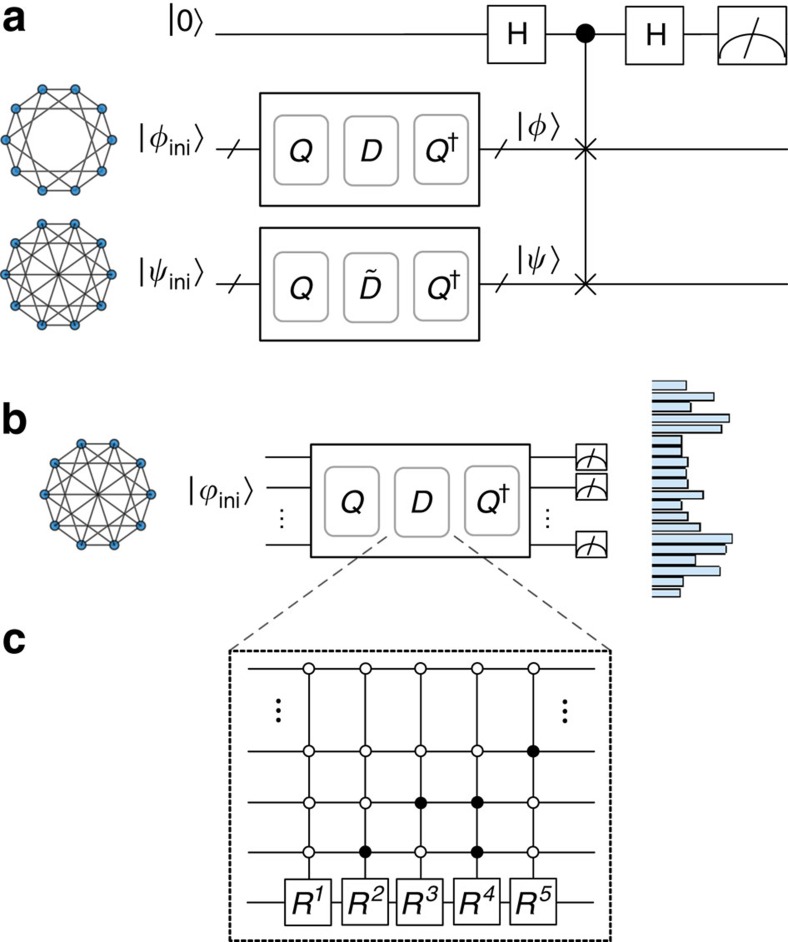
 and
and  of two compared processes according to
  . On measuring the ancillary qubit we obtain outcome ‘1' with probability
  —the probability of observing ‘1' indicates the similarity of dynamical behaviours of the two processes. See its complexity analysis in Supplementary Note 1. (b) Probability distributions are sampled by measuring the evolution state in a complete basis, such as the computational basis. (c) An example of the quantum circuit for implementing diagonal unitary operator D=exp(−itΛ), where the circulant Hamiltonian has 5 non-zero eigenvalues. The open and solid circles represent the control qubits as ‘if
  ' and ‘if
  ', respectively.
  , where
  is the corresponding eigenvalue.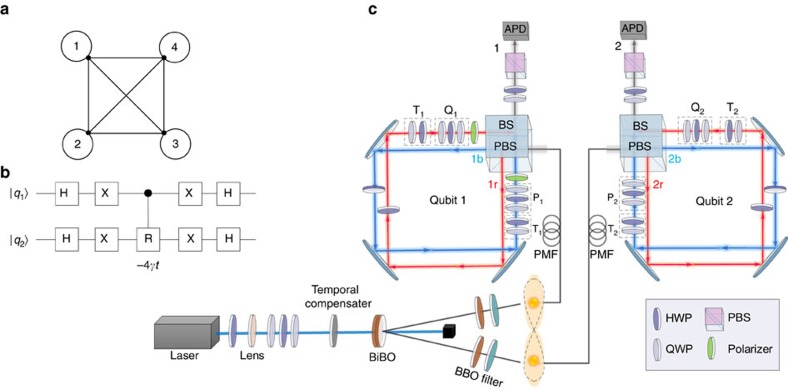
 . H and X represent the Hadamard and Pauli-X gate, respectively.
  is a phase gate. (c) The experimental set-up for a reconfigurable two-qubit photonics quantum processor, consisting of a polarization-entangled photon source using paired type-I BiBO crystal in the sandwich configuration and displaced Sagnac interferometers. See further details in Methods.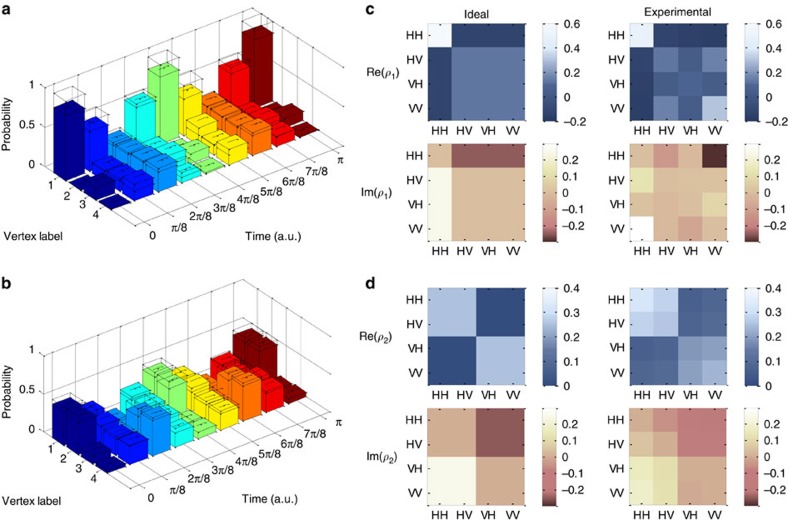
 and
and  . The s.d. of each individual probability is also plotted, which is calculated by propagating error assuming Poissonian statistics. (c,d) The ideal theoretical and experimentally reconstructed density matrices for the states
  (corresponding to ρ1) and
  (corresponding to ρ2). Both of the real and imaginary parts of the density matrices are obtained through the maximum likelihood estimation technique, and is shown as Re(ρ) and Im(ρ), respectively. Further results are shown in Supplementary Table 1, Supplementary Fig. 2 and Supplementary Note 4.
References
-
- Farhi E. & Gutmann S. Quantum computation and decision trees. Phys. Rev. A 58, 915 (1998).
-
- Kempe J. Quantum random walks: an introductory overview. Contemp. Phys. 44, 307–327 (2003).
-
- Childs A. M., Gosset D. & Webb Z. Universal computation by multiparticle quantum walk. Science 339, 791–794 (2013). - PubMed
-
- Childs A. M. & Goldstone J. Spatial search by quantum walk. Phys. Rev. A 70, 022314 (2004).
-
- Douglas B. L. & Wang J. B. A classical approach to the graph isomorphism problem using quantum walks. J. Phys. A 41, 075303 (2008).
Publication types
Grants and funding
LinkOut - more resources
Full Text Sources
Other Literature Sources
Research Materials
