


Schemas of Marital Change: From Arranged Marriages to Eloping for Love
- PMID: 27147752
- PMCID: PMC4852488
- DOI: 10.1111/jomf.12003
Schemas of Marital Change: From Arranged Marriages to Eloping for Love
Abstract
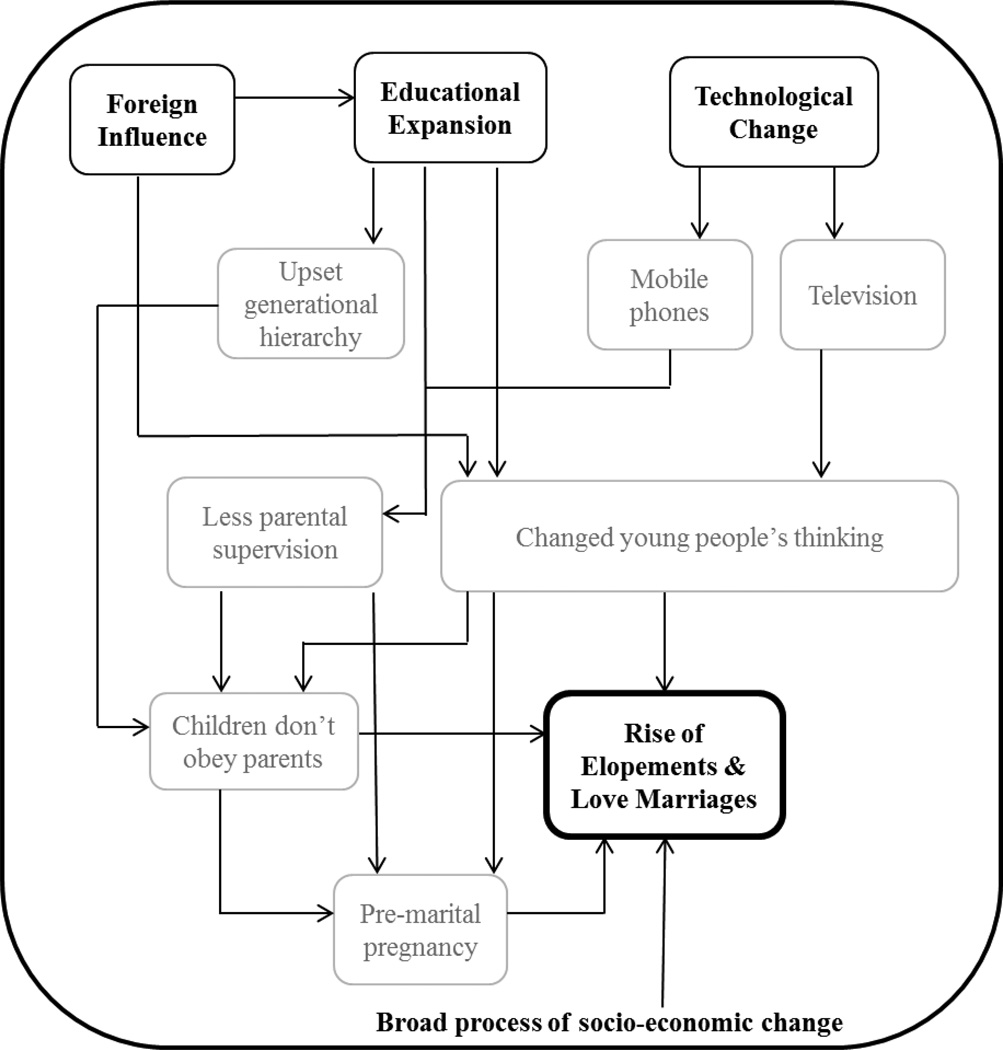
In recent decades, arranged marriages have become less common in many parts of Asia. This paper explores people's schemas surrounding just such a marital change in one Indian village using semi-structured interviews (N=30) and ethnographic fieldwork. Respondents categorize marriages into two main types: arranged marriages and elopements, also called love marriages. Arranged marriages were common in the past, while elopements are now dominant. Both types of marriages have characteristics that are perceived positively and the ideal marriage is a hybrid of the two. Respondents ascribe the rise of love marriages to educational expansion, technological change, and foreign influence. Many also see it as an inevitable part of a larger process of socio-economic change. These schemas are strongly shaped by global influences, but also reflect multiple layers of local beliefs and cultures.
Keywords: Family change; India; marriage; schemas.
Figures
References
-
- Adams BN. Themes and Threads of Family Theories: A Brief History. Journal of Comparative Family Studies. 2010;41:499–505.
-
- Ahearn LA. Invitations to Love: Literacy, Love Letters and Social Change in Nepal. Ann Arbor: The University of Michigan Press; 2001.
-
- Allen C. The Buddha and the Sahibs: The Men Who Discovered India’s Lost Religion. London: John Murray Publishers; 2002.
-
- Applbaum KD. Marriage with the proper stranger - arranged marriage in metropolitan Japan. Ethnology. 1995;34:37–51.
-
- Banerji M, Martin S, Desai S. Is education association with a transition towards autonomy in partner choice? A case study of India. India Human Development Survey Working Paper No. 8. 2008
Grants and funding
LinkOut - more resources
Full Text Sources
Other Literature Sources
Miscellaneous