. 2016 Apr 13:10:69.
doi: 10.3389/fnbeh.2016.00069. eCollection 2016.

Ant Homing Ability Is Not Diminished When Traveling Backwards

Affiliations

Ant Homing Ability Is Not Diminished When Traveling Backwards

Paul B Ardin et al. Front Behav Neurosci. .

Abstract

Ants are known to be capable of homing to their nest after displacement to a novel location. This is widely assumed to involve some form of retinotopic matching between their current view and previously experienced views. One simple algorithm proposed to explain this behavior is continuous retinotopic alignment, in which the ant constantly adjusts its heading by rotating to minimize the pixel-wise difference of its current view from all views stored while facing the nest. However, ants with large prey items will often drag them home while facing backwards. We tested whether displaced ants (Myrmecia croslandi) dragging prey could still home despite experiencing an inverted view of their surroundings under these conditions. Ants moving backwards with food took similarly direct paths to the nest as ants moving forward without food, demonstrating that continuous retinotopic alignment is not a critical component of homing. It is possible that ants use initial or intermittent retinotopic alignment, coupled with some other direction stabilizing cue that they can utilize when moving backward. However, though most ants dragging prey would occasionally look toward the nest, we observed that their heading direction was not noticeably improved afterwards. We assume ants must use comparison of current and stored images for corrections of their path, but suggest they are either able to chose the appropriate visual memory for comparison using an additional mechanism; or can make such comparisons without retinotopic alignment.

Keywords: ants; insect; navigation; retinotopic; view matching; visual homing.


Figures
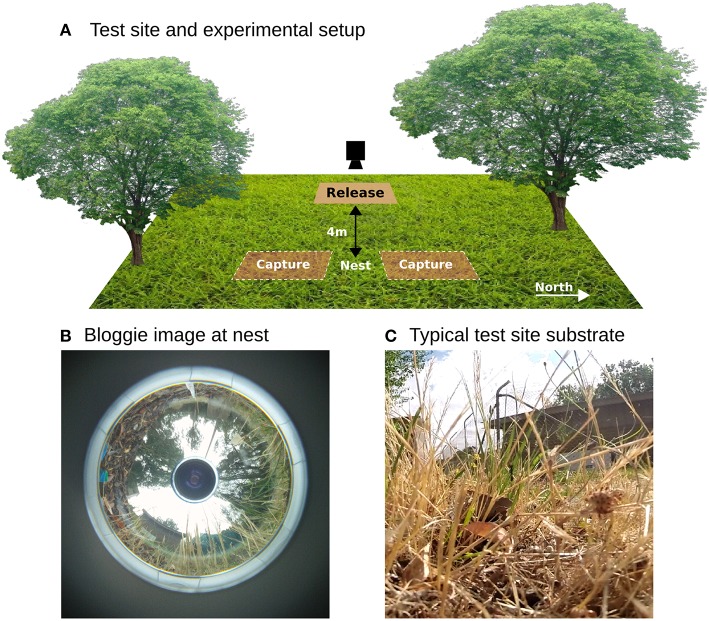
Figure 1
Figure 1
Overview. (A) Ants were captured approximately 1–1.5 m from the nest on foraging runs towards the north and south. They were then released on a platform 4m West and the entire homeward track filmed by repositioning a camera on a tripod. (B) A panoramic picture taken at the nest using Sony Bloggie camera shows there is a distinctive panorama dominated by the surrounding trees. (C) Image from within the grassy substrate highlighting the complex 3D environment through which the ants must navigate by walking or jumping.
Figure 2
Figure 2
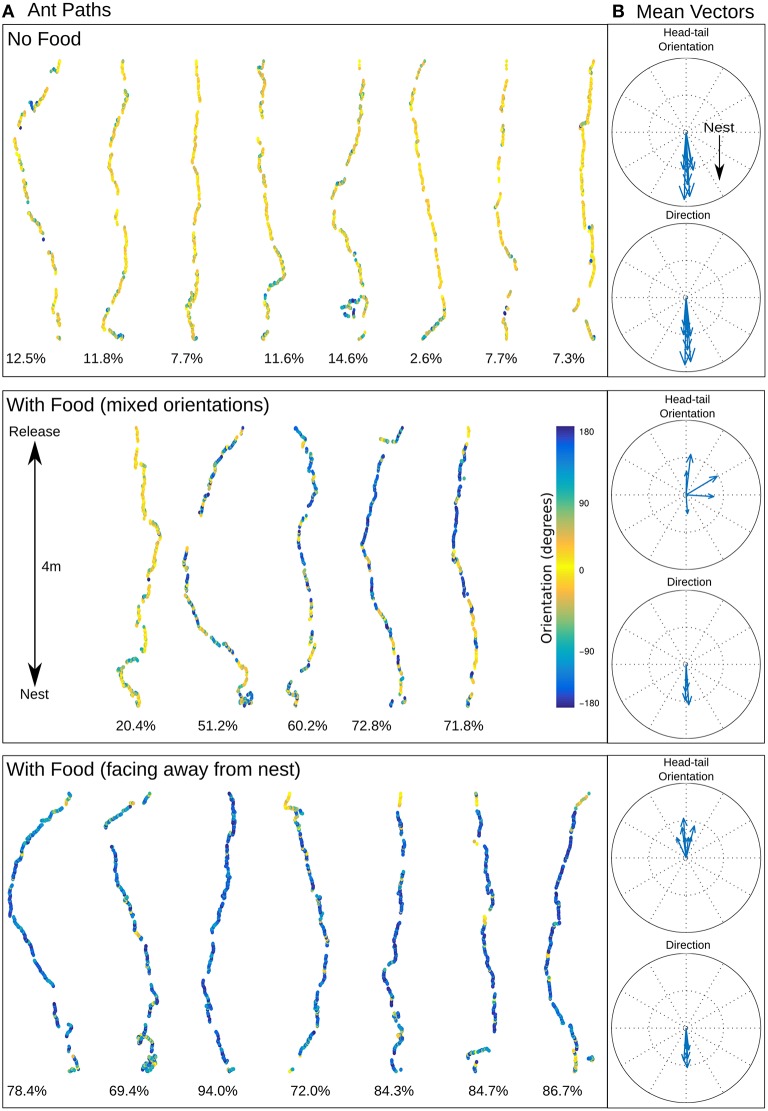
Ant homing. (A) Recorded ant paths, with head-tail orientation shown via color-coding for ants without food (top) and ants carrying prey (middle and bottom), and (B) mean vectors for each path for direction of movement and head-tail orientation. The mean direction for ants with or without food is almost identical (no food: mean 0.92 ± 56.40 degrees; with food (mixed orientations): mean 1.50 ± 68.94 degrees; with food (facing away from the nest): mean 1.80 ± 61.72 degrees) but the head-tail orientation is strikingly different (no food: mean 2.11 ± 47.32 degrees; with food (mixed orientations): mean 72.62 ± 131.88 degrees; with food (facing away from the nest): mean −177.59 ± 66.17 degrees). Below each path is shown the percentage of time the ant was moving backwards.
Figure 3
Figure 3
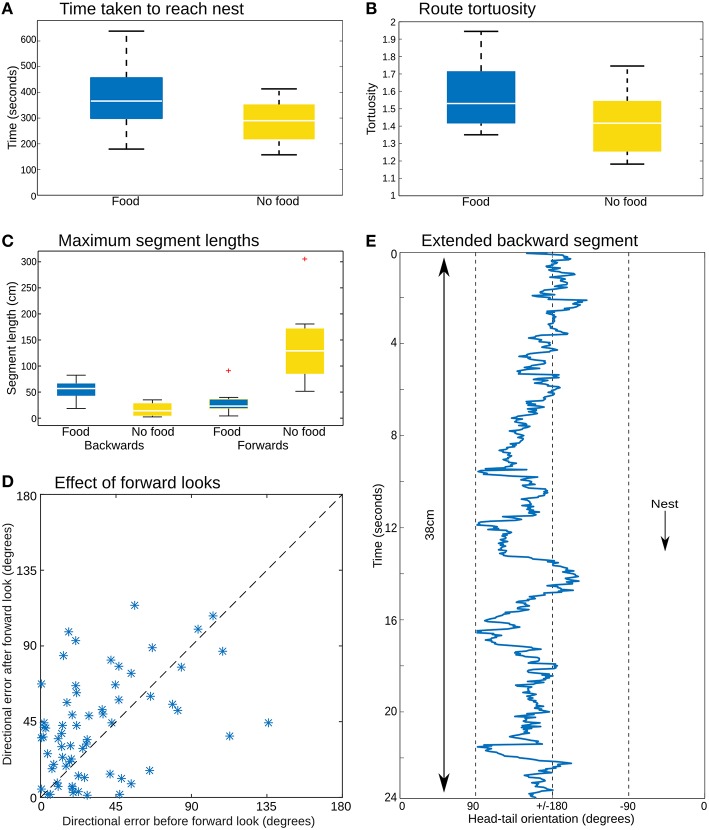
Path analysis. (A) The time to return to the nest is similar whether or not the animals were carrying a food item. (B) Path tortuosity was not significantly different. (C) While ants without food had distinctively longer segments facing toward the nest, the ants with food managed substantial distances without facing in the nest direction. (D) Comparing the direction of movement for three time steps before and after the moments at which prey-carrying ants face the nest (body-tail orientation <±5 degrees) shows no clear reduction in the error of the heading direction associated with such “forward looks,” which should appear as a preponderance of points below the x = y dashed line. (E) Head-tail orientation of a section of one ant path analyzed in every frame (25 Hz), showing an extended period of backward movement with no looks forward.

References

    1. Åkesson S., Wehner R. (2002). Visual navigation in desert ants cataglyphis fortis: are snapshots coupled to a celestial system of reference? J. Exp. Biol. 205, 1971–1978. - PubMed
    1. Ardin P., Mangan M., Wystrach A., Webb B. (2015). How variation in head pitch could affect image matching algorithms for ant navigation. J. Comp. Physiol. A 201, 585–597. 10.1007/s00359-015-1005-8 - DOI - PMC - PubMed
    1. Ardin P., Peng F., Mangan M., Lagogiannis K., Webb B. (2016). Using an insect mushroom body circuit to encode route memory in complex natural environments. PLoS Comput. Biol. 12:e1004683. 10.1371/journal.pcbi.1004683 - DOI - PMC - PubMed
    1. Baddeley B., Graham P., Husbands P., Philippides A. (2012). A model of ant route navigation driven by scene familiarity. PLoS Comput. Biol. 8:e1002336. 10.1371/journal.pcbi.1002336 - DOI - PMC - PubMed
    1. Cartwright B., Collett T. (1982). How honey bees use landmarks to guide their return to a food source. Nature 295, 560–564. 10.1038/295560a0 - DOI