Review
. 2016 Apr 12:7:357.
doi: 10.3389/fpls.2016.00357. eCollection 2016.

Cenh3: An Emerging Player in Haploid Induction Technology

Affiliations
Review

Cenh3: An Emerging Player in Haploid Induction Technology

Anne B Britt et al. Front Plant Sci. .

Abstract

True-breeding lines are required for the development and production of crop varieties. In a classical breeding approach these lines are obtained through inbreeding, and often 7-9 generations of inbreeding is performed to achieve the desired level of homozygosity, over a period of several years. In contrast, the chromosomes of haploids can be doubled to produce true-breeding lines in a single generation. Over the last century, scientists have developed a variety of techniques to induce haploids and doubled haploids, though these techniques apply only to particular crop varieties. Ravi and Chan (2010) discovered that haploids could be obtained in Arabidopsis through the manipulation of the centromere-specific histone 3 variant, CENH3. Their approach, which involved extensive modifications to a transgenic CENH3, held promise of being translated to crop species, and has been successfully employed in maize (see Kelliher et al., 2016). Refinements of this technology have since been developed which indicate that non-transgenic modifications to CENH3 will also induce haploids. The complementation of a cenh3 null by CENH3 from closely related plant species can result in plants that are fertile but haploid-inducing on crossing by CENH3 wt plants- suggesting that introgression of alien CENH3 may produce non-transgenic haploid inducers. Similarly, a remarkably wide variety of point mutations in CENH3, inducible by chemical agents, have recently been shown to result in haploid induction on crossing by wild-type CENH3 plants. These CENH3-variant plants grow normally, are fully fertile on self-pollination, and may be present in existing mutagenized collections.

Keywords: CENH3; Centromere; haploid induction; plant breeding; uniparental inheritance.


Figures
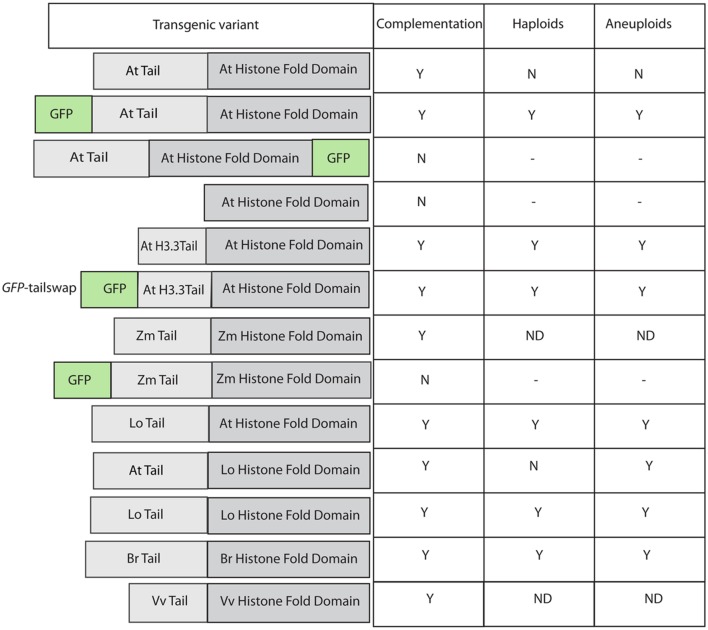
FIGURE 1
FIGURE 1
Effect of various modifications of transgenic CENH3 variants in an Arabidopsis thaliana cenh3 null. Table on the right summarizes complementation (of viability and fertility), haploid, and aneuploid induction by these lines. GFP-tailswap is the commonly used nomenclature in published literature for this construct.
FIGURE 2
FIGURE 2
Alignment of Arabidopsis thaliana histone3.3 vs. CENH3 sequences from A. thaliana, Brassica rapa, Lepidium oleraceum, Vitis vinifera, and Zea mays. Top two rows represent N-terminal tail with less conservation and the bottom three columns represent relatively well-conserved histone fold domain.
FIGURE 3
FIGURE 3
Schematic representation comparing the steps involved in generating haploids by transgenic vs. non-transgenic approaches. The transgenic approach involves generating CENH3 knockouts by TILLING or genome editing, with transgenic addition of point mutant, non-native or GFP-tailswap alleles (CENH3). The non-transgenic approach involves novel alleles, created either by chemical mutagenesis or though introgression of non-native CENH3. This later non-native approach is hypothetical and is yet to be demonstrated in plants. CENH3 represents variant CENH3 (Point mutant CENH3/ Non-native CENH3/ GFP-tailswapCENH3).

References

    1. Allshire R. C., Karpen G. H. (2008). Epigenetic regulation of centromeric chromatin: old dogs, new tricks? Nat. Rev. Genet. 9 923–937. 10.1038/nrg2466 - DOI - PMC - PubMed
    1. Buchwitz B. J., Ahmad K., Moore L. L., Roth M. B., Henikoff S. (1999). Cell division: a histone-H3-like protein in C. elegans. Nature 401 547–548. 10.1038/44062 - DOI - PubMed
    1. Cutter A. R., Hayes J. J. (2015). A brief review of nucleosome structure. FEBS Lett. 589 2914–2922. 10.1016/j.febslet.2015.05.016 - DOI - PMC - PubMed
    1. Dunwell J. M. (2010). Haploids in flowering plants: origins and exploitation. Plant Biotechnol. J. 8 377–424. 10.1111/j.1467-7652.2009.00498.x - DOI - PubMed
    1. Dwivedi S. L., Britt A. B., Tripathi L., Sharma S., Upadhyaya H. D., Ortiz R. (2015). Haploids: constraints and opportunities in plant breeding. Biotechnol. Adv. 33 812–829. 10.1016/j.biotechadv.2015.07.001 - DOI - PubMed
