


Differential Acclimation of Enzymatic Antioxidant Metabolism and Photosystem II Photochemistry in Tall Fescue under Drought and Heat and the Combined Stresses
- PMID: 27148288
- PMCID: PMC4830848
- DOI: 10.3389/fpls.2016.00453
Differential Acclimation of Enzymatic Antioxidant Metabolism and Photosystem II Photochemistry in Tall Fescue under Drought and Heat and the Combined Stresses
Abstract
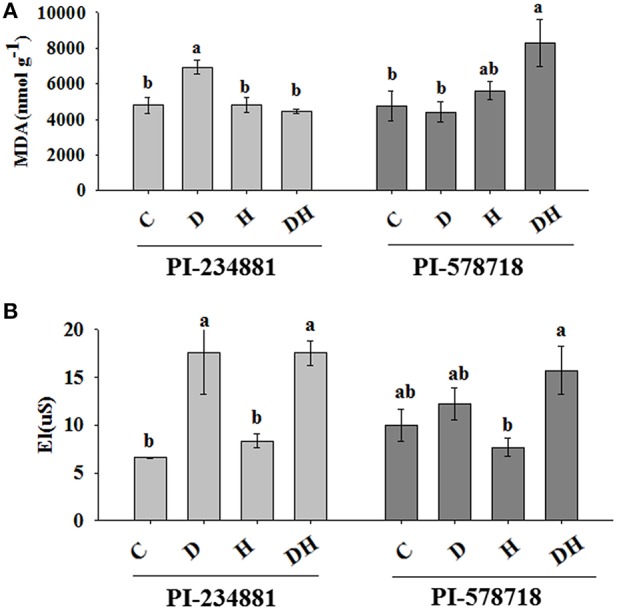
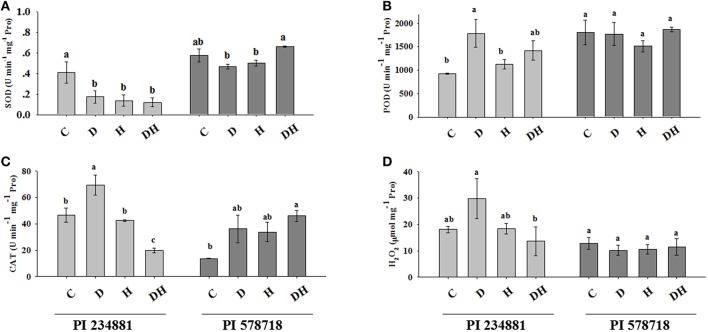
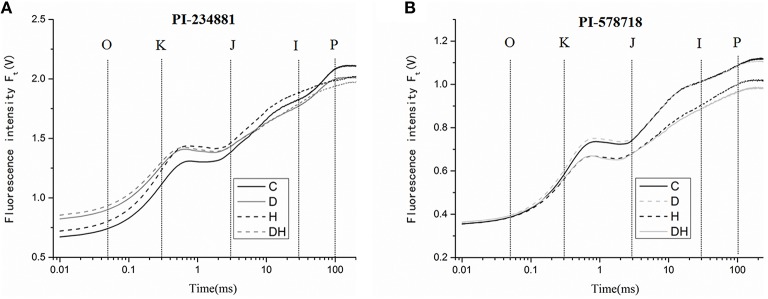
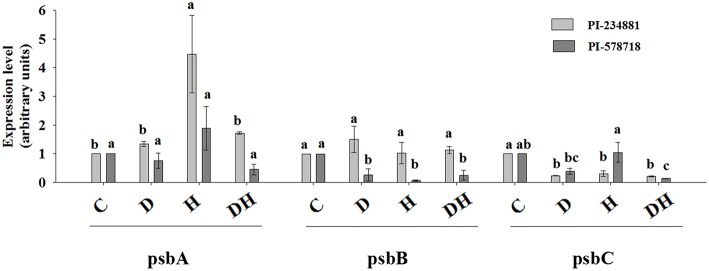
Quality inferiority in cool-season turfgrass due to drought, heat, and a combination of both stresses is predicted to be more prevalent in the future. Understanding the various response to heat and drought stress will assist in the selection and breeding of tolerant grass varieties. The objective of this study was to investigate the behavior of antioxidant metabolism and photosystem II (PSII) photochemistry in two tall fescue genotypes (PI 234881 and PI 578718) with various thermotolerance capacities. Wide variations were found between heat-tolerant PI 578718 and heat-sensitive PI 234881 for leaf relative water content, malondialdehyde and electrolyte leakage under drought, high-temperature or a combination of both stresses. The sensitivity of PI 234881 exposed to combined stresses was associated with lower superoxide dismutase activity and higher H2O2 accumulation than that in PI 578718. Various antioxidant enzymes displayed positive correlation with chlorophyll content, but negative with membrane injury index at most of the stages in both tall fescue genotypes. The JIP-test analysis in PI 578718 indicated a significant improvement in ABS/RC, TR0/RC, RE0/RC, RE0/ABS values as compared to the control regime, which indicated that PI 578718 had a high potential to protect the PSII system under drought and high temperature stress. And the PS II photochemistry in PI 234881 was damaged significantly compared with PI578718. Moreover, quantitative RT-PCR revealed that heat and drought stresses deduced the gene expression of psbB and psbC, but induced the expression of psbA. These findings to some extent confirmed that the various adaptations of physiological traits may contribute to breeding in cold-season turfgrass in response to drought, high-temperature, and a combination of both stresses.
Keywords: antioxidant enzymes; chlorophyll a fluorescence (OJIP); drought stress; gene expression; heat stress; tall fescue.
Figures
References
-
- Ali B., Hasan S., Hayat S., Hayat Q., Yadav S., Fariduddin Q., et al. (2008). A role for brassinosteroids in the amelioration of aluminium stress through antioxidant system in mung bean (Vigna radiata L. Wilczek). Environ. Exp. Bot. 62, 153–159. 10.1016/j.envexpbot.2007.07.014 - DOI
-
- Alvarez M. E. (2000). Salicylic acid in the machinery of hypersensitive cell death and disease resistance, in Programmed Cell Death in Higher Plants, eds Lam E., Fukuda H., Greenberg J. (Springer Netherlands: ), 185–198. - PubMed
LinkOut - more resources
Full Text Sources
Other Literature Sources
Research Materials
Miscellaneous
