Lessons learned from the application of whole-genome analysis to the treatment of patients with advanced cancers
- PMID: 27148575
- PMCID: PMC4850882
- DOI: 10.1101/mcs.a000570
Lessons learned from the application of whole-genome analysis to the treatment of patients with advanced cancers
Abstract
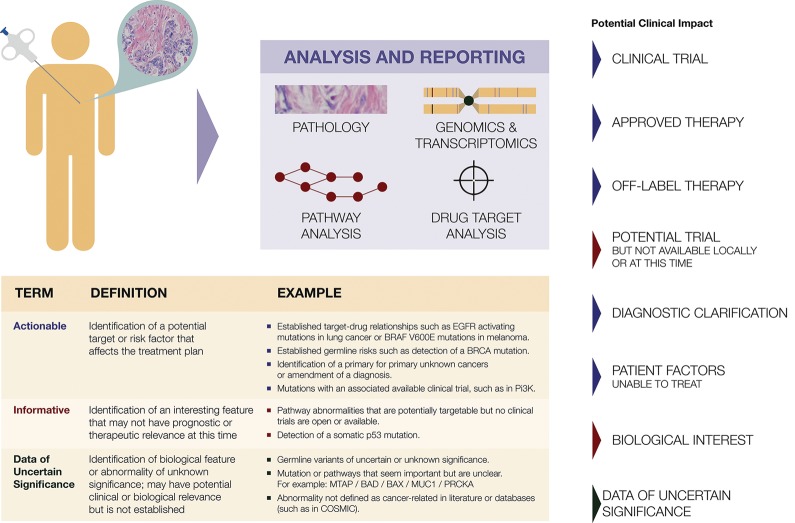
Given the success of targeted agents in specific populations it is expected that some degree of molecular biomarker testing will become standard of care for many, if not all, cancers. To facilitate this, cancer centers worldwide are experimenting with targeted "panel" sequencing of selected mutations. Recent advances in genomic technology enable the generation of genome-scale data sets for individual patients. Recognizing the risk, inherent in panel sequencing, of failing to detect meaningful somatic alterations, we sought to establish processes to integrate data from whole-genome analysis (WGA) into routine cancer care. Between June 2012 and August 2014, 100 adult patients with incurable cancers consented to participate in the Personalized OncoGenomics (POG) study. Fresh tumor and blood samples were obtained and used for whole-genome and RNA sequencing. Computational approaches were used to identify candidate driver mutations, genes, and pathways. Diagnostic and drug information were then sought based on these candidate "drivers." Reports were generated and discussed weekly in a multidisciplinary team setting. Other multidisciplinary working groups were assembled to establish guidelines on the interpretation, communication, and integration of individual genomic findings into patient care. Of 78 patients for whom WGA was possible, results were considered actionable in 55 cases. In 23 of these 55 cases, the patients received treatments motivated by WGA. Our experience indicates that a multidisciplinary team of clinicians and scientists can implement a paradigm in which WGA is integrated into the care of late stage cancer patients to inform systemic therapy decisions.
Figures


References
-
- Andre F, Mardis E, Salm M, Soria JC, Siu LL, Swanton C. 2014. Prioritizing targets for precision cancer medicine. Ann Oncol 25: 2295–2303. - PubMed
-
- Dienstmann R, Rodon J, Barretina J, Tabernero J. 2013. Genomic medicine frontier in human solid tumors: prospects and challenges. J Clin Oncol 31: 1874–1884. - PubMed
-
- Druker BJ, Sawyers CL, Kantarjian H, Resta DJ, Reese SF, Ford JM, Capdeville R, Talpaz M. 2001. Activity of a specific inhibitor of the BCR-ABL tyrosine kinase in the blast crisis of chronic myeloid leukemia and acute lymphoblastic leukemia with the Philadelphia chromosome. N Engl J Med 344: 1038–1042 [erratum appears in N Engl J Med 2001;345(3):232]. - PubMed
-
- Garraway LA. 2013. Genomics-driven oncology: framework for an emerging paradigm. J Clin Oncol 31: 1806–1814. - PubMed
LinkOut - more resources
Full Text Sources
Other Literature Sources
Medical