


Benign Prostatic Hyperplasia and the Risk of Prostate Cancer and Bladder Cancer: A Meta-Analysis of Observational Studies
- PMID: 27149447
- PMCID: PMC4863764
- DOI: 10.1097/MD.0000000000003493
Benign Prostatic Hyperplasia and the Risk of Prostate Cancer and Bladder Cancer: A Meta-Analysis of Observational Studies
Abstract
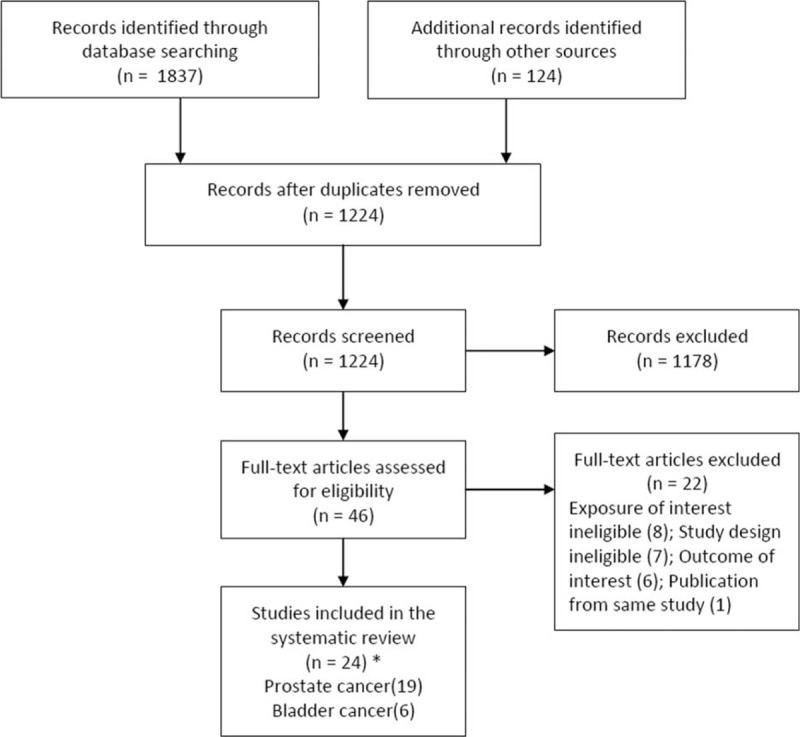
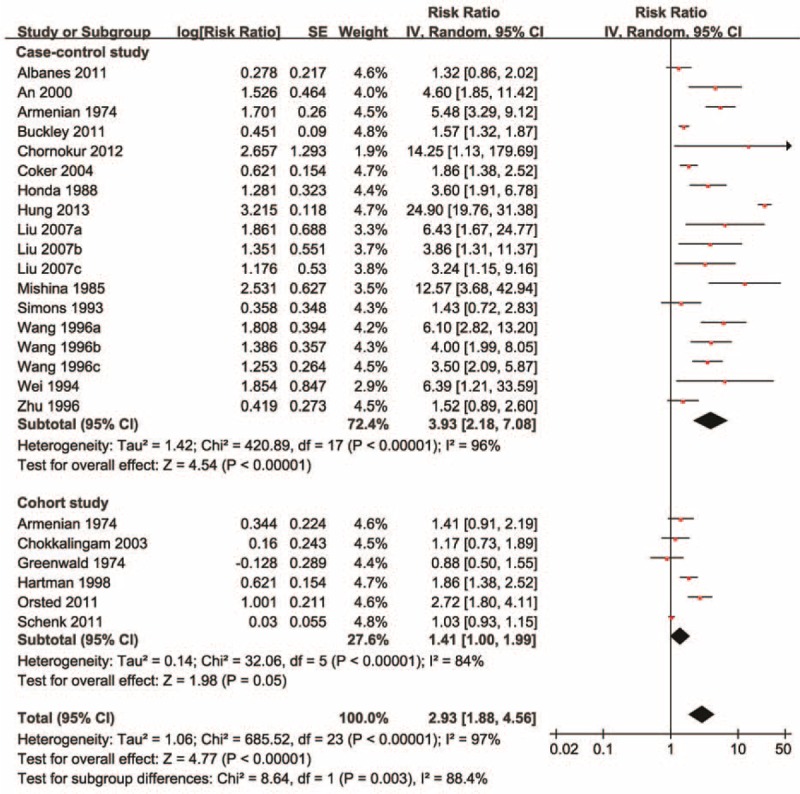
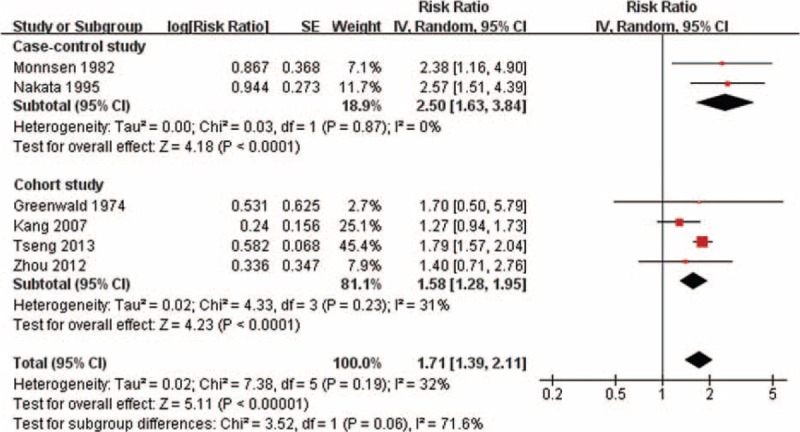
Benign prostatic hyperplasia (BPH) has been suggested to be a risk factor for certain urologic cancers, but the current evidence is inconsistent.The aim of this study was to investigate the association between BPH and urologic cancers.MEDLINE, EMBASE, Cochrane Library, and Web of Science were searched for potential eligible studies.We included case-control studies or cohort studies, which evaluated the association between BPH and urologic cancers (including prostate cancer, bladder cancer, kidney cancer, testicular cancer, or penile cancer).Overall effect estimates were calculated using the DerSimonian-Laird method for a random-effects model. Summary effect-size was calculated as risk ratio (RR), together with the 95% confidence interval (CI).This systematic review included 16 case-control studies and 10 cohort studies evaluating the association of BPH and prostate or bladder cancer; we did not identify any study about other urologic cancers. Meta-analyses demonstrated that BPH was associated with an increased incidence of prostate cancer (case-control study: RR = 3.93, 95% CI = 2.18-7.08; cohort-study: RR = 1.41, 95% CI = 1.00-1.99) and bladder cancer (case-control study: RR = 2.50, 95% CI = 1.63-3.84; cohort-study: RR = 1.58, 95% CI = 1.28-1.95). Subgroup analysis by ethnicity suggested that the association between BPH and prostate cancer was much stronger in Asians (RR = 6.09, 95% CI = 2.96-12.54) than in Caucasians (RR = 1.54, 95% CI = 1.19-2.01). Egger's tests indicated low risk of publication bias (prostate cancer: P = 0.11; bladder cancer: P = 0.95).BPH is associated with an increased risk of prostate cancer and bladder cancer. The risk of prostate cancer is particularly high in Asian BPH patients. Given the limitations of included studies, additional prospective studies with strict design are needed to confirm our findings.
Conflict of interest statement
The authors have no funding and conflicts of interest to disclose.
Figures
References
-
- McVary K. BPH: epidemiology and comorbidities. Am J Manag Care 2006; 12:S122–128. - PubMed
-
- McVary KT, Roehrborn CG, Avins AL, et al. Update on AUA guideline on the management of benign prostatic hyperplasia. J Urol 2011; 185:1793–1803. - PubMed
-
- Orsted D, Bojesen S, Nielsen S, et al. Association of clinical benign prostate hyperplasia with prostate cancer incidence and mortality revisited: a nationwide cohort study of 3 009 258 men. Eur Urol 2011; 60:691–698. - PubMed
Publication types
MeSH terms
LinkOut - more resources
Full Text Sources
Other Literature Sources
Medical
