. 2016 May 5;7(3):e00444-16.
doi: 10.1128/mBio.00444-16.

Whole-Genome Sequencing for Routine Pathogen Surveillance in Public Health: a Population Snapshot of Invasive Staphylococcus aureus in Europe

Collaborators, Affiliations

Whole-Genome Sequencing for Routine Pathogen Surveillance in Public Health: a Population Snapshot of Invasive Staphylococcus aureus in Europe

David M Aanensen et al. mBio. .

Abstract

The implementation of routine whole-genome sequencing (WGS) promises to transform our ability to monitor the emergence and spread of bacterial pathogens. Here we combined WGS data from 308 invasive Staphylococcus aureus isolates corresponding to a pan-European population snapshot, with epidemiological and resistance data. Geospatial visualization of the data is made possible by a generic software tool designed for public health purposes that is available at the project URL (http://www.microreact.org/project/EkUvg9uY?tt=rc). Our analysis demonstrates that high-risk clones can be identified on the basis of population level properties such as clonal relatedness, abundance, and spatial structuring and by inferring virulence and resistance properties on the basis of gene content. We also show that in silico predictions of antibiotic resistance profiles are at least as reliable as phenotypic testing. We argue that this work provides a comprehensive road map illustrating the three vital components for future molecular epidemiological surveillance: (i) large-scale structured surveys, (ii) WGS, and (iii) community-oriented database infrastructure and analysis tools.

Importance: The spread of antibiotic-resistant bacteria is a public health emergency of global concern, threatening medical intervention at every level of health care delivery. Several recent studies have demonstrated the promise of routine whole-genome sequencing (WGS) of bacterial pathogens for epidemiological surveillance, outbreak detection, and infection control. However, as this technology becomes more widely adopted, the key challenges of generating representative national and international data sets and the development of bioinformatic tools to manage and interpret the data become increasingly pertinent. This study provides a road map for the integration of WGS data into routine pathogen surveillance. We emphasize the importance of large-scale routine surveys to provide the population context for more targeted or localized investigation and the development of open-access bioinformatic tools to provide the means to combine and compare independently generated data with publicly available data sets.


Figures

FIG 1
FIG 1
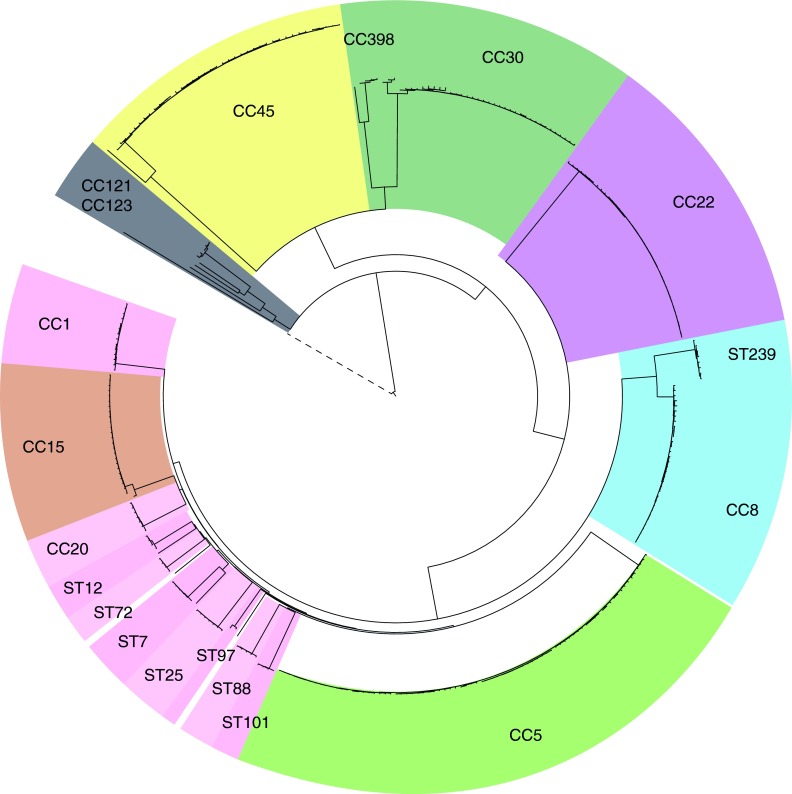
Phylogenetic relationship of the invasive S. aureus population circulating in Europe in 2006. A rooted neighbor-joining tree based on 235,226 genomewide core SNPs is shown. Lineages are highlighted and named according to the corresponding CC or ST.
FIG 2
FIG 2
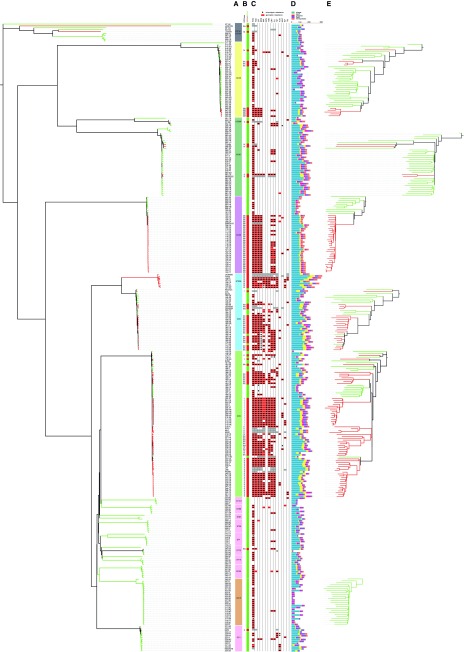
Phylogeny decoration. Colors of branches indicate MSSA (green) and MRSA (red) states. Each isolate is annotated by affiliation with a CC or ST (A), SSCmec type and MSSA (green) or MRSA (red) state (B), or antibiotic resistance profile (C). Red boxes indicate the presence of genetic resistance markers, black dots indicate phenotypic resistance, and gray boxes highlight resistance in reference genomes. (D) Size and composition of the accessory genome based on the number of noncore homologous groups with further categorization according to MGE type. (E) Close-up of phylogenetic trees of the six major lineages.
FIG 3
FIG 3
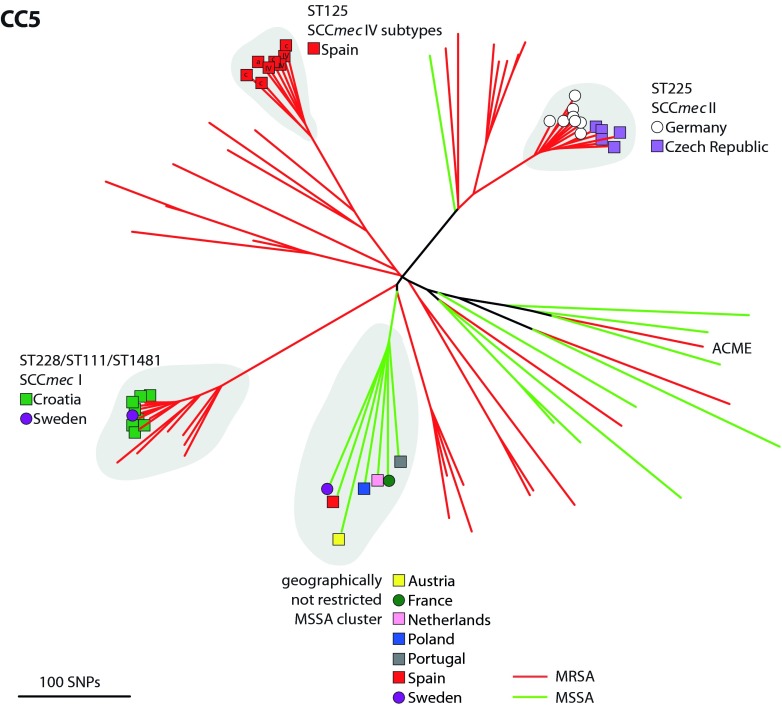
Phylogenetic reconstruction of CC5. Branch color indicates MSSA (green) or MRSA (red). Clusters described in Results are shaded gray. Symbols at the tips indicate the geographic origins of these isolates. SCCmec IV subtypes are shown for ST125.
FIG 4
FIG 4
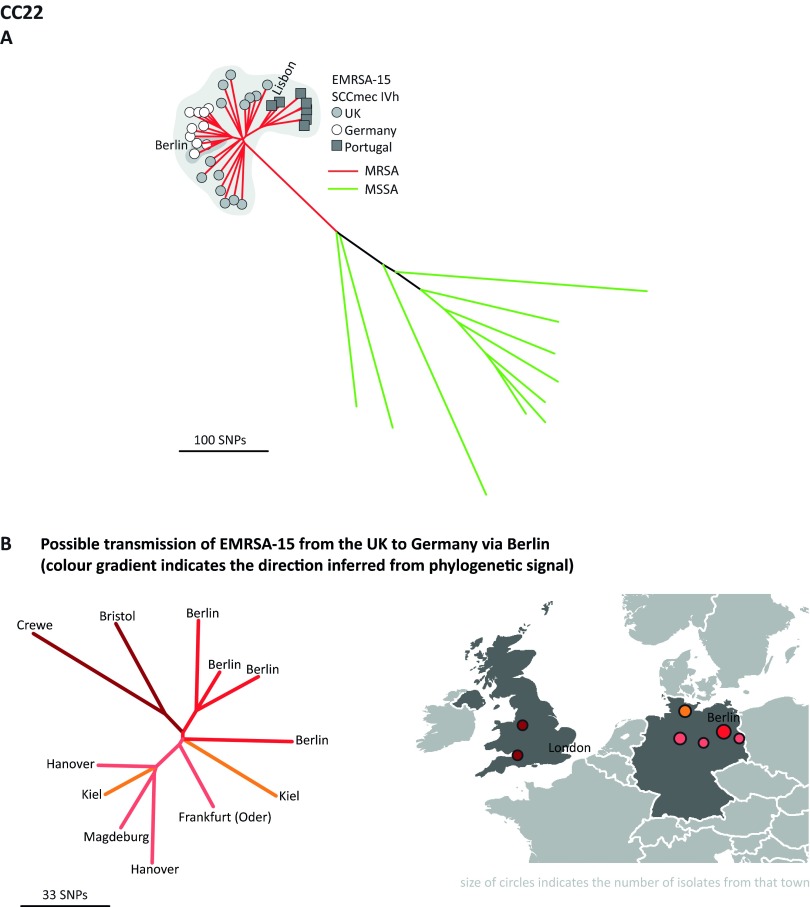
Phylogenetic reconstruction of CC22. Branch color indicates MSSA (green) or MRSA (red). The EMRSA-15 cluster is shaded gray. Symbols at the tips of the branches indicate the geographic origins of these isolates. A cluster consisting of isolates from Berlin indicating the possible point of EMRSA-15 introduction into Germany from the United Kingdom is shaded a darker gray. The position of an isolate from Lisbon is shown indicating the possible location of its entry into Portugal.
FIG 5
FIG 5
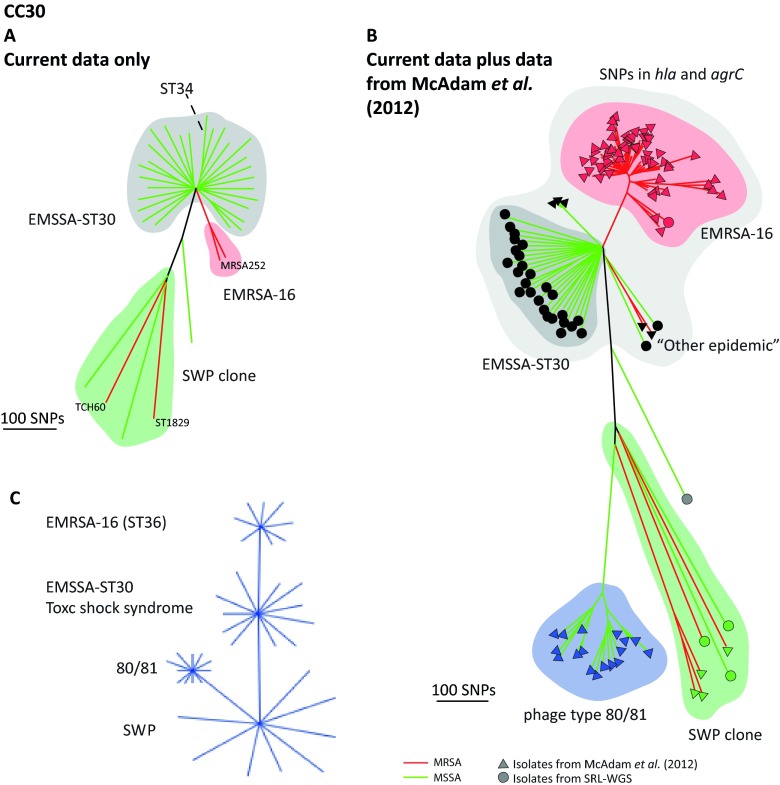
(A) Phylogenetic reconstruction of CC30 isolates in the sample. Branch color indicates MSSA (green) or MRSA (red). Reference genomes are named and clusters are highlighted and named in accordance with the report of McAdam et al. (7). The dashed line indicates the long branch leading to three ST34 isolates that evolved through the acquisition of a 200-kb homologous replacement within the chromosome from an ST10/ST145-like parent (66). (B) Phylogenetic tree of combined CC30 data obtained from isolates from the study of McAdam et al. (7) and isolates from panel A. Colors and cluster names are as in panel A. Light gray shading indicates isolates carrying SNPs in the hla and agrC genes thought to restrict these lineages to health care settings. (C) Representation of successive clonal radiations within the recent evolutionary history of CC30. These radiations correspond to recognized HRCs, both contemporary and historic. The SWP clone is a historic diversified starlike expansion with relatively long branches. Phage type 80/81 probably emerged from within this starlike expansion, as did the current MSSA HRC, which we have termed EMSSA-ST30. Finally, EMRSA-16 emerged from within the successful EMSSA-ST30 lineage, resulting in a more recent, and tightly clustered, starlike expansion.
FIG 6
FIG 6
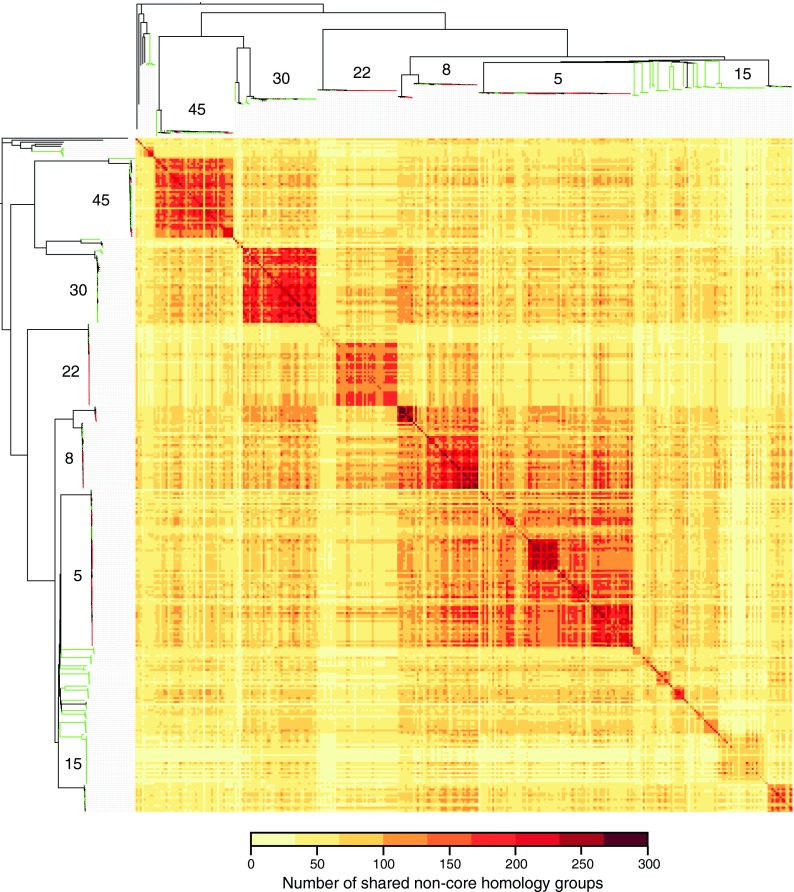
Conservation of ncHGs across the invasive S. aureus population in Europe. Isolates are arranged in the tree order of Fig. 2 along the left and top. The ncHGs in the pairwise comparison are displayed as a heat map matrix, and colors represent the total numbers of ncHGs that genome pairs have in common; darker shading indicates more ncHGs in common (see the scale at the bottom). The dark squares corresponding to (from the top) CC45, CC30, CC22, CC8, CC5, and (at the bottom) CC15.

References

    1. Smith JM, Feil EJ, Smith NH. 2000. Population structure and evolutionary dynamics of pathogenic bacteria. Bioessays 22:1115–1122. doi:10.1002/1521-1878(200012)22:12<1115::AID-BIES9>3.3.CO;2-I. - DOI - PubMed
    1. Cantón R, Ruiz-Garbajosa P. 2011. Co-resistance: an opportunity for the bacteria and resistance genes. Curr Opin Pharmacol 11:477–485. doi:10.1016/j.coph.2011.07.007. - DOI - PubMed
    1. Grundmann H, Aanensen DM, van den Wijngaard CC, Spratt BG, Harmsen D, Friedrich AW, European Staphylococcal Reference Laboratory Working Group . 2010. Geographic distribution of Staphylococcus aureus causing invasive infections in Europe: a molecular-epidemiological analysis. PLoS Med 7:e1000215. doi:10.1371/journal.pmed.1000215. - DOI - PMC - PubMed
    1. Feil EJ, Li BC, Aanensen DM, Hanage WP, Spratt BG. 2004. eBURST: inferring patterns of evolutionary descent among clusters of related bacterial genotypes from multilocus sequence typing data. J Bacteriol 186:1518–1530. doi:10.1128/JB.186.5.1518-1530.2004. - DOI - PMC - PubMed
    1. Everitt RG, Didelot X, Batty EM, Miller RR, Knox K, Young BC, Bowden R, Auton A, Votintseva A, Larner-Svensson H, Charlesworth J, Golubchik T, Ip CL, Godwin H, Fung R, Peto TE, Walker AS, Crook DW, Wilson DJ. 2014. Mobile elements drive recombination hotspots in the core genome of Staphylococcus aureus. Nat Commun 5:3956. doi:10.1038/ncomms4956. - DOI - PMC - PubMed

Publication types

MeSH terms