Review
. 2016 Jun;17(6):383-95.
doi: 10.1038/nrn.2016.38. Epub 2016 May 6.

The expanding biology of the C9orf72 nucleotide repeat expansion in neurodegenerative disease

Affiliations
Review

The expanding biology of the C9orf72 nucleotide repeat expansion in neurodegenerative disease

Aaron R Haeusler et al. Nat Rev Neurosci. 2016 Jun.

Abstract

A nucleotide repeat expansion (NRE) within the chromosome 9 open reading frame 72 (C9orf72) gene was the first of this type of mutation to be linked to multiple neurological conditions, including amyotrophic lateral sclerosis and frontotemporal dementia. The pathogenic mechanisms through which the C9orf72 NRE contributes to these disorders include loss of C9orf72 function and gain-of-function mechanisms of C9orf72 driven by toxic RNA and protein species encoded by the NRE. These mechanisms have been linked to several cellular defects - including nucleocytoplasmic trafficking deficits and nuclear stress - that have been observed in both patients and animal models.


Figures

Figure 1 ∣
Figure 1 ∣. The C9orf72 nucleotide repeat expansion.
This schematic illustrates the chromosome 9 open reading frame (C9orf72) gene, showing the site of the nucleotide repeat expansion (NRE; red), and three annotated transcript variants. Transcripts V2 and V3 encode the long form of the C9orf72 protein, whereas transcript V1 encodes the short form. Exons are shown as blue boxes. Transcript variants V1 and V3 contain the NRE in the first intron of the gene and therefore generate pre-mRNA that contains the repeat expansion and can produce RNA foci. The presence of the C9orf72 NRE in these transcripts also results in decreased use of the endogenous promoter of C9orf72 transcription (depicted) and increased use of alternative promoters identified between the endogenous promoter and the repeats. The NRE is located within the predicted promoter region of variant V2 and therefore may contribute to the reduced transcription and highly decreased levels of mRNA.
Figure 2 ∣
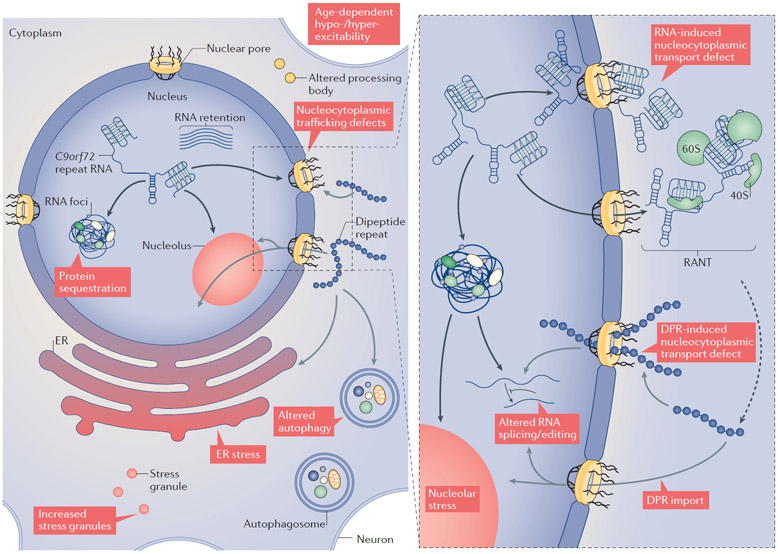
Figure 2 ∣. Cellular processes impaired by the C9orf72 nucleotide repeat expansion.
Cellular features and pathways that are altered by the RNA and/or dipeptide repeat proteins (DPRs) generated from the chromosome 9 open reading frame (C9orf72) nucleotide repeat expansion (NRE) mutation are shown. Black and grey arrows indicate pathological features linked to the C9orf72 RNA or DPRs, respectively. The repeat-containing RNA, which forms RNA foci, has been implicated in sequestering key RNA-binding proteins (RBPs). This process may lead directly to altered nucleolar function, changes in RNA processing or maturation and nucleocytoplasmic transport defects. DPRs have also been shown to lead to nucleocytoplasmic transport defects, as well as altering autophagy, nucleolar function and increasing endoplasmic reticulum (ER) stress. As shown in the right part of the image, RNA and DPRs generated from the C9orf72 NRE mutation converge on pathways driving nucleocytoplasmic trafficking defects, including altered nuclear pore complex dynamics, import factors and nucleolar stress. C9orf72 RNA can sequester nucleolar proteins, leading to nucleolar stress, or bind to nuclear pore complex proteins and disrupt nucleocytoplasmic trafficking. Cytoplasmic C9orf72 RNA can be non-canonically translated though repeat-associated non-ATG-dependent translation (RANT), leading to the production of DPRs. Specific DPRs can impair nucleocytoplasmic trafficking and, when imported into the nucleus, can associate with nucleolar proteins to cause nucleolar stress. Additionally, both the C9orf72 RNA and specific DPRs have been proposed to affect RNA splicing and/or editing.
Figure 3 ∣
Figure 3 ∣. Identification of a diverse C9orf72•protein interactome.
The diagram compares five different chromosome 9 open reading frame (C9orf72)•RNA-binding protein (RBP) interactomes discovered using RNA pulldown or protein arrays,,-. As shown, many unique proteins were identified that shared no overlap among the studies (see Supplementary information S2 (table)). Numbers indicate the number of protein candidates found to overlap between the indicated studies. The protein isoforms of heterogeneous nuclear ribonucleoprotein (hnRNP) H showed the most overlap between studies. Other proteins identified in at least three studies included splicing factor proline/glutamine-rich (SFPQ), interleukin enhancer-binding factor 2 (ILF2) and myelin basic protein (MBP). Of the overlapping RBPs, only hnRNP H has been shown to contribute to the increased alternative splicing events observed in patients carrying a C9orf72 nucleotide repeat expansion (NRE). Most RBP candidates have not been explored for potential functional consequences in vivo. Regions assigned no number designate comparisons in which there was no protein overlap.

References

    1. Renton AE et al. A hexanucleotide repeat expansion in C9ORF72 is the cause of chromosome 9p21-linked ALS-FTD. Neuron 72, 257–268 (2011). - PMC - PubMed
    1. DeJesus-Hernandez M et al. Expanded GGGGCC hexanucleotide repeat in noncoding region of C9ORF72 causes chromosome 9p-linked FTD and ALS. Neuron 72, 245–256 (2011).

      References and are the seminal publications that defined the C9orf72 mutation.

    1. Majounie E et al. Frequency of the C9orf72 hexanucleotide repeat expansion in patients with amyotrophic lateral sclerosis and frontotemporal dementia: a cross-sectional study. Lancet Neurol. 11, 323–330 (2012). - PMC - PubMed
    1. Zhang D, Iyer LM, He F & Aravind L Discovery of novel DENN proteins: implications for the evolution of eukaryotic intracellular membrane structures and human disease. Front. Genet 3, 283 (2012). - PMC - PubMed
    1. Levine TP, Daniels RD, Gatta AT, Wong LH & Hayes MJ The product of C9orf72, a gene strongly implicated in neurodegeneration, is structurally related to DENN Rab-GEFs. Bioinformatics 29, 499–503 (2013). - PMC - PubMed

MeSH terms