. 2016 May 3;8(5):132.
doi: 10.3390/toxins8050132.

Zebrafish Sensitivity to Botulinum Neurotoxins

Affiliations

Zebrafish Sensitivity to Botulinum Neurotoxins

Kamalakar Chatla et al. Toxins (Basel). .

Abstract

Botulinum neurotoxins (BoNT) are the most potent known toxins. The mouse LD50 assay is the gold standard for testing BoNT potency, but is not sensitive enough to detect the extremely low levels of neurotoxin that may be present in the serum of sensitive animal species that are showing the effects of BoNT toxicity, such as channel catfish affected by visceral toxicosis of catfish. Since zebrafish are an important animal model for diverse biomedical and basic research, they are readily available and have defined genetic lines that facilitate reproducibility. This makes them attractive for use as an alternative bioassay organism. The utility of zebrafish as a bioassay model organism for BoNT was investigated. The 96 h median immobilizing doses of BoNT/A, BoNT/C, BoNT/E, and BoNT/F for adult male Tübingen strain zebrafish (0.32 g mean weight) at 25 °C were 16.31, 124.6, 4.7, and 0.61 picograms (pg)/fish, respectively. These findings support the use of the zebrafish-based bioassays for evaluating the presence of BoNT/A, BoNT/E, and BoNT/F. Evaluating the basis of the relatively high resistance of zebrafish to BoNT/C and the extreme sensitivity to BoNT/F may reveal unique functional patterns to the action of these neurotoxins.

Keywords: botulinum neurotoxins; lethal dose 50; zebrafish.


Figures
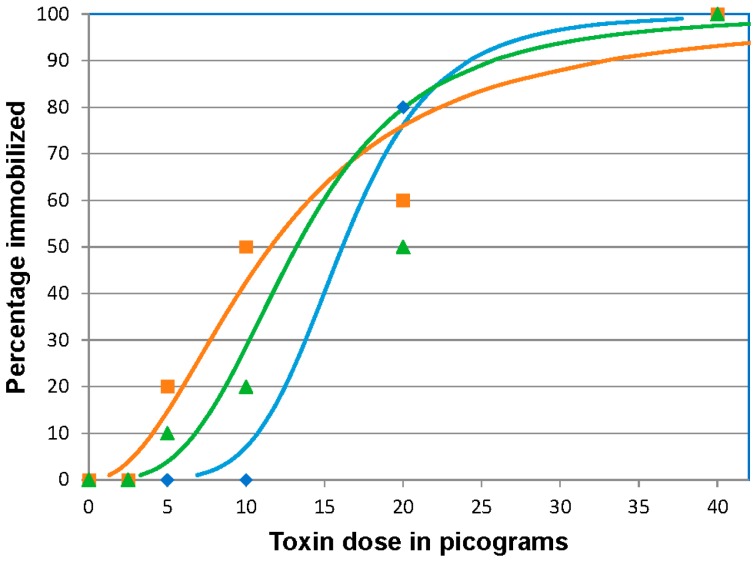
Figure 1
Figure 1
Botulinum neurotoxin A (BoNT/A) 96 h immobilizing dose response curves for zebrafish. Fish were injected intracoelomically with 10 µL of 40, 20, 10, 5, or 2.5 pg/fish BoNT/A diluted in gelatin phosphate buffer, (n = 10 fish/treatment/replicate). The results of three replicates are shown. The curves indicate the calculated dose effect by logit analysis on each replicate. The actual percentage immobilized for each dosage in each replicate is indicated by the symbol corresponding to the calculated curve of the same color. Blue curve and diamonds, orange curve and squares and green curve and triangles represent data from replicates 1, 2 and 3 respectively.
Figure 2
Figure 2
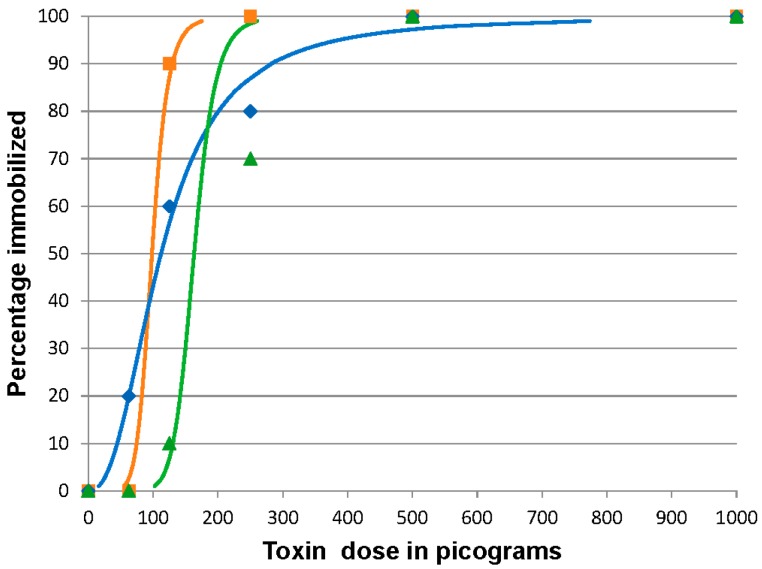
Botulinum neurotoxin C (BoNT/C) 96 h immobilizing dose response curves for zebrafish. Fish were injected intracoelomically with 10 µL containing 1000, 500, 250, 125, or 62.5 pg BoNT/C in gelatin phosphate buffer (n = 10 fish/treatment/replicate). The results of three replicates are shown. The curves indicate the calculated dose effect by logit analysis on each replicate. The actual percentage immobilized for each dosage in each replicate is indicated by the symbol corresponding to the calculated curve of the same color. Orange curve and squares, blue curve and diamonds, and green curve and triangles represent data from replicates 1, 2 and 3 respectively.
Figure 3
Figure 3
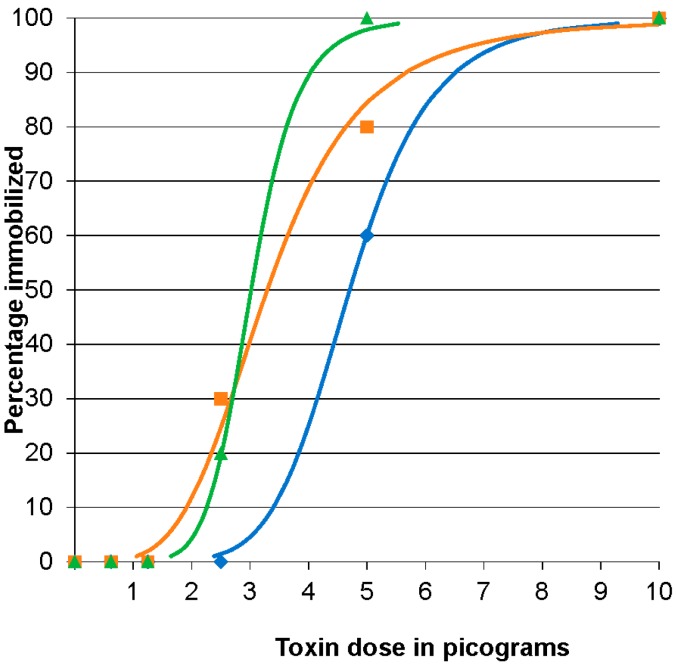
Botulinum neurotoxin E (BoNT/E) 96 h immobilizing dose response curves for zebrafish. Fish were injected intracoelomically with 10 µL containing 10, 5, 2.5, 1.25, or 0.62 pg BoNT/E activated with trypsin in gelatin phosphate buffer (n = 10 fish/treatment/replicate). The results of three replicates are shown. The actual percentage immobilized for each dosage in each replicate is indicated by the symbol corresponding to the calculated curve of the same color. Blue curve and diamonds, orange curve and squares and green curve and triangles represent data from replicates 1, 2 and 3 respectively.
Figure 4
Figure 4
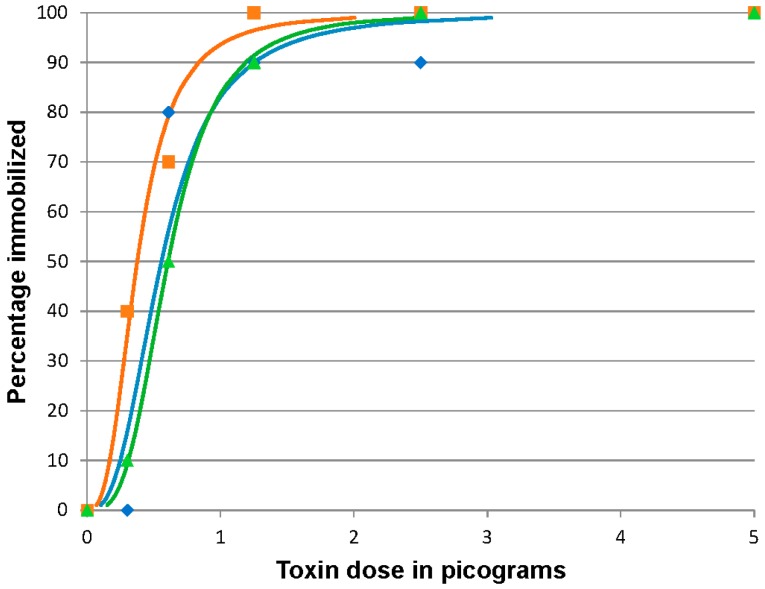
Botulinum neurotoxin F (BoNT/F) 96 h immobilizing dose response curves for zebrafish. Fish were injected intracoelomically with 10 µL containing 5, 2.5, 1.25, 0.62 or 0.3 pg BoNT/F diluted in gelatin phosphate buffer (n = 10 fish/treatment/replicate). The results of three replicates are shown. The actual percentage immobilized for each dosage in each replicate is indicated by the symbol corresponding to the calculated curve of the same color. Blue curve and diamonds, orange curve and squares and green curve and triangles represent data from replicates 1, 2 and 3 respectively.

References

    1. Shukla H.D., Sharma S.K. Clostridium botulinum: A bug with beauty and weapon. Crit. Rev. Microbiol. 2005;31:11–18. doi: 10.1080/10408410590912952. - DOI - PubMed
    1. Rusnak J.M., Smith L.A. Botulinum neurotoxin vaccines: Past history and recent developments. Hum. Vaccines. 2009;5:794–805. doi: 10.4161/hv.9420. - DOI - PubMed
    1. Gaunt P.S., Kalb S.R., Barr J.R. Detection of botulinum type E toxin in channel catfish with visceral toxicosis syndrome using catfish bioassay and endopep mass spectrometry. J. Vet. Diagn. Invest. 2007;19:349–354. doi: 10.1177/104063870701900402. - DOI - PubMed
    1. Yule A.M., Barker I.K., Austin J.W., Moccia R.D. Toxicity of Clostridium botulinum type e neurotoxin to great lakes fish: Implications for avian botulism. J. Wildl. Dis. 2006;42:479–493. doi: 10.7589/0090-3558-42.3.479. - DOI - PubMed
    1. Gessler F., Hampe K., Bohnel H. Sensitive detection of botulinum neurotoxin types C and D with an immunoaffinity chromatographic column test. Appl. Env. Microbiol. 2005;71:7897–7903. doi: 10.1128/AEM.71.12.7897-7903.2005. - DOI - PMC - PubMed

Publication types

Substances

LinkOut - more resources