Review
. 2016 Sep;149(1):13-24.
doi: 10.1111/imm.12617. Epub 2016 Jul 11.

Lipid rafts in immune signalling: current progress and future perspective

Affiliations
Review

Lipid rafts in immune signalling: current progress and future perspective

Pallavi Varshney et al. Immunology. 2016 Sep.

Abstract

Lipid rafts are dynamic assemblies of proteins and lipids that harbour many receptors and regulatory molecules and so act as a platform for signal transduction. They float freely within the liquid-disordered bilayer of cellular membranes and can cluster to form larger ordered domains. Alterations in lipid rafts are commonly found to be associated with the pathogenesis of several human diseases and recent reports have shown that the raft domains can also be perturbed by targeting raft proteins through microRNAs. Over the last few years, the importance of lipid rafts in modulating both innate and acquired immune responses has been elucidated. Various receptors present on immune cells like B cells, T cells, basophils and mast cells associate with lipid rafts on ligand binding and initiate signalling cascades leading to inflammation. Furthermore, disrupting lipid raft integrity alters lipopolysaccharide-induced cytokine secretion, IgE signalling, and B-cell and T-cell activation. The objective of this review is to summarize the recent progress in understanding the role of lipid rafts in the modulation of immune signalling and its related therapeutic potential for autoimmune diseases and inflammatory disorders.

Keywords: B/T-cell activation; IgE; Toll-like receptor; autoimmune disease; cytokine signalling; lipid rafts; microRNA.


Figures

Figure 1
Figure 1
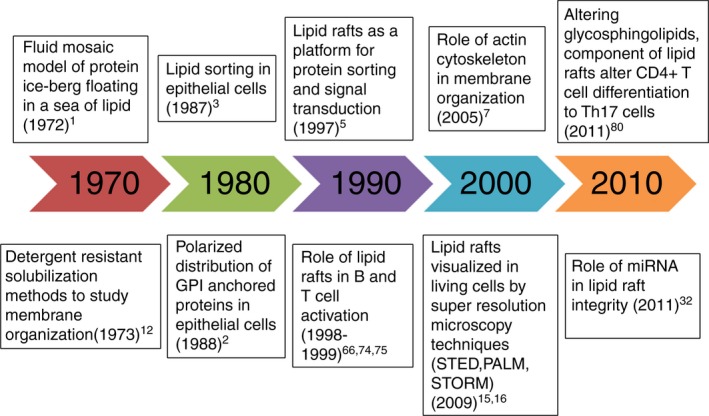
Timeline of pioneer discoveries in the field of lipid rafts and immune signalling.
Figure 2
Figure 2
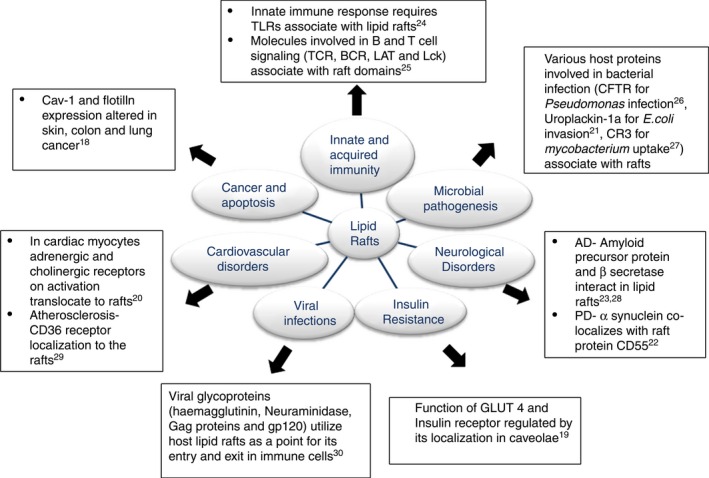
The role of lipid rafts in health and disease – Interaction of various molecules known to be involved in the pathogenesis of various diseases with lipid rafts. Abbreviations: AD, Alzheimer disease; PD, Parkinson's disease; CFTR, cystic fibrosis transmembrane conductance regulator; CR3, complement receptor 3; GLUT4, glucose transporter.
Figure 3
Figure 3
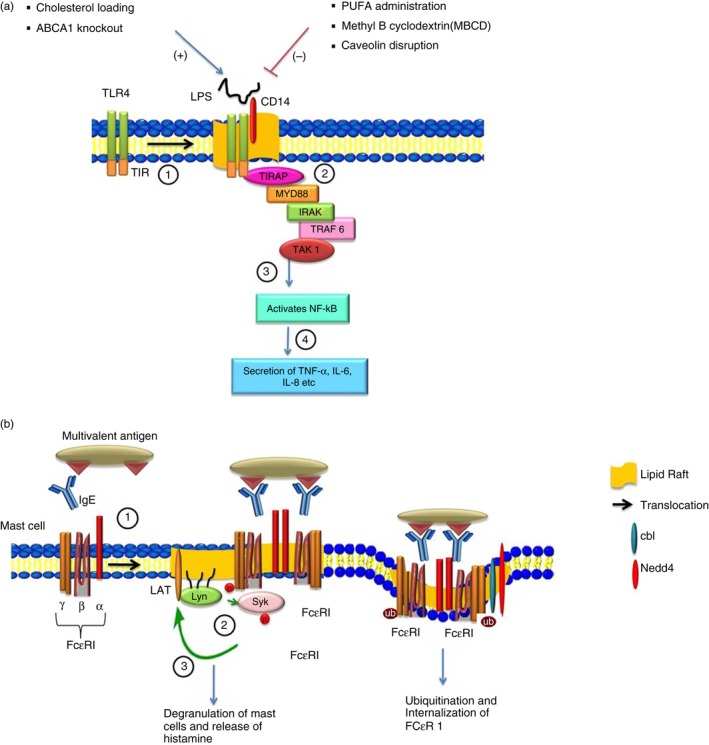
(a) The role of lipid rafts in Toll‐like receptor (TLR) signaling. (1) Binding of ligand such as lipopolysaccharide (LPS) with TLR4 results in its translocation to lipid rafts where it interacts with CD14. (2) In lipid rafts, the interaction of toll‐interleukin 1 receptor domain containing adaptor protein (TIRAP) with TLR4–CD14 complex through the TLR/interleukin‐1 receptor (TIR) domain recruits several adaptor molecules such as MYD88, interleukin‐1R‐associated kinase (IRAK) and tumour necrosis factor receptor‐associated factor 6 (TRAF6) and activates transforming growth factor‐β‐activated kinase 1 (TAK1). (3) TAK1 further activates nuclear factor‐κB (NFκB) and leads to the secretion of various cytokines like interleukin‐6 (IL‐6), IL‐8 etc. (4) Disruption of lipid rafts by polyunsaturated fatty acid (PUFA) administration and methyl‐β cyclodextrin (MBCD) or by caveolin disruption inhibits TLR signalling (−), while increasing the cellular cholesterol and ATP‐binding cassette transporter A1 (ABCA1) knockout enhances TLR signalling (+). (b) The role of lipid rafts in IgE signalling. (1) In mast cells, cross‐linking of IgE‐bound antigen with Fcε RI leads to its translocation to lipid rafts. (2) Within the raft domain, a doubly acylated Src‐like tyrosine kinase protein Lyn phosphorylates the immunoreceptor tyrosine‐based activation ( ITAM) domain and results in recruitment and phosphorylation of Syk kinase. (3) Syk further activates linker of activation of T cells (LAT) and recruits several other adaptor molecules in the lipid rafts resulting in the release of chemical mediators such as histamine. (4) Co‐localization of ubiquitin ligase Cbl and Nedd4 with Fcε RI inside the lipid raft domain results in ubiquitination and internalization of the receptor.
Figure 4
Figure 4
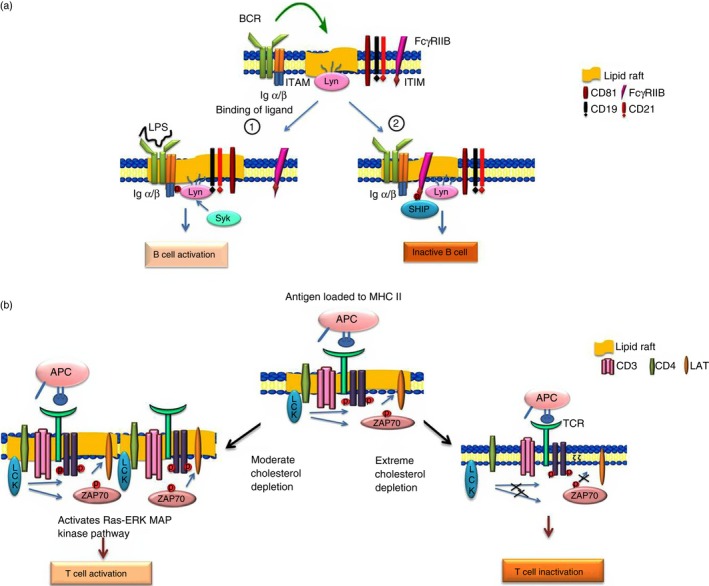
(a) The role of lipid rafts in B‐cell activation. Ligand binding localizes the B‐cell receptor (BCR) to lipid rafts where Lyn phosphorylates the immunoreceptor tyrosine‐based activation (ITAM) domain of BCR and recruits Syk and other molecules which lead to B‐cell activation. (1) In the presence of ligand (lipopolysaccharide; LPS), various co‐receptors such as CD19, CD21 and CD81 associate with the raft domain and positively regulate B‐cell signalling. (2) Interaction of the BCR with Fcγ RIIB co‐receptor leads to phosphorylation of the immunoreceptor tyrosine‐based inhibitory motif (ITIM) domain, which recruits SH2 domain containing inositol 5‐phosphatase (SHIP) phosphatase in the raft domain and negatively regulates B‐cell activation. (b) The role of lipid rafts in T‐cell activation. Cross‐linking of antigen loaded onto the MHC II molecule on antigen‐presenting cells (APC) with the T‐cell receptor (TCR) leads to TCRCD3 translocation to lipid rafts where lymphocyte‐specific protein tyrosine kinase (Lck) not only phosphorylates the ITAM domain present on ζ chain of TCR but also phosphorylates ZAP70, both of which bind to the phosphorylated domain and activate LAT, resulting in T‐cell activation. Moderate cholesterol depletion leads to raft‐clustering and activation of the Ras–extracellular signal‐regulated kinase (ERK) mitogen‐activated protein (MAP) kinase resulting in T‐cell signalling while extreme cholesterol depletion alters T‐cell activation by affecting the localization and phosphorylation of Lck, LAT and ZAP 70.

References

    1. Singer SJ, Nicolson GL. The fluid mosaic model of the structure of cell membranes. Science 1972; 175:720–31. - PubMed
    1. Lisanti MP, Sargiacomo M, Graeve L, Saltiel AR, Rodriguez‐Boulan E. Polarized apical distribution of glycosyl‐phosphatidylinositol‐anchored proteins in a renal epithelial cell line. Proc Natl Acad Sci USA 1988; 85:9557–61. - PMC - PubMed
    1. van MG, Stelzer EH, Wijnaendts‐van‐Resandt RW, Simons K. Sorting of sphingolipids in epithelial (Madin–Darby canine kidney) cells. J Cell Biol 1987; 105:1623–35. - PMC - PubMed
    1. Pike LJ. Rafts defined: a report on the keystone symposium on lipid rafts and cell function. J Lipid Res 2006; 47:1597–8. - PubMed
    1. Simons K, Toomre D. Lipid rafts and signal transduction. Nat Rev Mol Cell Biol 2000; 1:31–9. - PubMed

Publication types

LinkOut - more resources