


Prognostic value of hematological parameters in patients undergoing esophagectomy for esophageal squamous cell carcinoma
- PMID: 27154178
- PMCID: PMC5055579
- DOI: 10.1007/s10147-016-0986-9
Prognostic value of hematological parameters in patients undergoing esophagectomy for esophageal squamous cell carcinoma
Abstract
Background: It is now widely recognized that outcomes in cancer patients are not determined by their tumor characteristics alone. In this study, we retrospectively analyzed the clinical data of esophageal cancer patients to evaluate the impact of red blood cell distribution width (RDW), platelet distribution width (PDW), and mean platelet volume (MPV) on cancer-specific survival (CSS).
Study design: We retrospectively reviewed a database of 144 consecutive patients who underwent curative esophagectomy for esophageal squamous cell carcinoma at our institute between 2006 and 2014.
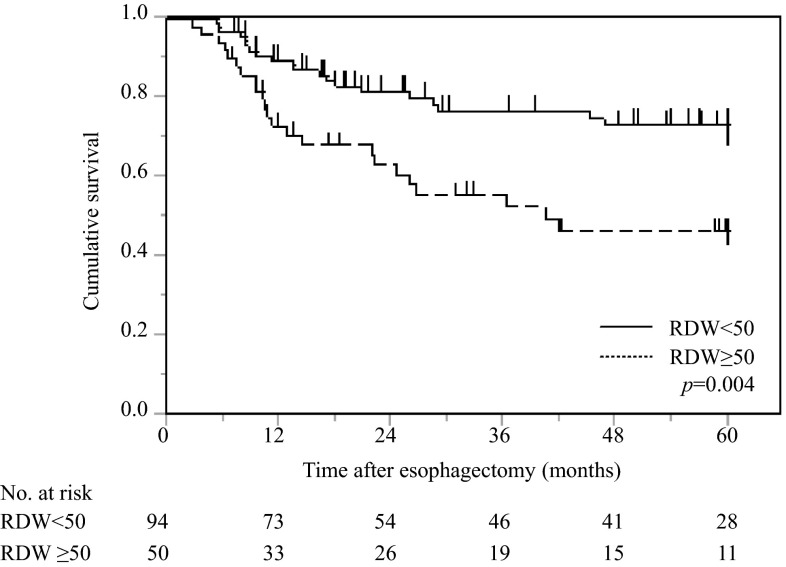
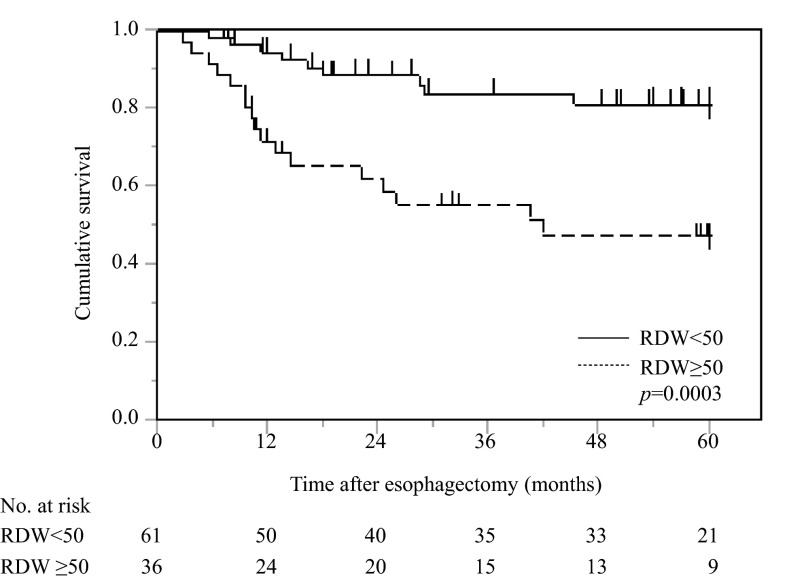
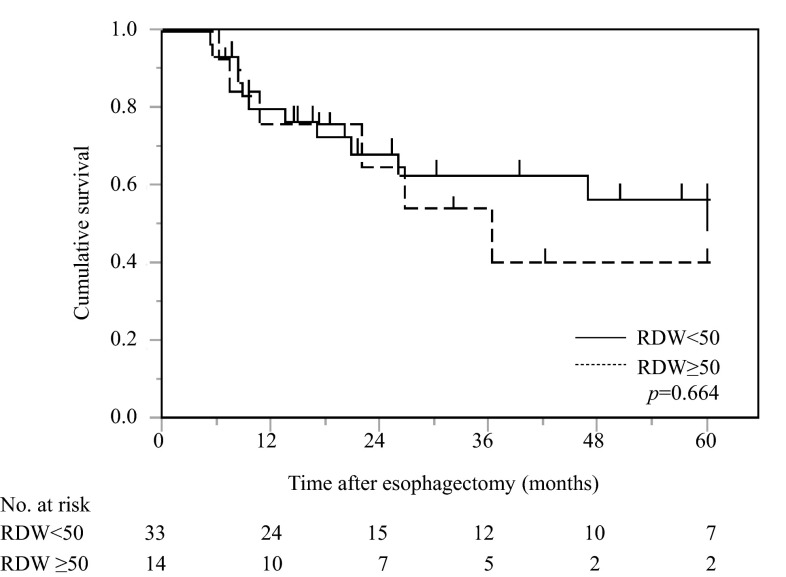
Result: In multivariate analysis, pathological stage (pStage) (p = 0.0002) and a high RDW (p = 0.0300) were found to be independently associated with poor survival. Patients with a high RDW had a significantly poorer prognosis in terms of CSS than those with a low RDW (p = 0.004). Among non-elderly patients, multivariate analysis demonstrated that pStage (p = 0.0120), and a high RDW (p = 0.0092) were independent risk factors for a worse prognosis. In addition, non-elderly patients with a high RDW had a significantly poorer prognosis in terms of CSS than those with a low RDW (p = 0.0003). On the other hand, univariate analysis demonstrated that pStage (p = 0.0008) was the only significant risk factor for a poor prognosis in elderly patients.
Conclusions: We confirmed that a high RDW was significantly associated with the CSS of esophageal cancer patients after curative esophagectomy. Furthermore, in non-elderly patients, a high RDW was a significant and independent predictor of poor survival.
Keywords: Esophageal cancer; Prognostic predictor; Red cell distribution width (RDW).
Conflict of interest statement
The authors declare that they have no conflict of interest.
Figures
References
-
- Forhecz Z, Gombos T, Borgulya G, et al. Red cell distribution width in heart failure: prediction of clinical events and relationship with markers of ineffective erythropoiesis, inflammation, renal function, and nutritional state. Am Heart J. 2009;158:659–666. doi: 10.1016/j.ahj.2009.07.024. - DOI - PubMed
MeSH terms
LinkOut - more resources
Full Text Sources
Other Literature Sources
Medical
