


A Remote Medication Monitoring System for Chronic Heart Failure Patients to Reduce Readmissions: A Two-Arm Randomized Pilot Study
- PMID: 27154462
- PMCID: PMC4890732
- DOI: 10.2196/jmir.5256
A Remote Medication Monitoring System for Chronic Heart Failure Patients to Reduce Readmissions: A Two-Arm Randomized Pilot Study
Erratum in
-
Corrigendum and Editorial Warning Regarding Use of the MMAS-8 Scale (A Remote Medication Monitoring System for Chronic Heart Failure Patients to Reduce Readmissions: A Two-Arm Randomized Pilot Study).J Med Internet Res. 2019 Feb 5;21(2):e13125. doi: 10.2196/13125. J Med Internet Res. 2019. PMID: 30721131 Free PMC article.
Abstract
Background: Heart failure (HF) is a chronic condition affecting nearly 5.7 million Americans and is a leading cause of morbidity and mortality. With an aging population, the cost associated with managing HF is expected to more than double from US $31 billion in 2012 to US $70 billion by 2030. Readmission rates for HF patients are high-25% are readmitted at 30 days and nearly 50% at 6 months. Low medication adherence contributes to poor HF management and higher readmission rates. Remote telehealth monitoring programs aimed at improved medication management and adherence may improve HF management and reduce readmissions.
Objective: The primary goal of this randomized controlled pilot study is to compare the MedSentry remote medication monitoring system versus usual care in older HF adult patients who recently completed a HF telemonitoring program. We hypothesized that remote medication monitoring would be associated with fewer unplanned hospitalizations and emergency department (ED) visits, increased medication adherence, and improved health-related quality of life (HRQoL) compared to usual care.
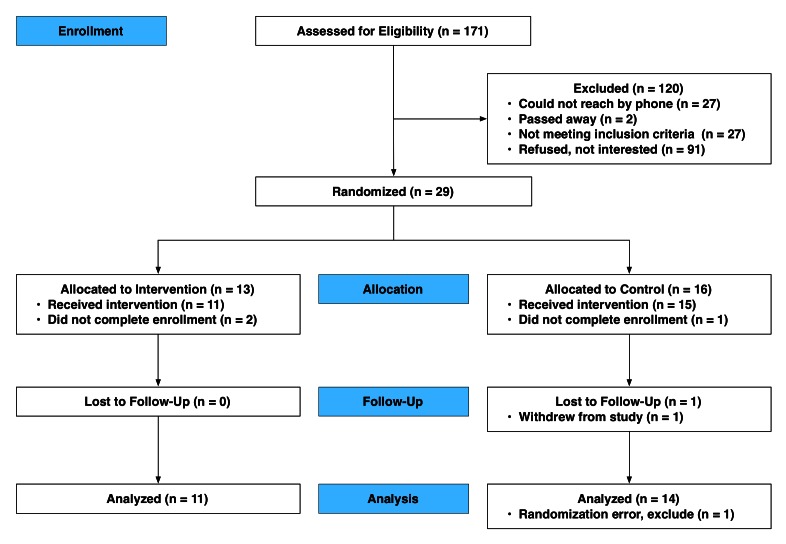
Methods: Participants were randomized to usual care or use of the remote medication monitoring system for 90 days. Twenty-nine participants were enrolled and the final analytic sample consisted of 25 participants. Participants completed questionnaires at enrollment and closeout to gather data on medication adherence, health status, and HRQoL. Electronic medical records were reviewed for data on baseline classification of heart function and the number of unplanned hospitalizations and ED visits during the study period.
Results: Use of the medication monitoring system was associated with an 80% reduction in the risk of all-cause hospitalization and a significant decrease in the number of all-cause hospitalization length of stay in the intervention arm compared to usual care. Objective device data indicated high adherence rates (95%-99%) among intervention group participants despite finding no significant difference in self-reported adherence between study arms. The intervention group had poorer heart function and HRQoL at baseline, and HRQoL declined significantly in the intervention group compared to controls.
Conclusions: The MedSentry medication monitoring system is a promising technology that merits continued development and evaluation. The MedSentry medication monitoring system may be useful both as a standalone system for patients with complex medication regimens or used to complement existing HF telemonitoring interventions. We found significant reductions in risk of all-cause hospitalization and the number of all-cause length of stay in the intervention group compared to controls. Although HRQoL deteriorated significantly in the intervention group, this may have been due to the poorer HF-functioning at baseline in the intervention group compared to controls. Telehealth medication adherence technologies, such as the MedSentry medication monitoring system, are a promising method to improve patient self-management,the quality of patient care, and reduce health care utilization and expenditure for patients with HF and other chronic diseases that require complex medication regimens.
Trial registration: ClinicalTrials.gov NCT01814696; https://clinicaltrials.gov/ct2/show/study/NCT01814696 (Archived by WebCite® at http://www.webcitation.org/6giqAVhno).
Keywords: ED visits; complex medication regimens; heart failure; hospitalization length of stay; medication adherence; medication management; self-care; self-management; telehealth; telemonitoring.
Conflict of interest statement
Conflicts of Interest: None declared
Figures
References
-
- Mozaffarian D, Benjamin E, Go A. Heart disease and stroke statistics--2015 update: a report from the American Heart Association. Circulation. 2015 Jan 27;131(4):e29–e322. - PubMed
-
- Heidenreich PA, Albert NM, Allen LA, Bluemke DA, Butler J, Fonarow GC, Ikonomidis JS, Khavjou O, Konstam MA, Maddox TM, Nichol G, Pham M, Piña IL, Trogdon JG, American Heart Association Advocacy Coordinating Committee. Council on Arteriosclerosis‚ ThrombosisVascular Biology. Council on Cardiovascular RadiologyIntervention. Council on Clinical Cardiology. Council on EpidemiologyPrevention. Stroke Council Forecasting the impact of heart failure in the United States: a policy statement from the American Heart Association. Circ Heart Fail. 2013 May;6(3):606–619. doi: 10.1161/HHF.0b013e318291329a. http://circheartfailure.ahajournals.org/cgi/pmidlookup?view=long&pmid=23... - DOI - PMC - PubMed
-
- Lloyd-Jones D, Adams R, Carnethon M, De Simone G, Ferguson TB, Flegal K, Ford E, Furie K, Go A, Greenlund K, Haase N, Hailpern S, Ho M, Howard V, Kissela B, Kittner S, Lackland D, Lisabeth L, Marelli A, McDermott M, Meigs J, Mozaffarian D, Nichol G, O'Donnell C, Roger V, Rosamond W, Sacco R, Sorlie P, Stafford R, Steinberger J, Thom T, Wasserthiel-Smoller S, Wong N, Wylie-Rosett J, Hong Y, American Heart Association Statistics Committee and Stroke Statistics Subcommittee Heart disease and stroke statistics--2009 update: a report from the American Heart Association Statistics Committee and Stroke Statistics Subcommittee. Circulation. 2009 Jan 27;119(3):e21–e181. doi: 10.1161/CIRCULATIONAHA.108.191261. http://circ.ahajournals.org/cgi/pmidlookup?view=long&pmid=19075105 - DOI - PubMed
-
- Ross JS, Chen J, Lin Z, Bueno H, Curtis JP, Keenan PS, Normand ST, Schreiner G, Spertus JA, Vidán MT, Wang Y, Wang Y, Krumholz HM. Recent national trends in readmission rates after heart failure hospitalization. Circ Heart Fail. 2010 Jan;3(1):97–103. doi: 10.1161/CIRCHEARTFAILURE.109.885210. http://circheartfailure.ahajournals.org/cgi/pmidlookup?view=long&pmid=19... - DOI - PMC - PubMed
-
- Yancy CW, Jessup M, Bozkurt B, Butler J, Casey DE, Drazner MH, Fonarow GC, Geraci SA, Horwich T, Januzzi JL, Johnson MR, Kasper EK, Levy WC, Masoudi FA, McBride PE, McMurray JJ, Mitchell JE, Peterson PN, Riegel B, Sam F, Stevenson LW, Tang WH, Tsai EJ, Wilkoff BL, American College of Cardiology Foundation. American Heart Association Task Force on Practice Guidelines 2013 ACCF/AHA guideline for the management of heart failure: a report of the American College of Cardiology Foundation/American Heart Association Task Force on Practice Guidelines. J Am Coll Cardiol. 2013 Oct 15;62(16):e147–e239. doi: 10.1016/j.jacc.2013.05.019. http://linkinghub.elsevier.com/retrieve/pii/S0735-1097(13)02114-1 - DOI - PubMed
Publication types
MeSH terms
Associated data
LinkOut - more resources
Full Text Sources
Other Literature Sources
Medical
Research Materials
Miscellaneous
