


Exome-wide Association Study Identifies CLEC3B Missense Variant p.S106G as Being Associated With Extreme Longevity in East Asian Populations
- PMID: 27154906
- PMCID: PMC5861862
- DOI: 10.1093/gerona/glw074
Exome-wide Association Study Identifies CLEC3B Missense Variant p.S106G as Being Associated With Extreme Longevity in East Asian Populations
Abstract
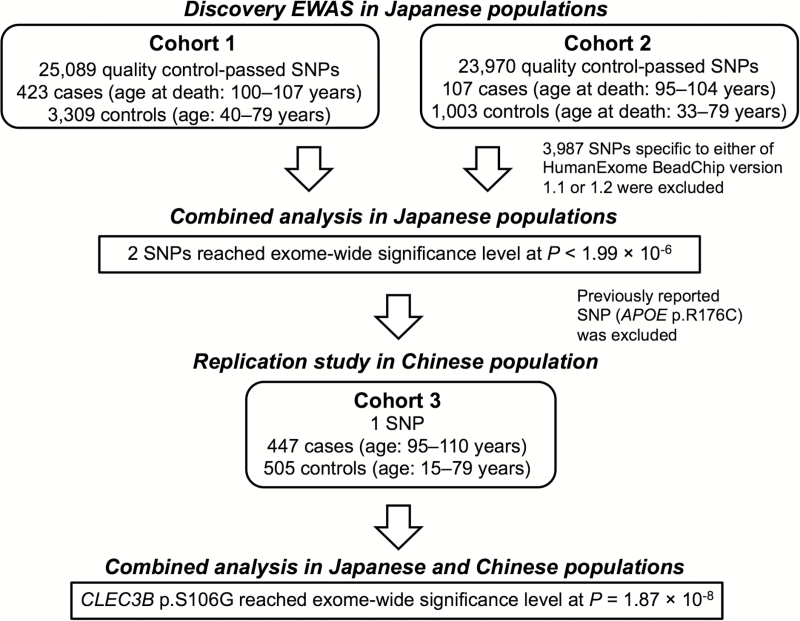
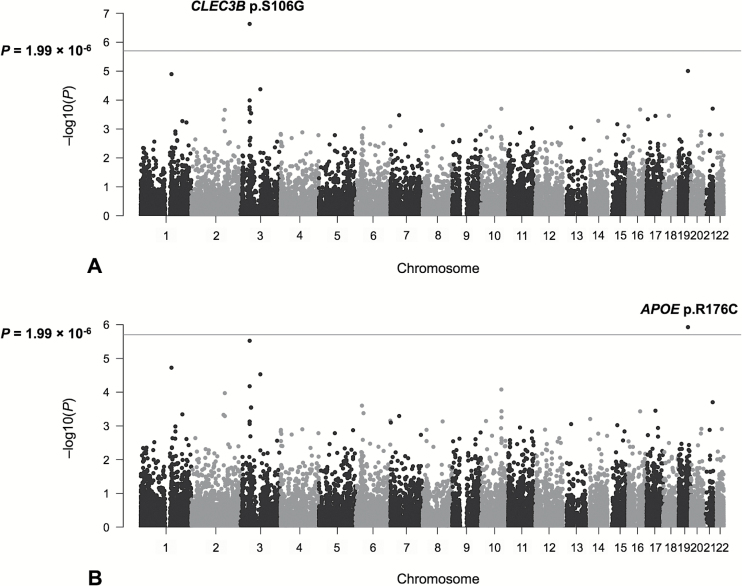
Life span is a complex trait regulated by multiple genetic and environmental factors; however, the genetic determinants of extreme longevity have been largely unknown. To identify the functional coding variants associated with extreme longevity, we performed an exome-wide association study (EWAS) on a Japanese population by using an Illumina HumanExome Beadchip and a focused replication study on a Chinese population. The EWAS on two independent Japanese cohorts consisting of 530 nonagenarians/centenarians demonstrated that the G allele of CLEC3B missense variant p.S106G was associated with extreme longevity at the exome-wide level of significance (p = 2.33×10⁻⁷, odds ratio [OR] = 1.50). The CLEC3B gene encodes tetranectin, a protein implicated in the mineralization process in osteogenesis as well as in the prognosis and metastasis of cancer. The replication study consisting of 448 Chinese nonagenarians/centenarians showed that the G allele of CLEC3B p.S106G was also associated with extreme longevity (p = .027, OR = 1.51), and the p value of this variant reached 1.87×10⁻⁸ in the meta-analysis of Japanese and Chinese populations. In conclusion, the present study identified the CLEC3B p.S106G as a novel longevity-associated variant, raising the novel hypothesis that tetranectin, encoded by CLEC3B, plays a role in human longevity and aging.
Keywords: Centenarian; Human aging; Human genetics; Longevity.
© The Author 2016. Published by Oxford University Press on behalf of The Gerontological Society of America.
Figures
References
-
- Salomon JA, Wang H, Freeman MK, et al. Healthy life expectancy for 187 countries, 1990–2010: a systematic analysis for the Global Burden Disease Study 2010. Lancet. 2012;380:2144–2162. doi:10.1016/S0140-6736(12)61690-0 - PubMed
-
- Herskind AM, McGue M, Holm NV, Sørensen TI, Harvald B, Vaupel JW. The heritability of human longevity: a population-based study of 2872 Danish twin pairs born 1870–1900. Hum Genet. 1996;97:319–323. doi:10.1007/BF02185763 - PubMed
-
- Mitchell BD, Hsueh WC, King TM, et al. Heritability of life span in the Old Order Amish. Am J Med Genet. 2001;102:346–352. doi:10.1002/ajmg.1483 - PubMed
-
- Skytthe A, Pedersen NL, Kaprio J, et al. Longevity studies in GenomEUtwin. Twin Res. 2003;6:448–454. doi:10.1375/136905203770326457 - PubMed
-
- Schoenmaker M, de Craen AJ, de Meijer PH, et al. Evidence of genetic enrichment for exceptional survival using a family approach: the Leiden Longevity Study. Eur J Hum Genet. 2006;14:79–84. doi:10.1038/sj.ejhg.5201508 - PubMed
MeSH terms
Substances
LinkOut - more resources
Full Text Sources
Other Literature Sources
