


Serum Cystatin C Concentrations in Cats with Hyperthyroidism and Chronic Kidney Disease
- PMID: 27155206
- PMCID: PMC5084826
- DOI: 10.1111/jvim.13956
Serum Cystatin C Concentrations in Cats with Hyperthyroidism and Chronic Kidney Disease
Abstract
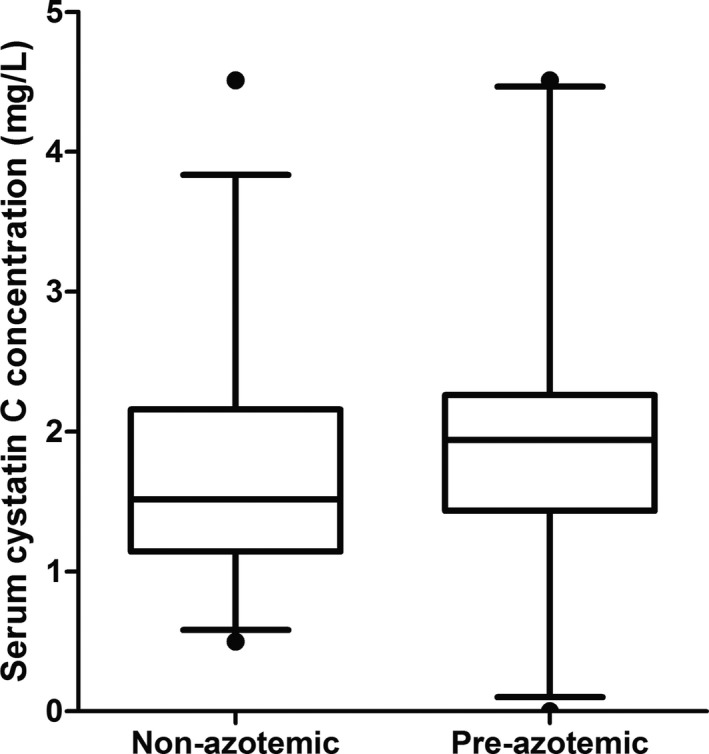
Background: Currently, no test can accurately predict the development of azotemia after treatment of hyperthyroidism. Serum cystatin C concentrations (sCysC) might be less influenced by changes in body muscle mass and so better indicate the presence of concurrent chronic kidney disease (CKD) in hyperthyroidism.
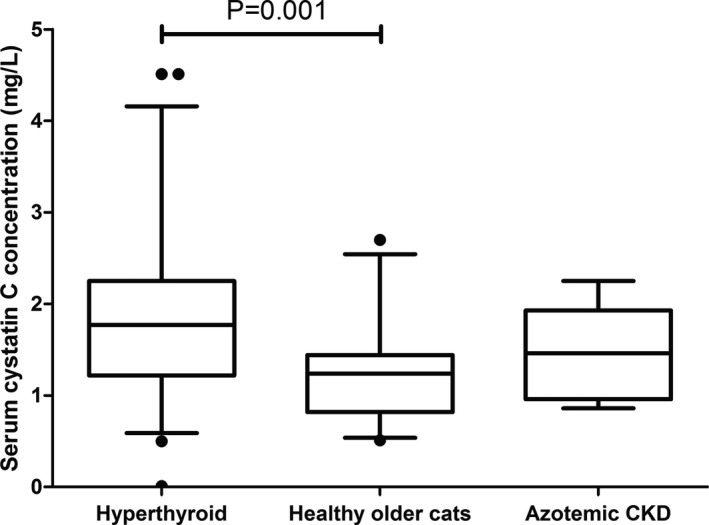
Hypotheses: sCysC will be higher in hyperthyroid cats that develop azotemia compared with hyperthyroid cats that remain nonazotemic after treatment; sCysC will be higher in nonhyperthyroid cats with azotemic CKD than healthy older cats and, sCysC will decrease after treatment of hyperthyroidism.
Animals: Ninety-one cats treated in first opinion practice.
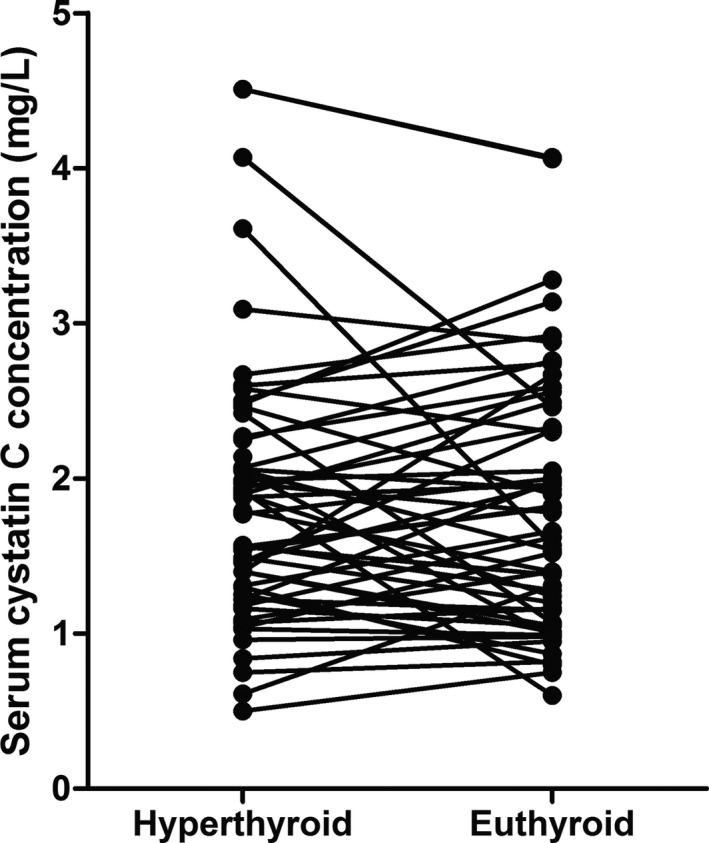
Methods: Case-control study. sCysC were compared between hyperthyroid cats which developed azotemia within 4 months of successful treatment of hyperthyroidism (pre-azotemic group) and hyperthyroid cats which remained nonazotemic after treatment (nonazotemic group), and between nonhyperthyroid cats with azotemic CKD and healthy older cats. sCysC were also compared between hyperthyroid cats before treatment and at time of establishment of euthyroidism. Data are presented as median [25th, 75th percentile].
Results: Baseline sCysC were not different between the pre-azotemic and nonazotemic groups (1.9 [1.4, 2.3] mg/L versus 1.5 [1.1, 2.2] mg/L, respectively; P = .22). sCysC in nonhyperthyroid cats with azotemic CKD and healthy older cats were not significantly different (1.5 [1.0, 1.9] mg/L versus 1.2 [0.8, 1.4] mg/L, respectively; P = .16). sCysC did not change significantly after treatment of hyperthyroidism (pretreatment 1.8 [1.2, 2.3] mg/L, after treatment 1.6 [1.1, 2.4] mg/L; P = .82).
Conclusions and clinical importance: sCysC do not appear to be a reliable marker of renal function in hyperthyroid cats.
Keywords: Azotemia; Clinical chemistry; Clinical pathology; Endocrinology; Renal function; Thyroid; Urinary tract; Validation.
Copyright © 2016 The Authors. Journal of Veterinary Internal Medicine published by Wiley Periodicals, Inc. on behalf of the American College of Veterinary Internal Medicine.
Figures
References
-
- Shiel RE, Mooney CT. Testing for hyperthyroidism in cats. Vet Clin North Am Small Anim Pract 2007;37:671–691, vi. - PubMed
-
- Williams TL, Elliott J, Syme HM. Association of iatrogenic hypothyroidism with azotemia and reduced survival time in cats treated for hyperthyroidism. J Vet Intern Med 2010;24:1086–1092. - PubMed
-
- Uchida K, Gotoh A. Measurement of cystatin‐C and creatinine in urine. Clin Chim Acta 2002;323:121–128. - PubMed
-
- den Hollander JG, Wulkan RW, Mantel MJ, Berghout A. Is cystatin C a marker of glomerular filtration rate in thyroid dysfunction? Clin Chem 2003;49:1558–1559. - PubMed
MeSH terms
Substances
LinkOut - more resources
Full Text Sources
Other Literature Sources
Medical
Miscellaneous
