


Nationwide increase in hospitalizations for heroin-related soft tissue infections: Associations with structural market conditions
- PMID: 27155756
- PMCID: PMC4881875
- DOI: 10.1016/j.drugalcdep.2016.04.009
Nationwide increase in hospitalizations for heroin-related soft tissue infections: Associations with structural market conditions
Abstract
Introduction: Little is known about trends in national rates of injection-related skin and soft tissue infections (SSTI) and their relationship to the structural risk environment for heroin users. Use of Mexican-sourced "Black Tar" heroin, predominant in western US states, may have greater risk for SSTI compared with eastern US powder heroin (Colombian-sourced) due to its association with non-intravenous injection or from possible contamination.
Methods: Using nationally representative hospital admissions data from the Nationwide Inpatient Sample and heroin price and purity data from the Drug Enforcement Administration, we looked at rates of hospital admissions for opiate-related SSTI (O-SSTI) between 1993 and 2010. Regression analyses examined associations between O-SSTI and heroin source, form and price.
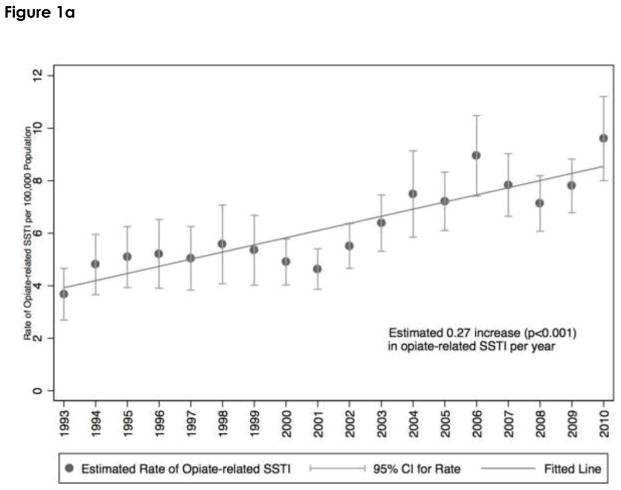
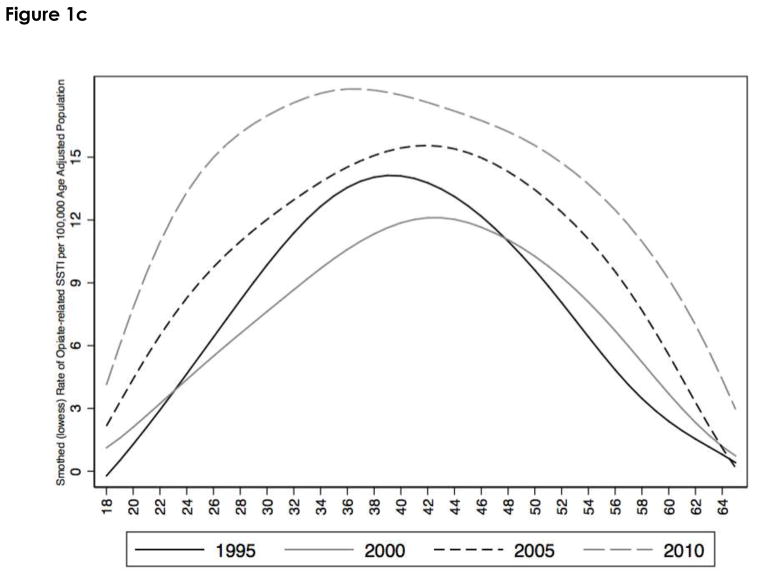
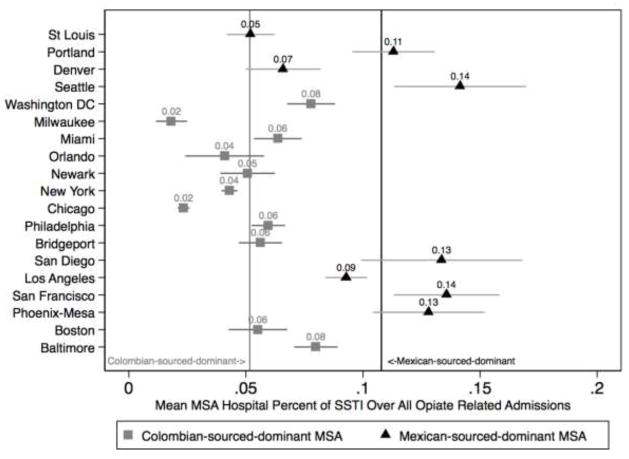
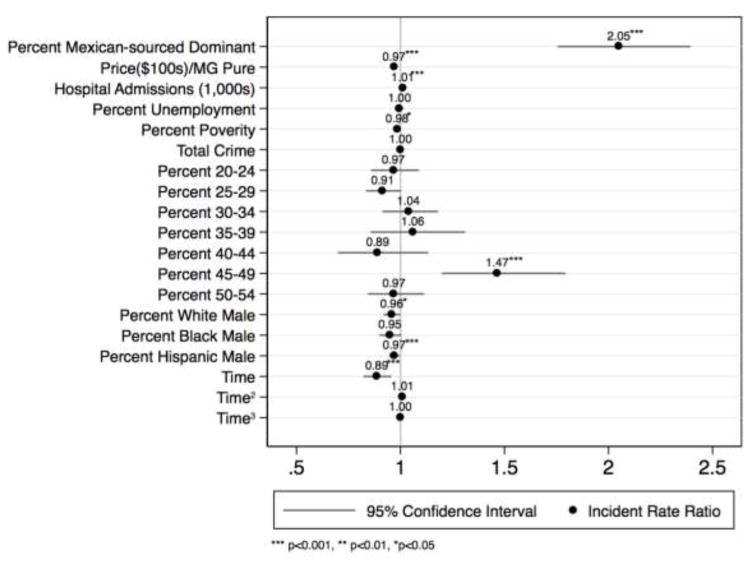
Results: Hospitalization rates of O-SSTI doubled from 4 to 9 per 100,000 nationally between 1993 and 2010; the increase concentrated among individuals aged 20-40. Heroin market features were strongly associated with changes in the rate of SSTI. Each $100 increase in yearly heroin price-per-gram-pure was associated with a 3% decrease in the rate of heroin-related SSTI admissions. Mexican-sourced-heroin-dominant cities had twice the rate of O-SSTI compared to Colombian-sourced-heroin-dominant cities.
Discussion: Heroin-related SSTI are increasing and structural factors, including heroin price and source-form, are associated with higher rates of SSTI hospital admissions. Clinical and harm reduction efforts should educate heroin users on local risk factors, e.g., heroin type, promote vein health strategies and provide culturally sensitive treatment services for persons suffering with SSTI.
Keywords: Black tar heroin; Drug markets; Heroin; Injection drug use; Soft tissue infection; Structural risk environment.
Copyright © 2016 Elsevier Ireland Ltd. All rights reserved.
Conflict of interest statement
No conflict declared by any of the authors
Figures
References
-
- Agency for Healthcare Research and Quality Healthcare Cost and Utilization Project (HCUP) Introduction to the HCUP Nationwide Inpatient Sample (NIS) Rockville, MD: 2008. from http://www.hcup-us.ahrq.gov/db/nation/nis/NIS_2008_INTRODUCTION.pdf.
-
- Arkes J, Pacula R, Paddock S, Caulkins JP, Reuter P. Why the DEA Stride data are still useful for understanding drug markets. Nber Working Paper Series. 2008 Retrieved from http://www.nber.org/papers/w14224.pdf.
-
- Bangsberg DR, Rosen JI, Aragon T, Campbell A, Weir L, Perdreau-Remington F. Clostridial myonecrosis cluster among injection drug users: a molecular epidemiology investigation. Arch Intern Med. 2002;162:517–522. http://www.ncbi.nlm.nih.gov/entrez/query.fcgi?cmd=Retrieve&db=PubMed&dop.... - PubMed
-
- Bardenheier B, Prevots DR, Khetsuriani N, Wharton M. Tetanus surveillance--United States, 1995–1997. MMWR Surveill Summ. 1998;47:1–13. http://www.ncbi.nlm.nih.gov/pubmed/9665156. - PubMed
-
- Barrett ML-GL, Coffey R, Levit K. Population Denominator Data for Use with the HCUP Databases (Updated with 2013 Population Data) 201. Retrieved from http://www.hcup-us.ahrq.gov/reports/methods/methods.jsp.
MeSH terms
Substances
Grants and funding
LinkOut - more resources
Full Text Sources
Other Literature Sources
Medical
