


Patient-Reported Outcomes Measurement Information System in Children with Crohn's Disease
- PMID: 27157449
- PMCID: PMC5157125
- DOI: 10.1016/j.jpeds.2016.03.069
Patient-Reported Outcomes Measurement Information System in Children with Crohn's Disease
Abstract
Objectives: To assess the criterion validity and responsiveness of Patient-Reported Outcomes Measurement Information System (PROMIS) in a web-based cohort of children with Crohn's disease.
Study design: We recruited children with Crohn's disease (ages 9-17 years) and their parents from the web-based Crohn's and Colitis Foundation of America Kids and Teens Study cohort. Upon entry into the cohort and 6 months later, children self-reported Crohn's disease activity, health-related quality of life, and PROMIS domains of pain interference, anxiety, depression, fatigue, and peer relationships.
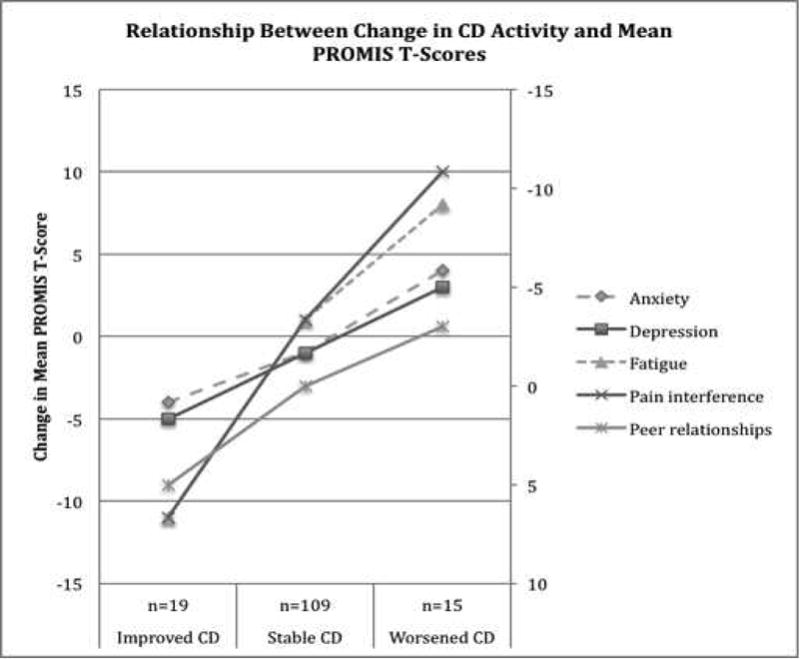
Results: Mean PROMIS scores for the 276 participating patients were worse among those with worse self-reported Crohn's disease activity (per Short Crohn's Disease Activity Index, P < .005 for all), Crohn's disease activity in the prior 6 months (per Manitoba Index, P < .01 for all), and health-related quality of life (per IMPACT-35, P < .001 for all). One hundred forty-three patients and their parents completed follow-up questionnaires, 75% of whom reported stable disease activity. Those with improved Crohn's disease activity reported improved PROMIS scores, and those with worsened Crohn's disease activity reported worse PROMIS scores for all domains except anxiety. All participants reported improved anxiety from baseline, but those with stable or worsened Crohn's disease activity reported less improvement (P = .07).
Conclusions: PROMIS scores were significantly associated with Crohn's disease activity in a linear and clinically meaningful manner, and responded to change in Crohn's disease activity over a 6-month period. This supports the criterion validity and responsiveness of pediatric PROMIS.
Keywords: Crohn's disease; PROMIS; anxiety; depression; fatigue; patient-reported outcomes; peer relationships; quality of life.
Copyright © 2016 Elsevier Inc. All rights reserved.
Conflict of interest statement
The authors declare no conflicts of interest.
Figures
References
-
- Patrick DGG, Acquadro C. In: Cochrane Handbook for Systematic Reviews of Interventions Version 5.0.1 ed. Julian PT, Higgins SG, editors. The Cochrane Collaboration, John Wiley & Sons Ltd.; 2008.
-
- Staff PN. PROMIS. Research: PROMIS Network. [Available from: http://www.nihpromis.org/researchers/InResearch.
-
- Staff PN. PROMIS Instrument Development and Validation Scientific Standards Version 2.0: PROMIS Network. 2013 [updated May 2013. 72]. Available from: http://www.nihpromis.org/Documents/PROMISStandards_Vers2.0_Final.pdf.
-
- Rothrock N. What is PROMIS? PROMIS: PROMIS Network. 2013
-
- Validation of Pediatric Patient Reported Outcomes in Chronic Disease (PEPR) Consortium (U19) National Institutes of Health; 2015.
Publication types
MeSH terms
Grants and funding
LinkOut - more resources
Full Text Sources
Other Literature Sources
Medical
