


Identification of a CD4 T-cell epitope in the hemagglutinin stalk domain of pandemic H1N1 influenza virus and its antigen-driven TCR usage signature in BALB/c mice
- PMID: 27157498
- PMCID: PMC5518815
- DOI: 10.1038/cmi.2016.20
Identification of a CD4 T-cell epitope in the hemagglutinin stalk domain of pandemic H1N1 influenza virus and its antigen-driven TCR usage signature in BALB/c mice
Abstract
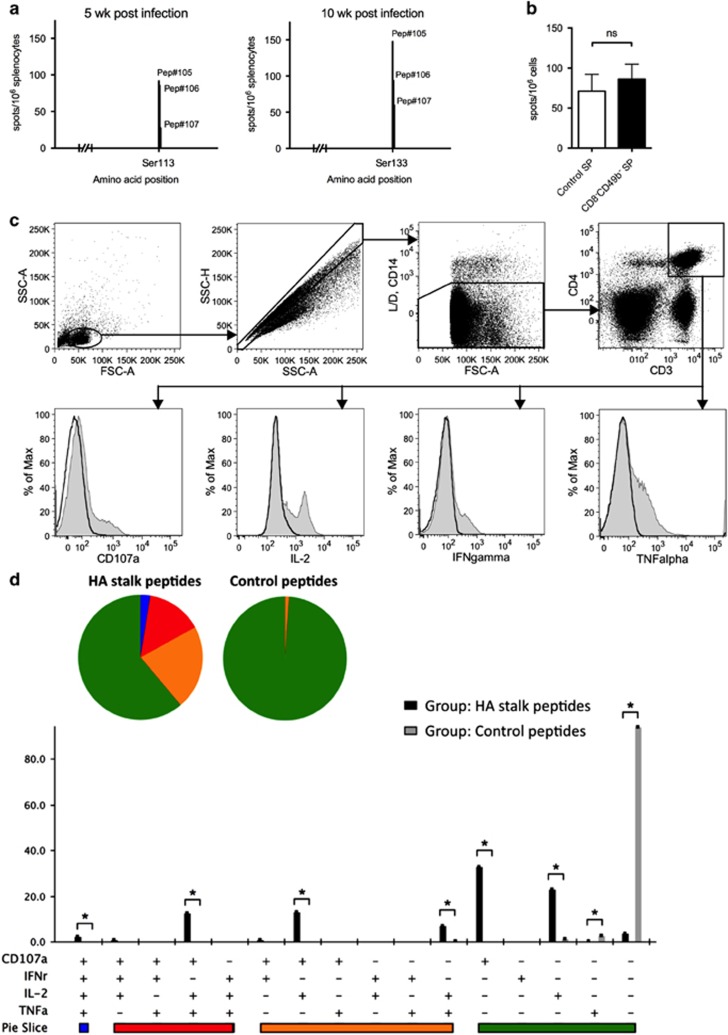
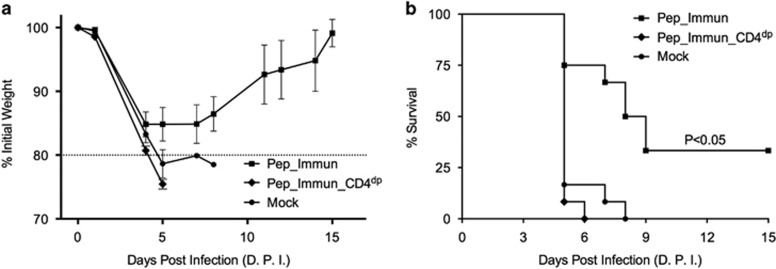
The stalk region of the influenza virus hemagglutinin is relatively well conserved compared with the globular head domain, which makes it a potential target for use as a universal vaccine against influenza. However, the role of CD4 T cells in the hemagglutinin stalk-specific immune response is not clear. Here we identified a mouse CD4 T-cell epitope that encompasses residues HA2113-131 from the hemagglutinin stalk domain after a sub-lethal infection of influenza. In response to stimulation with the identified epitope, splenocytes derived from the infected mice showed significant polyfunctionality as shown by IL-2, TNF-α and IFN-γ production as well as degranulation. Moreover, mice immunized with the peptide corresponding to this CD4 T-cell epitope exhibited interindividual sharing of the CD4 T-cell receptor β sequences, and they had a higher survival rate following a challenge with a lethal dose of pandemic H1N1 influenza virus. Thus, our data demonstrated a crucial role of hemagglutinin stalk-specific CD4 T cells in the host immune response against influenza virus infection.
Conflict of interest statement
The authors declare no conflict of interest.
Figures

Similar articles
-
Globular Head-Displayed Conserved Influenza H1 Hemagglutinin Stalk Epitopes Confer Protection against Heterologous H1N1 Virus.PLoS One. 2016 Apr 18;11(4):e0153579. doi: 10.1371/journal.pone.0153579. eCollection 2016. PLoS One. 2016. PMID: 27088239 Free PMC article.
-
Conserved stem fragment from H3 influenza hemagglutinin elicits cross-clade neutralizing antibodies through stalk-targeted blocking of conformational change during membrane fusion.Immunol Lett. 2016 Apr;172:11-20. doi: 10.1016/j.imlet.2016.02.006. Epub 2016 Feb 10. Immunol Lett. 2016. PMID: 26875772
-
Age-related changes in magnitude and diversity of cross-reactive CD4+ T-cell responses to the novel pandemic H1N1 influenza hemagglutinin.Hum Immunol. 2010 Oct;71(10):957-63. doi: 10.1016/j.humimm.2010.07.005. Epub 2010 Jul 30. Hum Immunol. 2010. PMID: 20650295
-
T cell epitope engineering: an avian H7N9 influenza vaccine strategy for pandemic preparedness and response.Hum Vaccin Immunother. 2018;14(9):2203-2207. doi: 10.1080/21645515.2018.1495303. Epub 2018 Sep 5. Hum Vaccin Immunother. 2018. PMID: 30015562 Free PMC article. Review.
-
CD4 T cells in protection from influenza virus: Viral antigen specificity and functional potential.Immunol Rev. 2018 Jul;284(1):91-105. doi: 10.1111/imr.12662. Immunol Rev. 2018. PMID: 29944766 Free PMC article. Review.
Cited by
-
Development of Universal Influenza Vaccines Targeting Conserved Viral Proteins.Vaccines (Basel). 2019 Nov 1;7(4):169. doi: 10.3390/vaccines7040169. Vaccines (Basel). 2019. PMID: 31683888 Free PMC article. Review.
-
Multi-epitope vaccines: a promising strategy against tumors and viral infections.Cell Mol Immunol. 2018 Feb;15(2):182-184. doi: 10.1038/cmi.2017.92. Epub 2017 Sep 11. Cell Mol Immunol. 2018. PMID: 28890542 Free PMC article. No abstract available.
-
Multi-Epitope-Based Vaccine Candidate for Monkeypox: An In Silico Approach.Vaccines (Basel). 2022 Sep 19;10(9):1564. doi: 10.3390/vaccines10091564. Vaccines (Basel). 2022. PMID: 36146643 Free PMC article.
-
Prediction and evaluation of multi epitope based sub-unit vaccine against Salmonella typhimurium.Saudi J Biol Sci. 2022 Feb;29(2):1092-1099. doi: 10.1016/j.sjbs.2021.09.061. Epub 2021 Oct 1. Saudi J Biol Sci. 2022. PMID: 35197778 Free PMC article.
-
Development of a Multiepitope Vaccine Against SARS-CoV-2: Immunoinformatics Study.JMIR Bioinform Biotechnol. 2022 Jul 19;3(1):e36100. doi: 10.2196/36100. eCollection 2022 Jan-Dec. JMIR Bioinform Biotechnol. 2022. PMID: 35891920 Free PMC article.
References
-
- Skehel JJ, Wiley DC. Receptor binding and membrane fusion in virus entry: the influenza hemagglutinin. Annu Rev Biochem 2000; 69: 531–569. - PubMed
MeSH terms
Substances
LinkOut - more resources
Full Text Sources
Other Literature Sources
Medical
Molecular Biology Databases
Research Materials
Miscellaneous
