Long-Term Changes in Subfoveal Choroidal Thickness After Cataract Surgery
- PMID: 27158971
- PMCID: PMC4918536
- DOI: 10.12659/msm.898714
Long-Term Changes in Subfoveal Choroidal Thickness After Cataract Surgery
Abstract
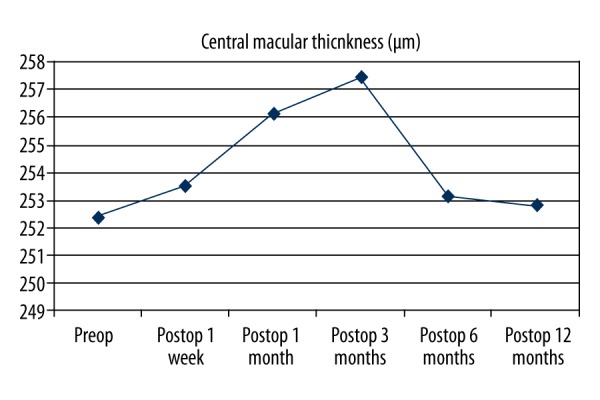
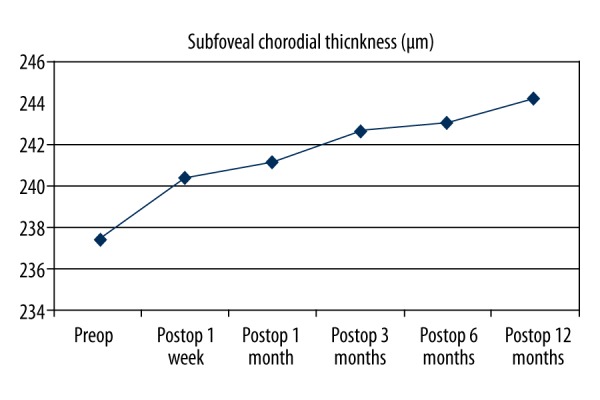
BACKGROUND Cataract surgery is associated with the development of late-onset age-related macular degeneration (AMD). The pathogenic mechanism is still not fully established. The purpose of this study was to evaluate the possible changes in central macula thickness (CMT) and subfoveal choroid thickness (SCT) after uneventful cataract surgery. MATERIAL AND METHODS A total of 65 eyes of 65 patients who underwent phacoemulsification and intracapsular lens implantation were included in this prospective study. Patients had not undergone previous ocular surgery and had no other ocular abnormality. CMT and SCT were measured at baseline and postoperatively at week 1 and months 1, 3, 6 and 12 via spectral domain optical cohorence tomography (SD-OCT). RESULTS CMT was 252.4±27.6 μm (mean ±SD) preoperatively, then 253.5±29.8, 256.1±28.7, 257.4±27.2, 253.18±23.7, and 252.8±21.7 μm at postoperative week 1 and postoperative months 1, 3, 6, and 12, respectively. There were insignificant changes in CMT, and it returned to baseline at six months after surgery (all p>0.05). SCT was 237.4±21.6 μm preoperatively, and 240.5±24.8, 241.2±25.7, 242.7±26.3, 243.1±24.2, and 244.2±21.4 μm at postoperative week 1 and postoperative months 1, 3, 6, and 12, respectively. Although there was an increase in SCT during follow-up, the difference between preoperative and postoperative values was not significant (p>0.05). CONCLUSIONS Uncomplicated phacoemulsification induces subclinical changes in CMT, probably due to the inflammatory insult of surgery, and CMT returns to baseline value. There were slight, insignificant increases in choroid thickness during follow-up, and this did not return to baseline during follow-up. Changes in the choroid after cataract surgery may provide clues to the development of late-onset AMD.
Figures
References
-
- Cioffi GA, Granstam E, Alm A. Adler’s Physiology of the Eye: Clinical Application. 10th ed. Mosby; St Louis: 2003. Ocular circulation; pp. 747–84.
-
- Spaide RF, Koizumi H, Pozzoni MC. Enhanced depth imaging spectral-domain optical coherence tomography. Am J Ophthalmol. 2008;146:496–500. - PubMed
-
- Nishida Y, Fujiwara T, Imamura Y, et al. Choroidal thickness and visual acuity in highly myopic eyes. Retina. 2012;32:1229–36. - PubMed
MeSH terms
LinkOut - more resources
Full Text Sources
Medical