


Quality of Life and Sexual Function 2 Years After Vaginal Surgery for Prolapse
- PMID: 27159758
- PMCID: PMC4879084
- DOI: 10.1097/AOG.0000000000001442
Quality of Life and Sexual Function 2 Years After Vaginal Surgery for Prolapse
Erratum in
-
Quality of Life and Sexual Function 2 Years After Vaginal Surgery for Prolapse: Correction.Obstet Gynecol. 2017 Feb;129(2):392-394. doi: 10.1097/AOG.0000000000001893. Obstet Gynecol. 2017. PMID: 29244708 No abstract available.
Abstract
Objective: To longitudinally assess the effect of native tissue vaginal apical prolapse repair with anti-incontinence surgery on quality of life, sexual function, and body image between uterosacral and sacrospinous suspensions.
Methods: A planned secondary analysis was performed on 374 women enrolled in a randomized trial of the two types of native tissue repair for apical prolapse. Condition-specific and generic quality of life, sexual function, overall and de novo dyspareunia, and body image were assessed using validated instruments at baseline; 6, 12, and 24 months postoperatively; and changes from baseline were assessed and compared between surgical groups. General linear mixed models were used for comparisons and clinically significant differences were assessed using minimum important differences.
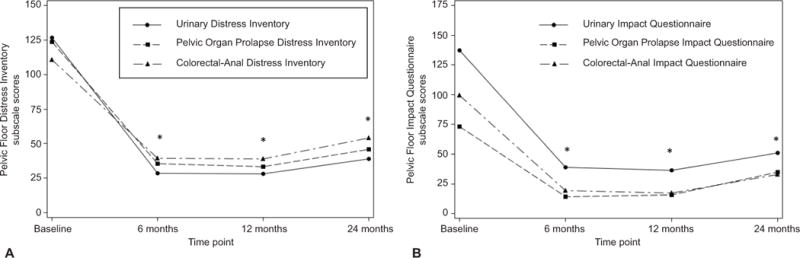
Results: Of the women randomized, 82% had outcomes available at 2 years. Overall, clinically and statistically significant improvements in generic and condition-specific quality of life and sexual function were observed after surgery. Dyspareunia rates decreased from 25% to 16% by 24 months with only 3% of all women undergoing treatment. De novo dyspareunia occurred in 5% and 10% by 12 and 24 months, respectively. Body image scores also significantly improved from baseline. There were no clinically meaningful or statistically significant differences between groups for any of these outcomes (all P>.05).
Conclusion: Native tissue vaginal prolapse surgery results in statistically and clinically significant improvements in quality of life, sexual function, and body image at 24 months with no significant differences between uterosacral and sacrospinous suspensions. One in 10 women experience de novo dyspareunia but few requested treatment.
Clinical trial registration: ClinicalTrials.gov, www.clinicaltrials.gov, NCT00597935.
Conflict of interest statement
The other authors did not report any potential conflicts of interest.
Figures
References
-
- Lawrence JM, Lukacz ES, Nager CW, Hsu JW, Luber KM. Prevalence and co-occurrence of pelvic floor disorders in community-dwelling women. Obstet Gynecol. 2008;111(3):678–85. - PubMed
-
- Athanasiou S, Grigoriadis T, Chalabalaki A, Protopapas A, Antsaklis A. Pelvic organ prolapse contributes to sexual dysfunction: a cross-sectional study. Acta Obstet Gynecol Scand. 2012;91(6):704–9. - PubMed
-
- Lowenstein L, Gamble T, Sanses TV, van Raalte H, Carberry C, Jakus S, et al. Sexual function is related to body image perception in women with pelvic organ prolapse. J Sex Med. 2009;6(8):2286–91. - PubMed
Publication types
MeSH terms
Associated data
Grants and funding
- U10 HD041261/HD/NICHD NIH HHS/United States
- U01 HD041249/HD/NICHD NIH HHS/United States
- U10 HD054215/HD/NICHD NIH HHS/United States
- U10 HD054214/HD/NICHD NIH HHS/United States
- U01 HD069031/HD/NICHD NIH HHS/United States
- U10 HD041267/HD/NICHD NIH HHS/United States
- UG1 HD054214/HD/NICHD NIH HHS/United States
- U10 HD054136/HD/NICHD NIH HHS/United States
- UG1 HD054215/HD/NICHD NIH HHS/United States
- U10 HD054241/HD/NICHD NIH HHS/United States
- U10 HD041250/HD/NICHD NIH HHS/United States
- UG1 HD041261/HD/NICHD NIH HHS/United States
LinkOut - more resources
Full Text Sources
Other Literature Sources
Medical
Molecular Biology Databases
