Review
. 2016 Oct;21(5):321-32.
doi: 10.1016/j.siny.2016.04.008. Epub 2016 May 7.

The genetics of cerebellar malformations

Affiliations
Review

The genetics of cerebellar malformations

Kimberly A Aldinger et al. Semin Fetal Neonatal Med. 2016 Oct.

Abstract

The cerebellum has long been recognized for its role in motor co-ordination, but it is also increasingly appreciated for its role in complex cognitive behavior. Historically, the cerebellum has been overwhelmingly understudied compared to the neocortex in both humans and model organisms. However, this tide is changing as advances in neuroimaging, neuropathology, and neurogenetics have led to clinical classification and gene identification for numerous developmental disorders that impact cerebellar structure and function associated with significant overall neurodevelopmental dysfunction. Given the broad range in prognosis and associated medical and neurodevelopmental concerns accompanying cerebellar malformations, a working knowledge of these disorders and their causes is critical for obstetricians, perinatologists, and neonatologists. Here we present an update on the genetic causes for cerebellar malformations that can be recognized by neuroimaging and clinical characteristics during the prenatal and postnatal periods.

Keywords: Brain malformation; Cerebellum; Genetics; Magnetic resonance imaging; Neurodevelopment; Neuroimaging.


Conflict of interest statement

statement None declared.

Figures
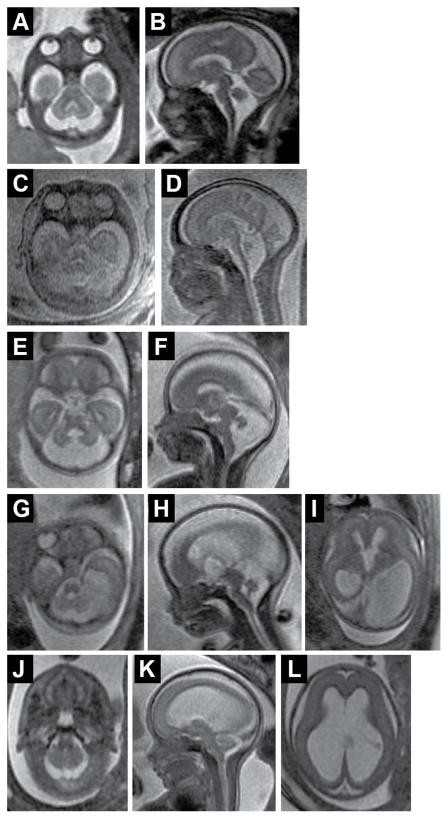
Fig. 1
Fig. 1
Fetal neuroimaging of cerebellar malformations. (A, B) Axial and sagittal views of a 22-week gestation fetus with confirmed VLDLR-related cerebellar hypoplasia. Note that cerebellar hypoplasia more severely affects the vermis; there are no primary fissure and other vermis landmarks on the sagittal view. (C, D) Axial and sagittal views of a 25-week gestation fetus with TSEN54-related pontocerebellarhyplasia. Note marked hypoplasia of the vermis, hemispheres and pons. (E, F) Axial and sagittal views of a 20-week gestation fetus with Joubert syndrome. Note the more severely affected vermis with dysplastic brainstem. (G–I) Axial and sagittal views of a 20-week gestation fetus with POMGNT1-related muscle–eye–brain disease demonstrating cerebellar hypoplasia of vermis and hemispheres, “kinked brainstem” and severe, asymmetric lateral ventriculomegaly. (J–L) Axial and sagittal views of a 20-week gestation fetus with rhombencephalosynapsis demonstrating small cerebellum without an obvious vermis and severe ventriculomegaly with partially absent septum (diagnosis was confirmed by autopsy).
Fig. 2
Fig. 2
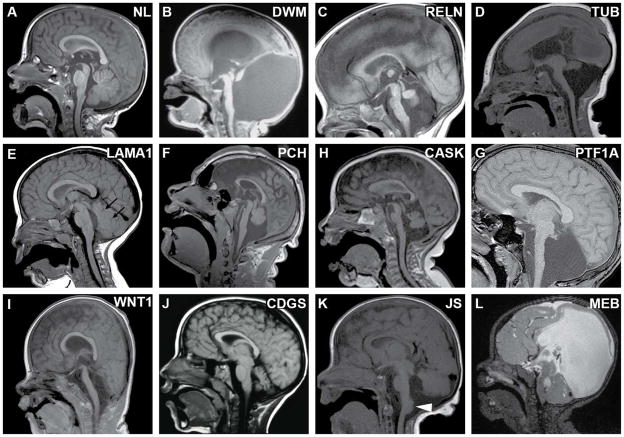
Sagittal views of cerebellar malformations with known genetic causes. (A) Unaffected individual for comparison. (B) Dandy–Walker malformation (unknown cause) with hypoplastic, rotated vermis and marked enlargement of 4th ventricle and posterior fossa. (C) Cerebellar hypoplasia in a patient with biallelic RELN mutations, demonstrating hypoplastic brainstem and characteristic absent folia of the vermis; note the normal tectum. (D) Tubulinopathy (TUBA1A mutation) with brainstem hypoplasia, vermis hypoplasia, lissencephaly and microcephaly; note the large, dysplastic tectum. (E) Mild cerebellar vermis hypoplasia, abnormal 4th ventricle shape, and small cysts (arrows) in a patient with biallelic LAMA1 mutations. (F) Pontocerebellarhyplasia (PCH) (homozygous TSEN54 mutation) with hypoplastic brainstem and vermis (which is less affected than hemispheres); note the normal tectum. (G) PCH in a patient with congenital diabetes; note the extremely small vermis and flat pons with preserved tectum. (H) CASK-related PCH; note that the pons is not severely affected in this patient. (I) Cerebellar agenesis, with severe pontine and midbrain hypoplasia in a severely affected patient with biallelic WNT1 mutations. (J) Congenital disorder of glycosylation Type 1a due to biallelic PMM2 mutations. (K) TCTN2-related Joubert syndrome with vermis hypoplasia (obscured by hemispheres in this image), horizontal superior cerebellar peduncles, large dysplastic tectum and heterotopia at the dorsal cervicomedullary junction (arrowhead). (L) Muscle–eye–brain disease due to POMGNT1 mutations; note the markedly hypoplastic and dysplastic brainstem, cerebellar cysts, abnormal tectum, and hydrocephalus. Adapted with permission from Doherty et al. [12], except for panel (I) which is from Aldinger et al. [40].
Fig. 3
Fig. 3
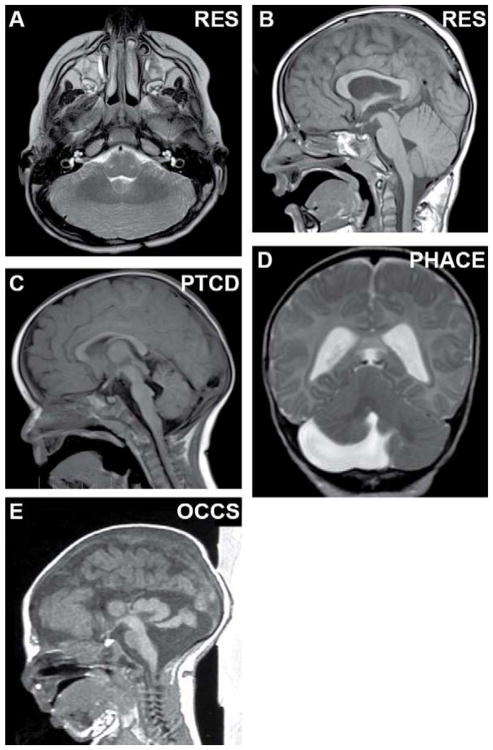
Cerebellar malformations without known genetic causes. (A, B) Axial and sagittal views of rhombencephalosynapsis with absent vermis, fusion of the hemispheres, and lack of vermis morphology on sagittal view. (C) Sagittal view of pontine tegmental cap dysplasia with dorsal “cap”, absence of the ventral pons and mild vermis hypoplasia. (D) Coronal view of unilateral cerebellar hypoplasia in PHACE syndrome (Posterior fossa malformations, Hemangioma, Arterial anomalies, Cardiac defects and Eye anomalies). (E) Sagittal view of massively enlarged tectum and vermis hypoplasia with preserved pons in oculocerebrocutaneous syndrome. (B, C) Adapted with permission from Doherty et al. [12].

References

    1. Long A, Moran P, Robson S. Outcome of fetal cerebral posterior fossa anomalies. Prenat Diagn. 2006;26:707–10. - PubMed
    1. Hirsch J-F, Pierre-Kahn A, Renier D, Sainte-Rose C, Hoppe-Hirsch E. The Dandy–Walker malformation: a review of 40 cases. J Neurosurg. 1984;61:515–22. - PubMed
    1. Osenbach RK, Menezes AH. Diagnosis and management of the Dandy–Walker malformation: 30 years of experience. Pediatr Neurosurg. 1992;18:179–89. - PubMed
    1. Murray JC, Johnson JA, Bird TD. Dandy–Walker malformation: etiologic heterogeneity and empiric recurrence risks. Clin Genet. 1985;28:272–83. - PubMed
    1. Grinberg I, Northrup H, Ardinger H, Prasad C, Dobyns WB, Millen KJ. Heterozygous deletion of the linked genes ZIC1 and ZIC4 is involved in Dandy–Walker malformation. Nat Genet. 2004;36:1053–5. - PubMed