


Preliminary Data: An Adapted Hospital Elder Life Program to Prevent Delirium and Reduce Complications of Acute Illness in Long-Term Care Delivered by Certified Nursing Assistants
- PMID: 27160212
- PMCID: PMC4882219
- DOI: 10.1111/jgs.14091
Preliminary Data: An Adapted Hospital Elder Life Program to Prevent Delirium and Reduce Complications of Acute Illness in Long-Term Care Delivered by Certified Nursing Assistants
Abstract
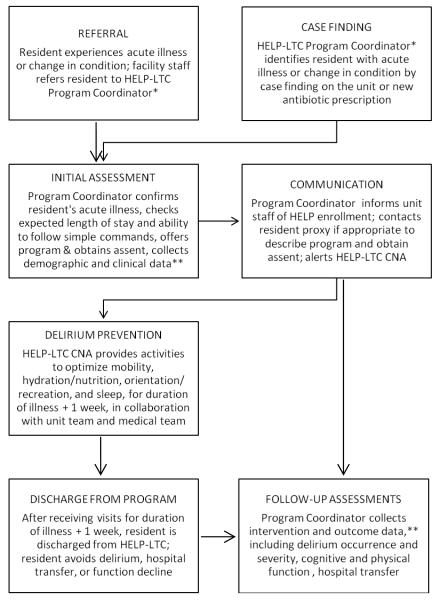
Nursing home (NH) residents have a high prevalence of delirium risk factors, experience two to four acute medical conditions (e.g., infections) each year, and have an incidence of delirium during these conditions similar to that of hospitalized older adults. Many NH residents with delirium do not return to their prior level of cognitive function. They are more likely to die, be hospitalized, and less likely to be discharged home than those without delirium. Research on the prevention or treatment of delirium in NHs is limited. This article describes the development and pilot testing of a multicomponent delirium prevention intervention in the NH setting adapted from the Hospital Elder Life Program (HELP-LTC). Activities to reduce the risk of delirium that were appropriate for functionally impaired NH residents were developed and delivered during treatment for and recovery from acute illness, a novel resident-targeting approach. Expertly trained certified nursing assistants (CNAs - a total of 1.4 full-time equivalent (FTE) positions-) visited residents throughout the facility and delivered the activities. The current study reports on incident delirium, delirium remission, cognitive and physical function change, hospitalization, and death associated with acute medical conditions as ascertained by a program coordinator. The integration and acceptance of the CNAs' activities by residents and staff are also reported on. Hospitalization and death were ascertained in a nonintervention comparison group. Findings support a test of the intervention in a controlled trial. The potential effect is great; there are approximately 1.4 million NH residents in the United States and an estimated 1 million with dementia or cognitive impairment, an important delirium risk factor. An intervention would be broadly adoptable if a reduction in healthcare costs through prevention of hospitalization offset the cost of the program's CNAs.
Keywords: delirium; intervention; nosocomial infection; nursing homes.
© 2016, Copyright the Authors Journal compilation © 2016, The American Geriatrics Society.
Figures
References
-
- Alessi CA, Harker JO. A prospective study of acute illness in the nursing home. Aging (Milano) 1998;10:479–489. - PubMed
-
- Boockvar KS, Gruber-Baldini AL, Burton L, et al. Outcomes of infection in nursing home residents with and without early hospital transfer. J Am Geriatr Soc. 2005;53:590–596. - PubMed
-
- Inouye SK, Charpentier PA. Precipitating factors for delirium in hospitalized elderly persons. Predictive model and interrelationship with baseline vulnerability. JAMA. 1996;275:852–857. - PubMed
-
- Kiely DK, Bergmann MA, Murphy KM, et al. Delirium among newly admitted postacute facility patients: Prevalence, symptoms, and severity. J Gerontol A Biol Sci Med Sci. 2003;58:M441–445. - PubMed
-
- Boockvar K, Signor D, Ramaswamy R, et al. Delirium during acute illness in nursing home residents. J Am Med Dir Assoc. 2013;14:656–660. - PubMed
Publication types
MeSH terms
Grants and funding
LinkOut - more resources
Full Text Sources
Other Literature Sources
Medical
