. 2016 Apr 28;20(1):142.
doi: 10.1186/s13054-016-1290-9.

Do spontaneous and mechanical breathing have similar effects on average transpulmonary and alveolar pressure? A clinical crossover study

Affiliations

Do spontaneous and mechanical breathing have similar effects on average transpulmonary and alveolar pressure? A clinical crossover study

Giacomo Bellani et al. Crit Care. .

Abstract

Background: Preservation of spontaneous breathing (SB) is sometimes debated because it has potentially both negative and positive effects on lung injury in comparison with fully controlled mechanical ventilation (CMV). We wanted (1) to verify in mechanically ventilated patients if the change in transpulmonary pressure was similar between pressure support ventilation (PSV) and CMV for a similar tidal volume, (2) to estimate the influence of SB on alveolar pressure (Palv), and (3) to determine whether a reliable plateau pressure could be measured during pressure support ventilation (PSV).

Methods: We studied ten patients equipped with esophageal catheters undergoing three levels of PSV followed by a phase of CMV. For each condition, we calculated the maximal and mean transpulmonary (ΔPL) swings and Palv.

Results: Overall, ΔPL was similar between CMV and PSV, but only loosely correlated. The differences in ΔPL between CMV and PSV were explained largely by different inspiratory flows, indicating that the resistive pressure drop caused this difference. By contrast, the Palv profile was very different between CMV and SB; SB led to progressively more negative Palv during inspiration, and Palv became lower than the set positive end-expiratory pressure in nine of ten patients at low PSV. Finally, inspiratory occlusion holds performed during PSV led to plateau and Δ PL pressures comparable with those measured during CMV.

Conclusions: Under similar conditions of flow and volume, transpulmonary pressure change is similar between CMV and PSV. SB during mechanical ventilation can cause remarkably negative swings in Palv, a mechanism by which SB might potentially induce lung injury.

Keywords: Controlled ventilation; Esophageal pressure; Mechanical ventilation; Pressure support ventilation; Transpulmonary pressure.


Figures
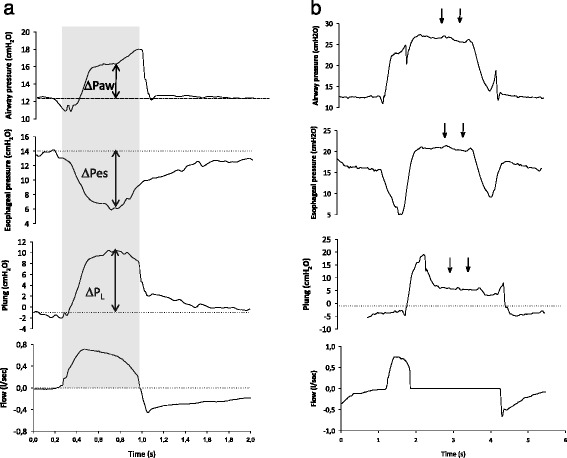
Fig. 1
Fig. 1
Individual examples of airway and esophageal pressure tracings of pressure support breaths sampled during regular tidal ventilation (a) and one prolonged inspiratory hold (b). a For each selected breath, from the airway (ΔPaw) and esophageal (ΔPes) pressure swings we calculated the transpulmonary lung pressure (Plung) swings (ΔPL) as changes from the end expiration (dotted lines) at two time points of interest: the point of maximum ΔPL and the mean over inspiration (gray rectangular area). b Following an inspiratory hold, when the patient relaxes the inspiratory muscles, a plateau is seen in airway and esophageal pressure (arrows), whose differences from the end-expiratory level represent the elastic recoil pressure of the respiratory system and of the chest wall, respectively
Fig. 2
Fig. 2
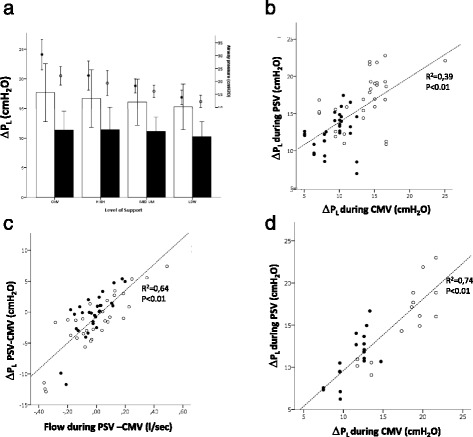
a Pressures (transpulmonary pressure swings [ΔPL] on the left, shown as bars and standard deviation), versus the level of support (high, medium, or low). It shows that, by contrast with airway pressure, ΔPL swings during inspiration were similar and not statistically different between controlled mechanical ventilation (CMV) and any of the support levels. Closed symbols represent mean values during inspiration, and open symbols show maximum values during inspiration. The correlation between the value recorded during CMV and pressure support ventilation (PSV), albeit significant, was poor (b). The difference between the measurement of ΔPL obtained during CMV and PSV was explained largely by the corresponding difference in the inspiratory flow (c), as shown by the highly significant correlation. Indeed, when the analysis was restricted to the breaths with similar inspiratory flows (i.e., with an absolute difference less than 0.1 L/minute) (d), the correlation of ΔPL obtained during CMV and PSV became very tight
Fig. 3
Fig. 3
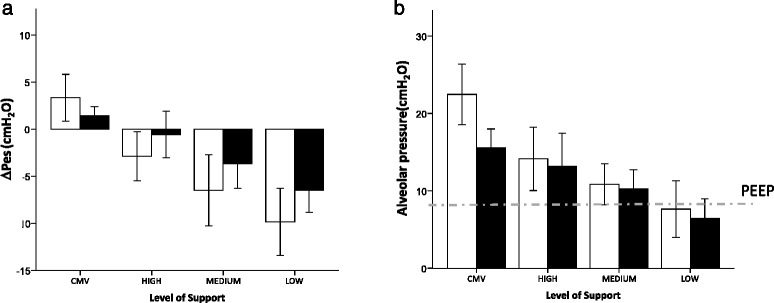
The swings of esophageal pressure (ΔPes) from baseline (a), shown as mean and standard deviation, were positive during controlled mechanical ventilation (CMV) but became negative during pressure support ventilation and progressively lower for decreasing levels of support (high, medium, and low). This was the case when we considered both the mean values during inspiration (closed bars) and at the moment of maximum transpulmonary pressure (open bars). Similarly, alveolar pressure (Palv) (b), shown as bars and standard deviation, progressively decreased from CMV through the different levels of pressure support ventilation (high, medium, and low). Moreover, Palv was, on average, lower than the set positive end-expiratory pressure (PEEP) (dashed line), both as a mean during inspiration (closed bars) and at the moment of maximum transpulmonary pressure (open bars), if a low level of support was applied
Fig. 4
Fig. 4
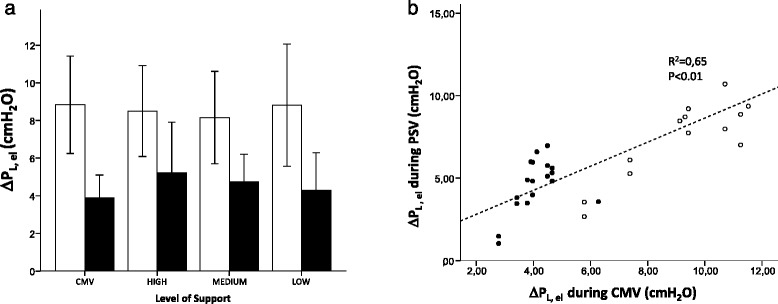
The transalveolar pressure (i.e. the pressure distending the alveoli), which is caused by the elastic recoil of the lungs (ΔPL,el), was similar and nonsignificantly different between controlled mechanical ventilation (CMV) and any of the support levels of pressure support ventilation (high, medium, and low), either as a mean value (open symbols) or as a maximum value (closed symbols), during inspiration (a), shown as mean and standard deviation. The values measured during pressure support ventilation (PSV) and CMV were very closely correlated and close to the line of identity (dashed line), as shown in (b) (analysis restricted to breaths with similar inspiratory flow)
Fig. 5
Fig. 5
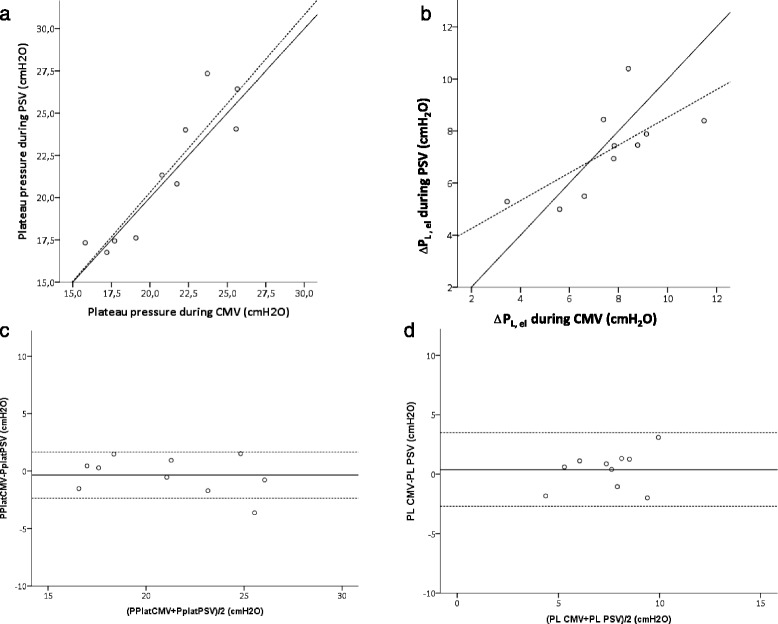
Tight correlation (solid line, very close to the identity, represented by the dashed line) was found between the values obtained during an inspiratory hold obtained while under controlled mechanical ventilation (CMV) and pressure support ventilation (PSV) for plateau airway pressure (Pplat) in the airways (a), static transpulmonary pressure (ΔPL,el) (b), and the respective Bland-Altman analyses (c and d), showing mean bias (solid line) and 95 % confidence intervals (dotted lines)

References

    1. Marini JJ. Spontaneously regulated vs. controlled ventilation of acute lung injury/acute respiratory distress syndrome. Curr Opin Crit Care. 2011;17(1):24–9. doi: 10.1097/MCC.0b013e328342726e. - DOI - PubMed
    1. Yoshida T, Papazian L. When to promote spontaneous respiratory activity in acute respiratory distress patients? Anesthesiology. 2014;120(6):1313–5. doi: 10.1097/ALN.0000000000000260. - DOI - PubMed
    1. Hraiech S, Yoshida T, Papazian L. Balancing neuromuscular blockade versus preserved muscle activity. Curr Opin Crit Care. 2015;21(1):26–33. doi: 10.1097/MCC.0000000000000175. - DOI - PubMed
    1. Dreyfuss D, Soler P, Basset G, Saumon G. High inflation pressure pulmonary edema: respective effects of high airway pressure, high tidal volume, and positive end-expiratory pressure. Am Rev Respir Dis. 1988;137(5):1159–64. doi: 10.1164/ajrccm/137.5.1159. - DOI - PubMed
    1. Engelberts D, Malhotra A, Butler JP, Topulos GP, Loring SH, Kavanagh BP. Relative effects of negative versus positive pressure ventilation depend on applied conditions. Intensive Care Med. 2012;38(5):879–85. doi: 10.1007/s00134-012-2512-5. - DOI - PMC - PubMed

Publication types