


Constructing Causal Diagrams for Common Perinatal Outcomes: Benefits, Limitations and Motivating Examples with Maternal Antidepressant Use in Pregnancy
- PMID: 27160789
- PMCID: PMC4970924
- DOI: 10.1111/ppe.12302
Constructing Causal Diagrams for Common Perinatal Outcomes: Benefits, Limitations and Motivating Examples with Maternal Antidepressant Use in Pregnancy
Abstract
Background: Covariate selection to reduce bias in observational data analysis has primarily relied upon statistical criteria to guide researchers. This approach may lead researchers to condition on variables that ultimately increase bias in the effect estimates. The use of directed acyclic graphs (DAGs) aids researchers in constructing thoughtful models based on hypothesised biologic mechanisms to produce the least biased effect estimates possible.
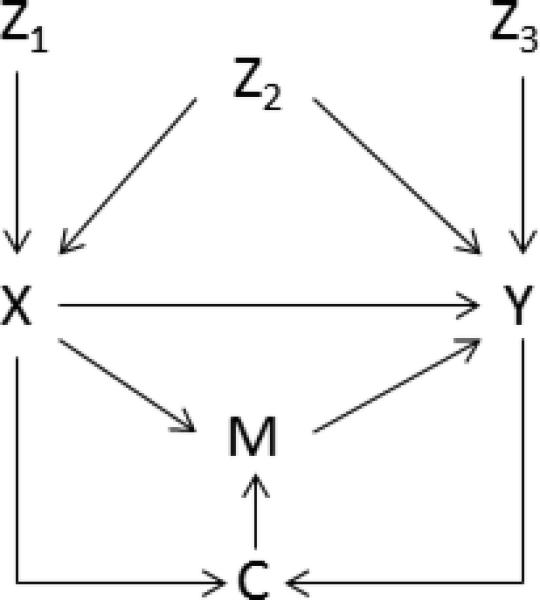
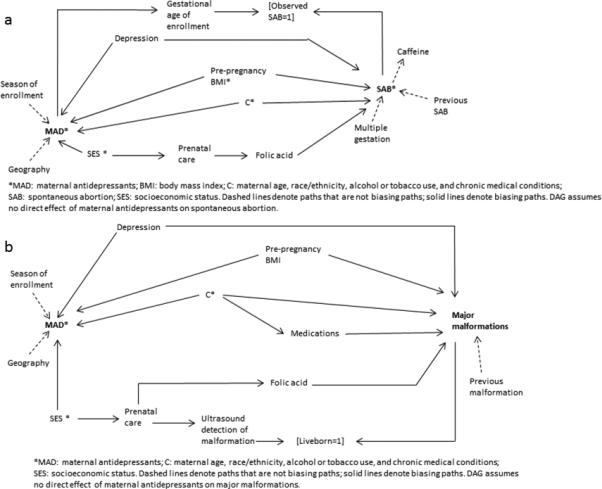
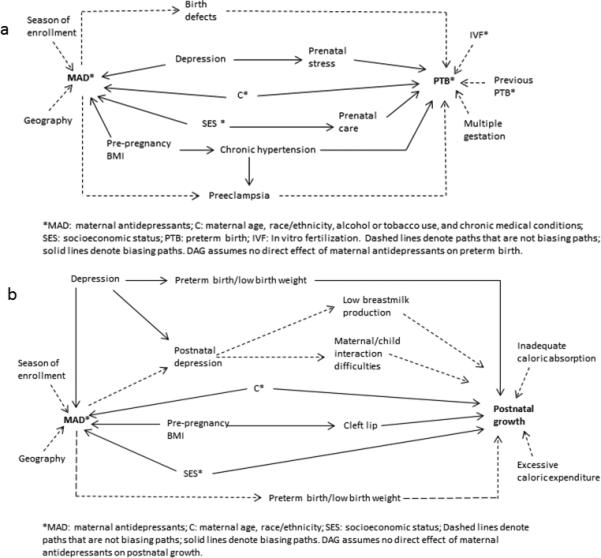
Methods: After providing an overview of different relations in DAGs and the prevailing mechanisms by which conditioning on variables increases or reduces bias in a model, we illustrate examples of DAGs for maternal antidepressants in pregnancy and four separate perinatal outcomes.
Results: By comparing and contrasting the diagrams for maternal antidepressant use in pregnancy and spontaneous abortion, major malformations, preterm birth, and postnatal growth, we illustrate the different conditioning sets required for each model. Moreover, we illustrate why it is not appropriate to condition on the same set of covariates for the same exposure and different perinatal outcomes. We further discuss potential selection biases, overadjustment of mediators on the causal path, and sufficient sets of conditioning variables.
Conclusion: In our efforts to construct parsimonious models that minimise confounding and selection biases, we must rely upon our scientific knowledge of the causal mechanism. By structuring data collection and analysis around hypothesised DAGs, we ultimately aim to validly estimate the causal effect of interest.
Keywords: causal inference; directed acyclic graphs; perinatal epidemiology.
© 2016 John Wiley & Sons Ltd.
Figures
References
-
- Robins JM. Data, Design, and Background Knowledge in Etiologic Inference. Epidemiology. 2015;12(3):313–320. - PubMed
-
- Hernán M a., Hernández-Diaz S, Werler MM, Mitchell A a. Causal knowledge as a prerequisite for confounding evaluation: An application to birth defects epidemiology. Am J Epidemiol. 2002;155(2):176–184. doi:10.1093/aje/155.2.176. - PubMed
-
- Halsey LG, Curran-Everett D, Vowler SL, Drummond GB. The fickle P value generates irreproducible results. Nat Methods. 2015;12(3):179–185. doi:10.1038/nmeth.3288. - PubMed
Publication types
MeSH terms
Substances
Grants and funding
LinkOut - more resources
Full Text Sources
Other Literature Sources
Medical
