


Review
doi: 10.1038/mto.2016.6.
eCollection 2016.
Chimeric antigen receptor T-cell therapy for solid tumors
Affiliations
- PMID: 27162934
- PMCID: PMC4849432
- DOI: 10.1038/mto.2016.6
Item in Clipboard
Review
Chimeric antigen receptor T-cell therapy for solid tumors
Mol Ther Oncolytics.
.
Abstract
Chimeric antigen receptor (CAR) T cells are engineered constructs composed of synthetic receptors that direct T cells to surface antigens for subsequent elimination. Many CAR constructs are also manufactured with elements that augment T-cell persistence and activity. To date, CAR T cells have demonstrated tremendous success in eradicating hematological malignancies (e.g., CD19 CARs in leukemias). This success is not yet extrapolated to solid tumors, and the reasons for this are being actively investigated. Here in this mini-review, we discuss some of the key hurdles encountered by CAR T cells in the solid tumor microenvironment.
Figures
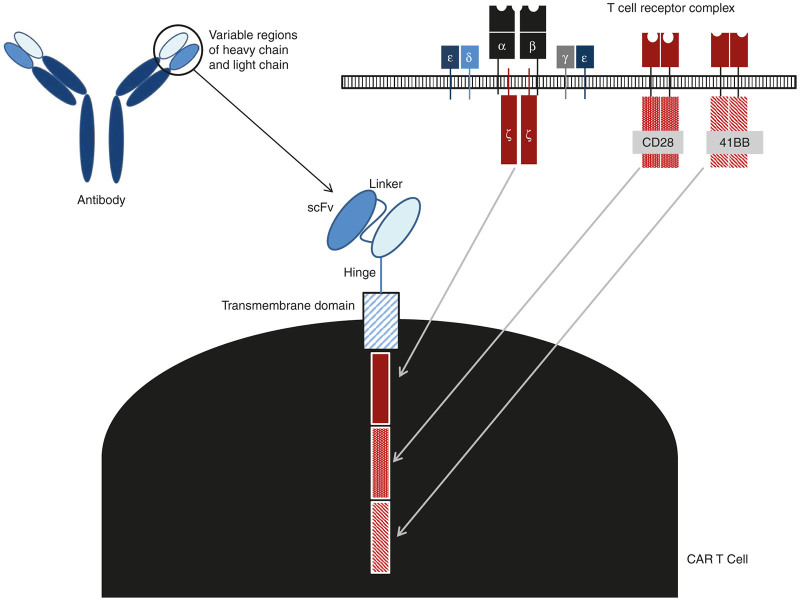
Building blocks of chimeric antigen receptor (CAR) T cell. The single chain (scFv) targeting moiety is taken from the antigen-binding domain of antibodies, fused to the CD3ζ transmembrane and intracellular signaling domains from the T-cell receptor complex; this is the first-generation CAR. Later, additional intracellular signaling domains were added for costimulatory signals, such as the CD28 and 41BB signaling domains, to yield second- and third-generation CARs.
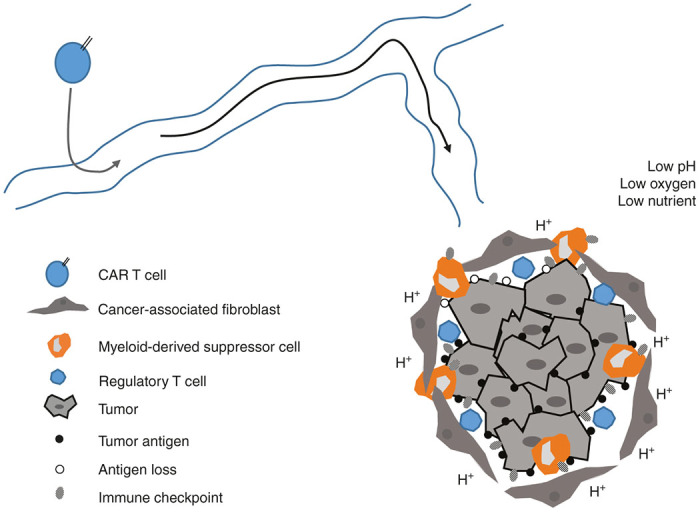
Immunosuppressive tumor microenvironment. This diagram represents a simplified schema of the negative elements that barrage activated chimeric antigen receptor T cells as they navigate through the tumor landscape, thereby inactivating them. These barriers in solid tumors rapidly neutralize the antitumor effect.
References
-
- Willemsen, RA, Debets, R, Hart, E, Hoogenboom, HR, Bolhuis, RL and Chames, P (2001). A phage display selected fab fragment with MHC class I-restricted specificity for MAGE-A1 allows for retargeting of primary human T lymphocytes. Gene Ther 8: 1601–1608. - PubMed
-
- Gill, S, Maus, MV and Porter, DL (2015). Chimeric antigen receptor T cell therapy: 25 years in the making. Blood Rev (Epub ahead of print). - PubMed
Publication types
Grants and funding
LinkOut - more resources
Full Text Sources
Other Literature Sources
