


Effect of Pioglitazone in Preventing In-Stent Restenosis after Percutaneous Coronary Intervention in Patients with Type 2 Diabetes: A Meta-Analysis
- PMID: 27163676
- PMCID: PMC4862640
- DOI: 10.1371/journal.pone.0155273
Effect of Pioglitazone in Preventing In-Stent Restenosis after Percutaneous Coronary Intervention in Patients with Type 2 Diabetes: A Meta-Analysis
Abstract
Background: The benefits of pioglitazone in patients with type 2 diabetes mellitus (T2DM) after percutaneous coronary intervention (PCI) is unclear.
Objectives: To evaluate the effect of pioglitazone on prevention of in-stent restenosis (ISR) in patients with T2DM after PCI.
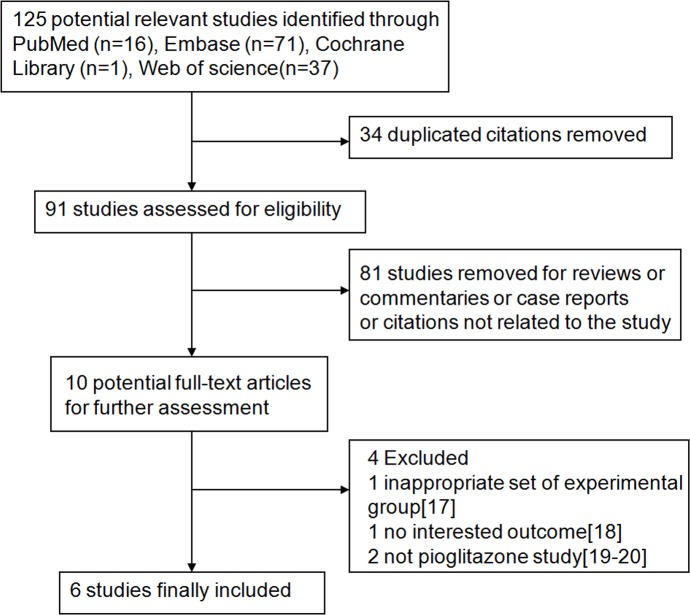
Methods: All full-text published relevant studies compared the effect of pioglitazone with control group (placebo or no pioglitazone treatment) on ISR in patients with T2DM after PCI were identified by searching the databases including PubMed, EMBASE, Cochrane Library and ISI Web of Science through October 2015. The endpoints were defined as the rate of ISR, late lumen loss, in-stent neointimal volume, target lesion revascularization (TLR) and major adverse cardiac events (MACE).
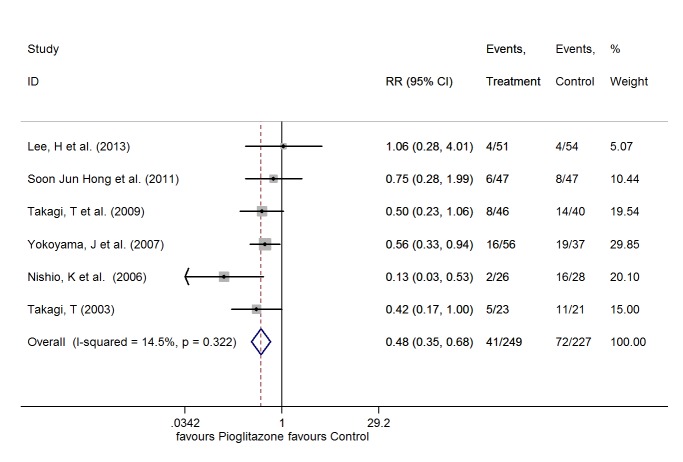
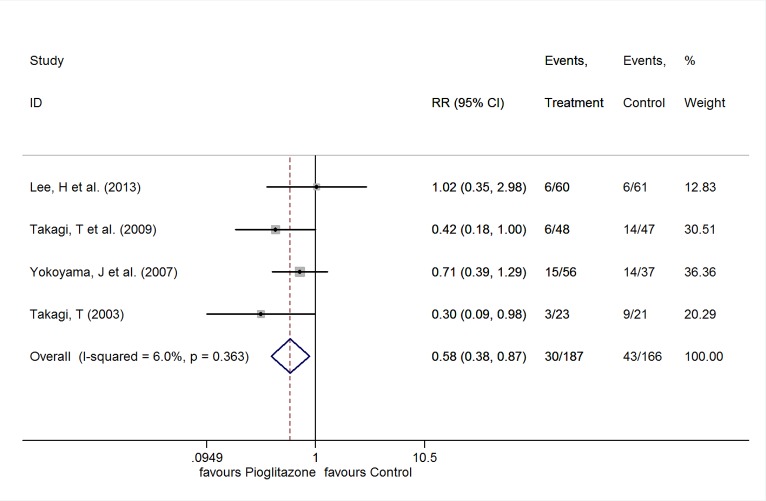
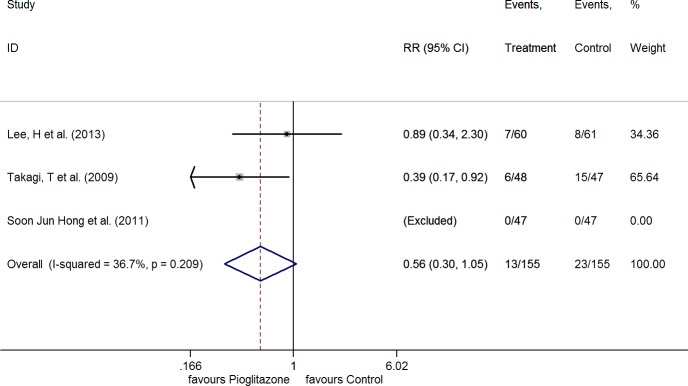
Results: Six studies (5 RCTs and 1 retrospective study), comprising 503 patients, were included into this meta-analysis. In the pioglitazone group, as compared with the control group, the risk ratio for ISR was 0.48 (I2 = 14.5%, P = 0.322; 95%CI 0.35 to 0.68, P<0.001), the risk ratio for TLR was 0.58 (I2 = 6.0%, P = 0.363; 95%CI 0.38 to 0.87, P = 0.009). The result showed there was no association between the use of pioglitazone and the events of MACE (I2 = 36.7%, P = 0.209; RR 0.56, 95%CI 0.30 to 1.05, P = 0.071). For the considerable heterogeneity, further analysis was not suitable for the endpoints of late lumen loss (I2 = 81.9%, P<0.001) and neointimal volume (I2 = 75.9%, P = 0.016).
Conclusions: The treatment of pioglitazone was associated with a reduction in ISR and TLR in T2DM patients suffering from PCI, except the incidence of MACE.
Conflict of interest statement
Figures
References
-
- Silva JA, Ramee SR, White CJ, Collins TJ, Jenkins JS, Nunez E, et al. Primary stenting in acute myocardial infarction: influence of diabetes mellitus in angiographic results and clinical outcome. Am Heart J. 1999; 138: 446–455. - PubMed
-
- Joner M, Farb A, Cheng Q, Finn AV, Acampado E, Burke AP, et al. Pioglitazone inhibits in-stent restenosis in atherosclerotic rabbits by targeting transforming growth factor-beta and MCP-1. Arterioscler Thromb Vasc Biol. 2007; 27: 182–189. - PubMed
-
- Kasai T, Miyauchi K, Yokoyama T, Kajimoto K, Sumiyoshi K, Kubota N, et al. Pioglitazone attenuates neointimal thickening via suppression of the early inflammatory response in a porcine coronary after stenting. Atherosclerosis. 2008; 197: 612–619. - PubMed
-
- Okura H, Takagi T, Yoshida K. Therapies Targeting Inflammation After Stent Implantation.Curr Vasc Pharmacol. 2013; 11: 399–406. - PubMed
Publication types
MeSH terms
Substances
LinkOut - more resources
Full Text Sources
Other Literature Sources
Medical
Miscellaneous
