


Declining malaria transmission in rural Amazon: changing epidemiology and challenges to achieve elimination
- PMID: 27165432
- PMCID: PMC4863332
- DOI: 10.1186/s12936-016-1326-2
Declining malaria transmission in rural Amazon: changing epidemiology and challenges to achieve elimination
Abstract
Background: In recent years, considerable success in reducing its incidence has been achieved in Brazil, leading to a relative increase in the proportion of cases caused by Plasmodium vivax, considered a harder-to-eliminate parasite. This study aim is to describe the transmission dynamics and associated risk factors in a rural settlement area in the Western Brazilian Amazon.
Methods: A prospective cohort was established in a rural settlement area for 3 years. Follow-up included continuous passive case detection and monthly active case detection for a period of 6 months. Demographic, clinical and transmission control practices data were collected. Malaria diagnosis was performed through thick blood smear. Univariable and multivariable analyses of factors associated with malaria incidence were performed using negative binomial regression models. Factors associated with recurrence of P. vivax and Plasmodium falciparum malaria within 90 days of a previous episode were analysed using univariable and multivariable Cox-Proportional Hazard models.
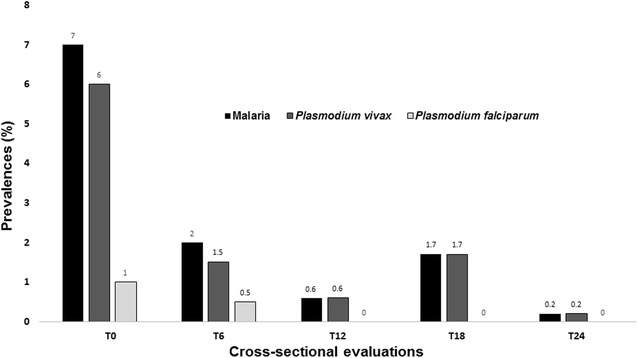
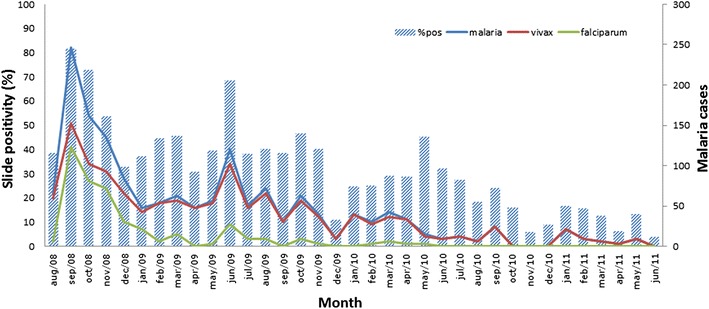
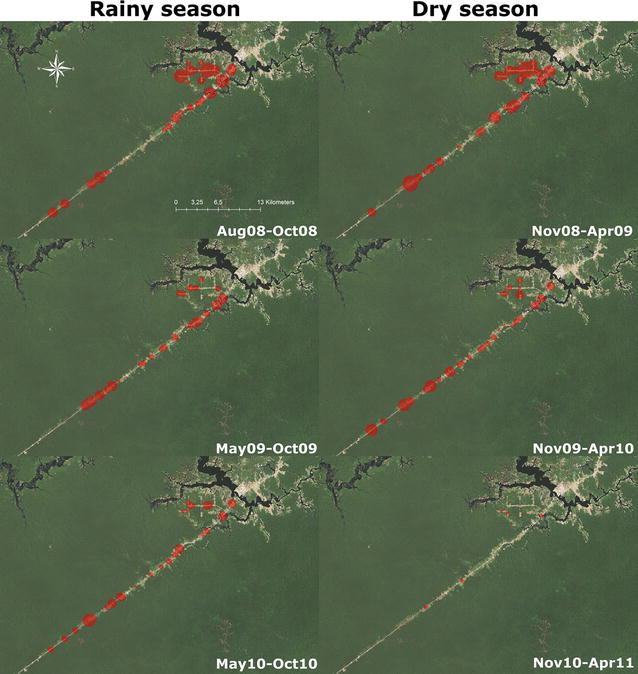
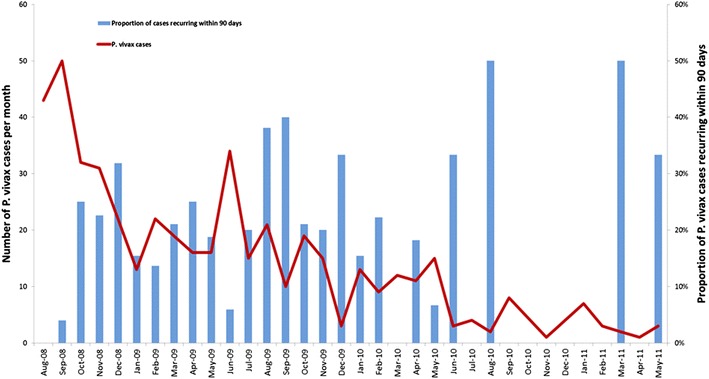
Results: Malaria prevalence decreased from 7 % at the study beginning to 0.6 % at month 24, with P. vivax predominating and P. falciparum disappearing after 1 year of follow-up. Malaria incidence was significantly higher in the dry season [IRR (95 % CI) 1.4 (1.1-1.6); p < 0.001)]. Use of ITN was associated to malaria protection in the localities [IRR (95 % CI) 0.7 (0.6-0.8); p = 0.001)]. A recurrent P. vivax episode within 90 days was observed in 29.4 % of individuals after an initial diagnosis. A previous P. vivax [IRR (95 % CI) 2.3 (1.3-4.0); p = 0.006)] or mixed P. vivax + P. falciparum [IRR (95 % CI) 2.9 (1.5-5.7); p = 0.002)] infections were significantly associated to a vivax malaria episode within 90 days of follow-up.
Conclusions: In an area of P. falciparum and P. vivax co-endemicity, a virtual disappearance of P. falciparum was observed with P. vivax increasing its relative contribution, with a large proportion of recurring episodes. This finding reinforces the perception of P. falciparum being more responsive to early diagnosis and treatment and ITN use and the contribution of relapsing P. vivax to maintain this species' transmission. In areas of P. vivax endemicity, antihypnozoite treatment effectiveness assessment in different transmission intensity may be a fundamental activity for malaria control and elimination.
Keywords: Amazon; Elimination; Health Surveillance; Malaria; Plasmodium falciparum; Plasmodium vivax.
Figures


References
-
- WHO . World malaria report 2014. Geneva, Switzerland: World Health Organization; 2014.
-
- WHO. Malaria—Overview of malaria elimination. Geneva: World Health Organization; 2015. http://www.who.int/malaria/areas/elimination/overview/en/.
-
- Pan American HealthOrganization . Situation of malaria in the region of the Americas, 2000–2013. Geneva: World Health Organization; 2014.
Publication types
MeSH terms
LinkOut - more resources
Full Text Sources
Other Literature Sources
Medical
