Review
. 2016 May 10;110(9):1924-32.
doi: 10.1016/j.bpj.2016.03.030.

Meandering Down the Energy Landscape of Protein Folding: Are We There Yet?

Affiliations
Review

Meandering Down the Energy Landscape of Protein Folding: Are We There Yet?

Rachel M Abaskharon et al. Biophys J. .

Abstract

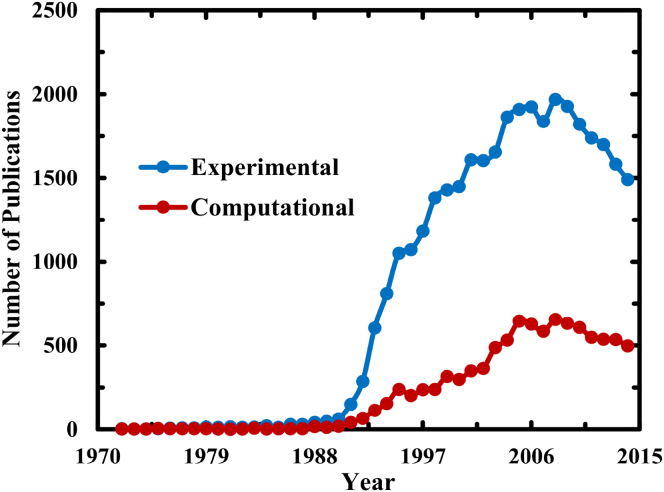
As judged by a single publication metric, the activity in the protein folding field has been declining over the past 5 years, after enjoying a decade-long growth. Does this development indicate that the field is sunsetting or is this decline only temporary? Upon surveying a small territory of its landscape, we find that the protein folding field is still quite active and many important findings have emerged from recent experimental studies. However, it is also clear that only continued development of new techniques and methods, especially those enabling dissection of the fine details and features of the protein folding energy landscape, will fuel this old field to move forward.


Figures

Figure 1
Figure 1
Plot of the number of computational and experimental protein folding articles found on the ISI Web of Science database per year. The number of computational articles per year was produced by using the search, “protein folding” and (comput or simulat or theor), whereas the number of experimental articles per year was obtained by subtracting this value from that of the search using protein folding. To see this figure in color, go online.
Figure 2
Figure 2
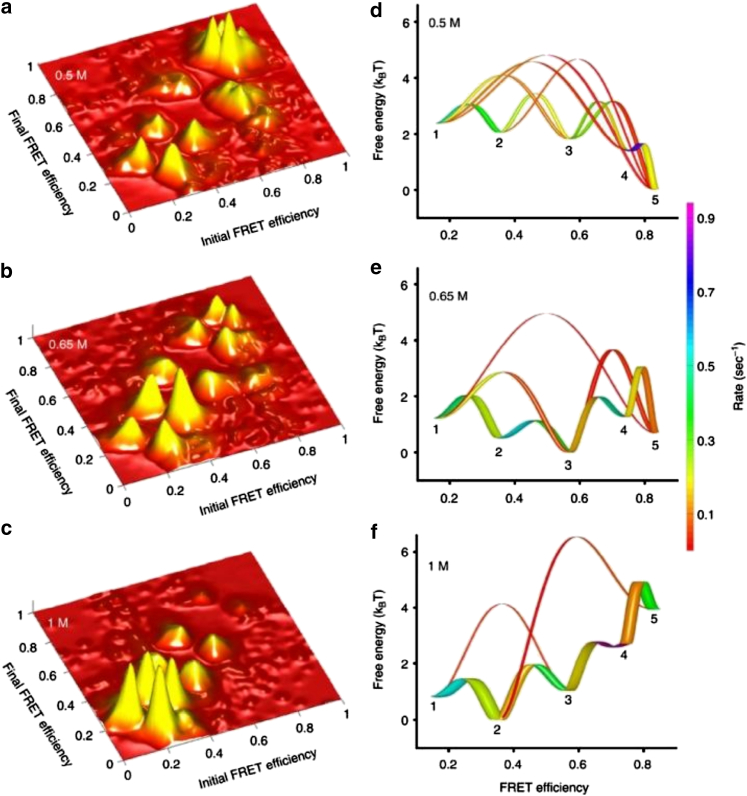
(ac) Two-dimensional transition maps of the adenylate kinase protein at three different GdmCl concentrations, as indicated. (df) One-dimensional free energy maps of adenylate kinase showing five of the six metastable states as well as the transitions between them that contain at least 10% of the flux from beginning to end (or vice versa). The color bar indicates the rate of flux, whereas the line widths show the relative productive flux along each pathway. This figure is adapted from (26) with permission. To see this figure in color, go online.
Figure 3
Figure 3
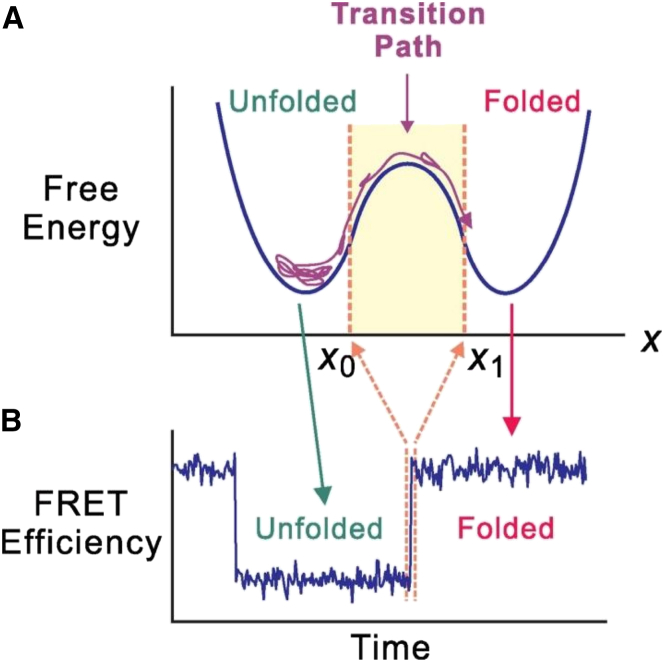
(A) Representation of a one-dimensional free energy diagram for a two-state folding protein indicating the transition path region. (B) Sample FRET efficiency trajectory with the width of the highlighted jump region being the transition-path time. This figure is adapted from (29) with permission. To see this figure in color, go online.
Figure 4
Figure 4
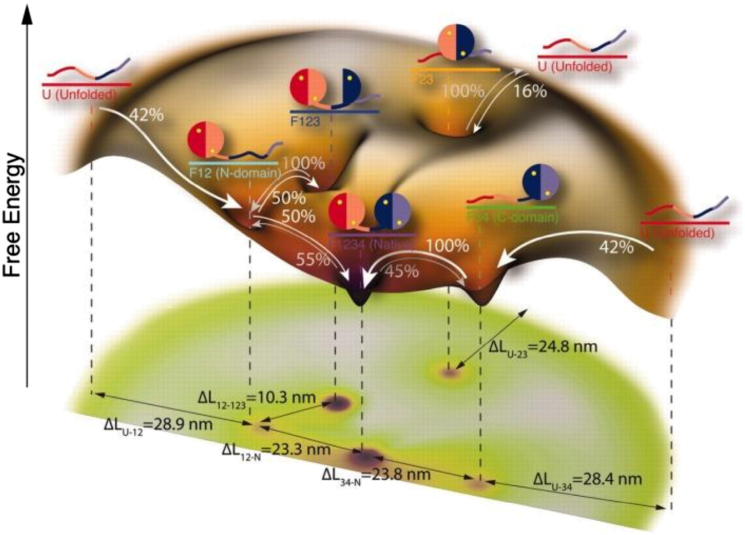
Schematic of the free energy diagram of the calmodulin protein with arrows indicating the observed transitions and the percentages giving the fraction of transitions along each pathway at zero force. Distances are differences in the contour length of calmodulin, and the cartoon representations of the protein highlight the regions of calmodulin that are folded at each state. This figure is adapted from (35) with permission. To see this figure in color, go online.
Figure 5
Figure 5
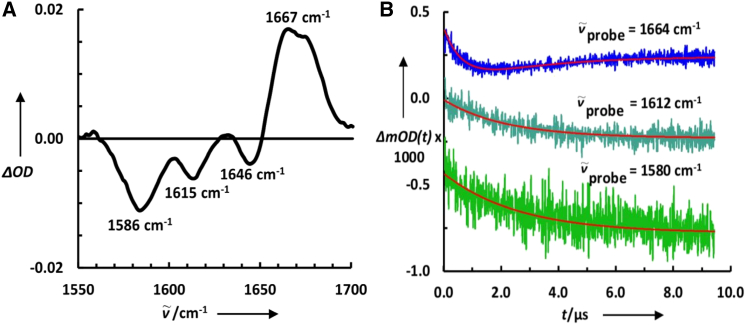
(A) FTIR temperature difference spectrum (65°C−25°C) of 13C-labeled Trp-Cage 10b. (B) Conformational relaxation kinetics of 13C-labeled Trp-Cage 10b, probed at the frequencies indicated, in response to a temperature jump from 5°C to 10°C. Smooth lines are fits of these data to either single exponential (1580 cm−1 and 1612 cm−1) or double exponential (1664 cm−1) functions. The traces are offset for clarity. This figure is adapted from (62) with permission. To see this figure in color, go online.

References

    1. Anfinsen C.B., Haber E., White F.H., Jr. The kinetics of formation of native ribonuclease during oxidation of the reduced polypeptide chain. Proc. Natl. Acad. Sci. USA. 1961;47:1309–1314. - PMC - PubMed
    1. Levinthal C. Are there pathways for protein folding. J. Chim. Phys. Physico-Chemie Biol. 1968;65:44–45.
    1. Bryngelson J.D., Onuchic J.N., Wolynes P.G. Funnels, pathways, and the energy landscape of protein folding: a synthesis. Proteins. 1995;21:167–195. - PubMed
    1. Dill K.A., Chan H.S. From Levinthal to pathways to funnels. Nat. Struct. Biol. 1997;4:10–19. - PubMed
    1. Matouschek A., Kellis J.T., Jr., Fersht A.R. Mapping the transition state and pathway of protein folding by protein engineering. Nature. 1989;340:122–126. - PubMed

Publication types