


Quantitative evaluation of patient setup uncertainty of stereotactic radiotherapy with the frameless 6D ExacTrac system using statistical modeling
- PMID: 27167267
- PMCID: PMC5690915
- DOI: 10.1120/jacmp.v17i3.5959
Quantitative evaluation of patient setup uncertainty of stereotactic radiotherapy with the frameless 6D ExacTrac system using statistical modeling
Abstract
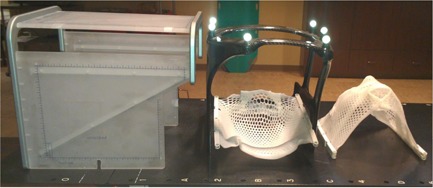
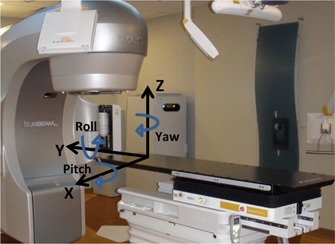
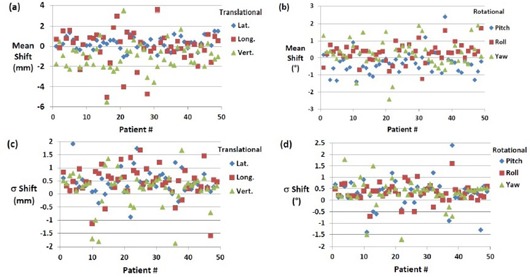
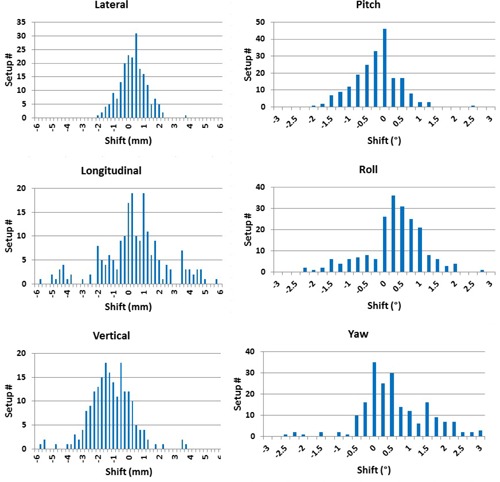
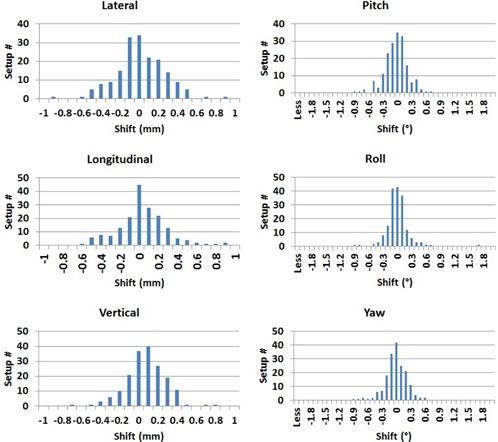
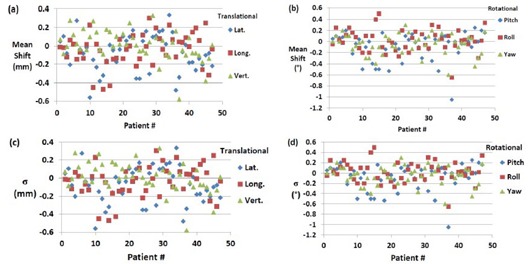
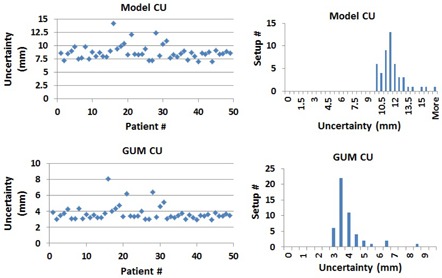
The purpose of this study is to evaluate patient setup accuracy and quantify indi-vidual and cumulative positioning uncertainties associated with different hardware and software components of the stereotactic radiotherapy (SRS/SRT) with the frameless 6D ExacTrac system. A statistical model is used to evaluate positioning uncertainties of the different components of SRS/SRT treatment with the Brainlab 6D ExacTrac system using the positioning shifts of 35 patients having cranial lesions. All these patients are immobilized with rigid head-and-neck masks, simu-lated with Brainlab localizer and planned with iPlan treatment planning system. Stereoscopic X-ray images (XC) are acquired and registered to corresponding digitally reconstructed radiographs using bony-anatomy matching to calculate 6D translational and rotational shifts. When the shifts are within tolerance (0.7 mm and 1°), treatment is initiated. Otherwise corrections are applied and additional X-rays (XV) are acquired to verify that patient position is within tolerance. The uncertain-ties from the mask, localizer, IR -frame, X-ray imaging, MV, and kV isocentricity are quantified individually. Mask uncertainty (translational: lateral, longitudinal, vertical; rotational: pitch, roll, yaw) is the largest and varies with patients in the range (-2.07-3.71 mm, -5.82-5.62 mm, -5.84-3.61 mm; -2.10-2.40°, -2.23-2.60°, and -2.7-3.00°) obtained from mean of XC shifts for each patient. Setup uncer-tainty in IR positioning (0.88, 2.12, 1.40 mm, and 0.64°, 0.83°, 0.96°) is extracted from standard deviation of XC. Systematic uncertainties of the frame (0.18, 0.25, -1.27mm, -0.32°, 0.18°, and 0.47°) and localizer (-0.03, -0.01, 0.03mm, and -0.03°, 0.00°, -0.01°) are extracted from means of all XV setups and mean of all XC distributions, respectively. Uncertainties in isocentricity of the MV radiotherapy machine are (0.27, 0.24, 0.34 mm) and kV imager (0.15, -0.4, 0.21 mm). A statisti-cal model is developed to evaluate the individual and cumulative systematic and random positioning uncertainties induced by the different hardware and software components of the 6D ExacTrac system. The uncertainties from the mask, local-izer, IR frame, X-ray imaging, couch, MV linac, and kV imager isocentricity are quantified using statistical modeling.
Figures
References
-
- Schell MC. Stereotactic radiosurgery. Melville, NY: AIP; 1995.
-
- Lightstone AW, Benedict SH, Bova FJ, et al. Intracranial stereotactic positioning systems: report of the American Association of Physicists in Medicine Radiation Therapy Committee Task Group No. 68. Med Phys. 2005;32(7):2380–98. - PubMed
-
- Engelsman M, Rosenthal SJ, Michaud SL, et al. Intra‐ and interfractional patient motion for a variety of immobilization devices. Med Phys. 2005;32(11):3468–74. - PubMed
-
- Salter BJ, Fuss M, Vollmer DG, et al. The TALON removable head frame system for stereotactic radiosurgery/radiotherapy: measurement of the repositioning accuracy. Int J Radiat Oncol Biol Phys. 2001;51(2):555–62. - PubMed
-
- Kooy HM, Dunbar SF, Tarbell NJ, et al. Adaptation and verification of the relocatable Gill‐Thomas‐Cosman frame in stereotactic radiotherapy. Int J Radiat Oncol Biol Phys. 1994;30(3):685–91. - PubMed
Publication types
MeSH terms
LinkOut - more resources
Full Text Sources
Other Literature Sources
Medical
