Genome-wide Association Studies of Posttraumatic Stress Disorder in 2 Cohorts of US Army Soldiers
- PMID: 27167565
- PMCID: PMC4936936
- DOI: 10.1001/jamapsychiatry.2016.0350
Genome-wide Association Studies of Posttraumatic Stress Disorder in 2 Cohorts of US Army Soldiers
Abstract
Importance: Posttraumatic stress disorder (PTSD) is a prevalent, serious public health concern, particularly in the military. The identification of genetic risk factors for PTSD may provide important insights into the biological foundation of vulnerability and comorbidity.
Objective: To discover genetic loci associated with the lifetime risk for PTSD in 2 cohorts from the Army Study to Assess Risk and Resilience in Servicemembers (Army STARRS).
Design, setting, and participants: Two coordinated genome-wide association studies of mental health in the US military contributed participants. The New Soldier Study (NSS) included 3167 unique participants with PTSD and 4607 trauma-exposed control individuals; the Pre/Post Deployment Study (PPDS) included 947 unique participants with PTSD and 4969 trauma-exposed controls. The NSS data were collected from February 1, 2011, to November 30, 2012; the PDDS data, from January 9 to April 30, 2012. The primary analysis compared lifetime DSM-IV PTSD cases with trauma-exposed controls without lifetime PTSD. Data were analyzed from March 18 to December 27, 2015.
Main outcomes and measures: Association analyses for PTSD used logistic regression models within each of 3 ancestral groups (European, African, and Latino American) by study, followed by meta-analysis. Heritability and genetic correlation and pleiotropy with other psychiatric and immune-related disorders were estimated.
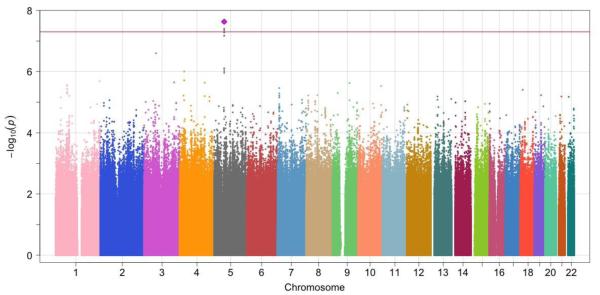
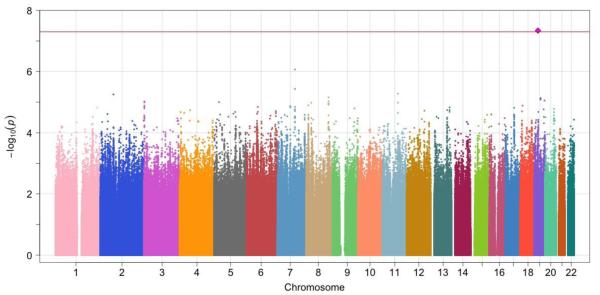
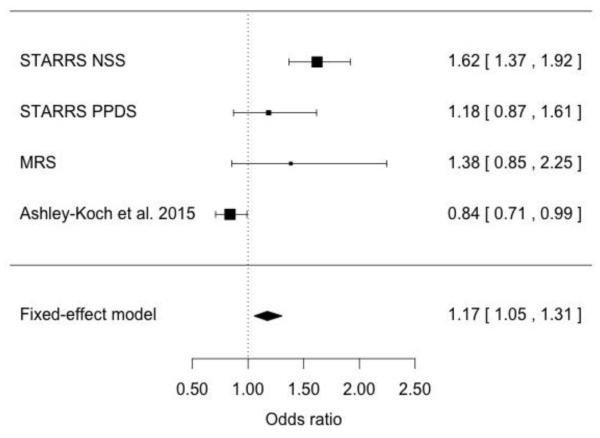
Results: The NSS population was 80.7% male (6277 of 7774 participants; mean [SD] age, 20.9 [3.3] years); the PPDS population, 94.4% male (5583 of 5916 participants; mean [SD] age, 26.5 [6.0] years). A genome-wide significant locus was found in ANKRD55 on chromosome 5 (rs159572; odds ratio [OR], 1.62; 95% CI, 1.37-1.92; P = 2.34 × 10⁻⁸) and persisted after adjustment for cumulative trauma exposure (adjusted OR, 1.64; 95% CI, 1.39-1.95; P = 1.18 × 10⁻⁸) in the African American samples from the NSS. A genome-wide significant locus was also found in or near ZNF626 on chromosome 19 (rs11085374; OR, 0.77; 95% CI, 0.70-0.85; P = 4.59 × 10⁻⁸) in the European American samples from the NSS. Similar results were not found for either single-nucleotide polymorphism in the corresponding ancestry group from the PPDS sample, in other ancestral groups, or in transancestral meta-analyses. Single-nucleotide polymorphism-based heritability was nonsignificant, and no significant genetic correlations were observed between PTSD and 6 mental disorders or 9 immune-related disorders. Significant evidence of pleiotropy was observed between PTSD and rheumatoid arthritis and, to a lesser extent, psoriasis.
Conclusions and relevance: In the largest genome-wide association study of PTSD to date, involving a US military sample, limited evidence of association for specific loci was found. Further efforts are needed to replicate the genome-wide significant association with ANKRD55-associated in prior research with several autoimmune and inflammatory disorders-and to clarify the nature of the genetic overlap observed between PTSD and rheumatoid arthritis and psoriasis.
Figures
References
-
- Thomas JL, Wilk JE, Riviere LA, McGurk D, Castro CA, Hoge CW. Prevalence of mental health problems and functional impairment among active component and National Guard soldiers 3 and 12 months following combat in Iraq. Arch Gen Psychiatry. 2010;67(6):614–623. - PubMed
-
- Stander VA, Thomsen CJ, Highfill-McRoy RM. Etiology of depression comorbidity in combat-related PTSD: a review of the literature. Clin Psychol Rev. 2014;34(2):87–98. - PubMed
-
- Ramsawh HJ, Fullerton CS, Mash HB, et al. Risk for suicidal behaviors associated with PTSD, depression, and their comorbidity in the U.S. Army. J Affect Disord. 2014;161:116–122. - PubMed
Publication types
MeSH terms
Substances
Grants and funding
LinkOut - more resources
Full Text Sources
Other Literature Sources
Medical
Miscellaneous