


Review
doi: 10.1007/s00281-016-0569-x.
Epub 2016 May 12.
Macrophage-epithelial interactions in pulmonary alveoli
Affiliations
- PMID: 27170185
- PMCID: PMC5018989
- DOI: 10.1007/s00281-016-0569-x
Item in Clipboard
Review
Macrophage-epithelial interactions in pulmonary alveoli
Semin Immunopathol.
2016 Jul.
Abstract
Alveolar macrophages have been investigated for years by approaches involving macrophage extraction from the lung by bronchoalveolar lavage, or by cell removal from lung tissue. Since extracted macrophages are studied outside their natural milieu, there is little understanding of the extent to which alveolar macrophages interact with the epithelium, or with one another to generate the lung's innate immune response to pathogen challenge. Here, we review new evidence of macrophage-epithelial interactions in the lung, and we address the emerging understanding that the alveolar epithelium plays an important role in orchestrating the macrophage-driven immune response.
Figures
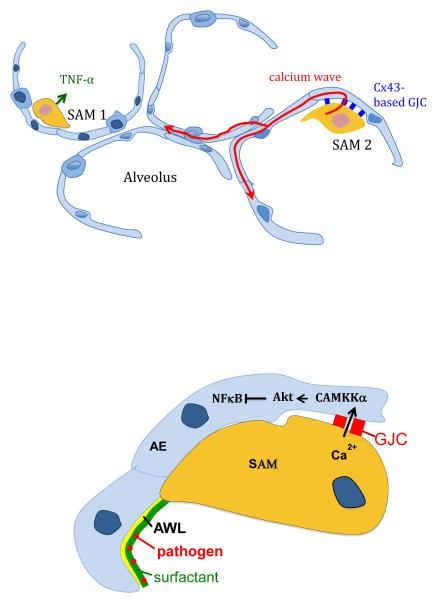
Functional heterogeneity in sessile alveolar macrophages (SAMs). The upper figure shows a macrophage that forms gap junctional channels (GJCs) with the alveolar epithelium (right) and one that does not (left). LPS challenge induces secretion of proinflammatory cytokines from the macrophages, initiating alveolar inflammation. Ca2+ waves (red arrows) originate from the GJC-forming macrophage, then diffuse in the adjoining alveolar epithelium. The lower figure shows that GJC transmitted Ca2+ activates CAMKKα-induced signaling, inhibiting inflammatory signaling in the alveolar epithelium (AE). Pathogen sensing by sessile macrophages takes place as the alveolar wall liquid (AWL) convectively transports pathogens caught in alveolar surfactant towards the macrophages.
References
-
- Rubenfeld GD, Caldwell E, Peabody E, Weaver J, Martin DP, Neff M, Stern EJ, Hudson LD. Incidence and outcomes of acute lung injury. The New England journal of medicine. 2005;353(16):1685–93. - PubMed
-
- Maus UA, Janzen S, Wall G, Srivastava M, Blackwell TS, Christman JW, Seeger W, Welte T, Lohmeyer J. Resident alveolar macrophages are replaced by recruited monocytes in response to endotoxin-induced lung inflammation. Am J Respir Cell Mol Biol. 2006;35(2):227–35. - PubMed
-
- Herold S, Tabar TS, Janssen H, Hoegner K, Cabanski M, Lewe-Schlosser P, Albrecht J, Driever F, Vadasz I, Seeger W, Steinmueller M, Lohmeyer J. Exudate macrophages attenuate lung injury by the release of IL-1 receptor antagonist in gram-negative pneumonia. American journal of respiratory and critical care medicine. 2011;183(10):1380–90. - PubMed
Publication types
MeSH terms
Substances
Grants and funding
LinkOut - more resources
Full Text Sources
Other Literature Sources
