


Closed incision negative pressure therapy: international multidisciplinary consensus recommendations
- PMID: 27170231
- PMCID: PMC7949983
- DOI: 10.1111/iwj.12612
Closed incision negative pressure therapy: international multidisciplinary consensus recommendations
Abstract
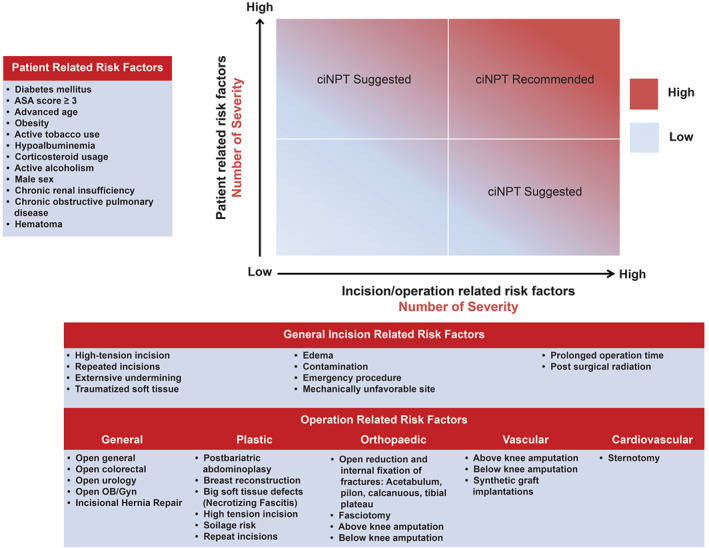
Surgical site occurrences (SSOs) affect up to or over 25% of patients undergoing operative procedures, with the subset of surgical site infections (SSIs) being the most common. Commercially available closed incision negative pressure therapy (ciNPT) may offer surgeons an additional option to manage clean, closed surgical incisions. We conducted an extensive literature search for studies describing ciNPT use and assembled a diverse panel of experts to create consensus recommendations for when using ciNPT may be appropriate. A literature search of MEDLINE, EMBASE and the Cochrane Central Register of Controlled Trials using key words 'prevention', 'negative pressure wound therapy (NPWT)', 'active incisional management', 'incisional vacuum therapy', 'incisional NPWT', 'incisional wound VAC', 'closed incisional NPWT', 'wound infection', and 'SSIs' identified peer-reviewed studies published from 2000 to 2015. During a multidisciplinary consensus meeting, the 12 experts reviewed the literature, presented their own ciNPT experiences, identified risk factors for SSOs and developed comprehensive consensus recommendations. A total of 100 publications satisfied the search requirements for ciNPT use. A majority presented data supporting ciNPT use. Numerous publications reported SSI risk factors, with the most common including obesity (body mass index ≥30 kg/m2 ); diabetes mellitus; tobacco use; or prolonged surgical time. We recommend that the surgeon assess the individual patient's risk factors and surgical risks. Surgeons should consider using ciNPT for patients at high risk for developing SSOs or who are undergoing a high-risk procedure or a procedure that would have highly morbid consequences if an SSI occurred.
Keywords: Consensus recommendation; Negative pressure therapy; Surgical incision management; Surgical site infection.
© 2016 The Authors. International Wound Journal published by Medicalhelplines.com Inc and John Wiley & Sons Ltd.
Figures
References
-
- World Health Organization . WHO Guidelines for safe surgery 2009: safe surgery saves lives. Geneva: World Health Organization, 2009. - PubMed
-
- Zimlichman E, Henderson D, Tamir O, Franz C, Song P, Yamin CK, Keohane C, Denham CR, Bates DW. Health care‐associated infections: a meta‐analysis of costs and financial impact on the US health care system. JAMA Intern Med 2013;173:2039–46. - PubMed
-
- Centers for Disease Control and Prevention . Surgical site infection (SSI) event. Atlanta, GA: Centers for Disease Control and Prevention, 2015:1–27.
-
- Stevens DL, Bisno AL, Chambers HF, Dellinger EP, Goldstein EJ, Gorbach SL, Hirschmann JV, Kaplan SL, Montoya JG, Wade JC. Practice guidelines for the diagnosis and management of skin and soft tissue infections: 2014 update by the Infectious Diseases Society of America. Clin Infect Dis 2014;59:e10–52. - PubMed
-
- Centre for Evidence‐Based Medicine . Oxford Centre for Evidence‐based Medicine – Levels of evidence (March 2009). Oxford: Centre for Evidence‐Based Medicine, 2014. URL http://www.cebm.net/oxford‐centre‐evidence‐based‐medicine‐levels‐evidenc... [accessed on 23 January 2015].
Publication types
MeSH terms
Substances
LinkOut - more resources
Full Text Sources
Other Literature Sources
Medical
