


Physical Activity Benefits the Skeleton of Children Genetically Predisposed to Lower Bone Density in Adulthood
- PMID: 27172274
- PMCID: PMC4970901
- DOI: 10.1002/jbmr.2872
Physical Activity Benefits the Skeleton of Children Genetically Predisposed to Lower Bone Density in Adulthood
Abstract
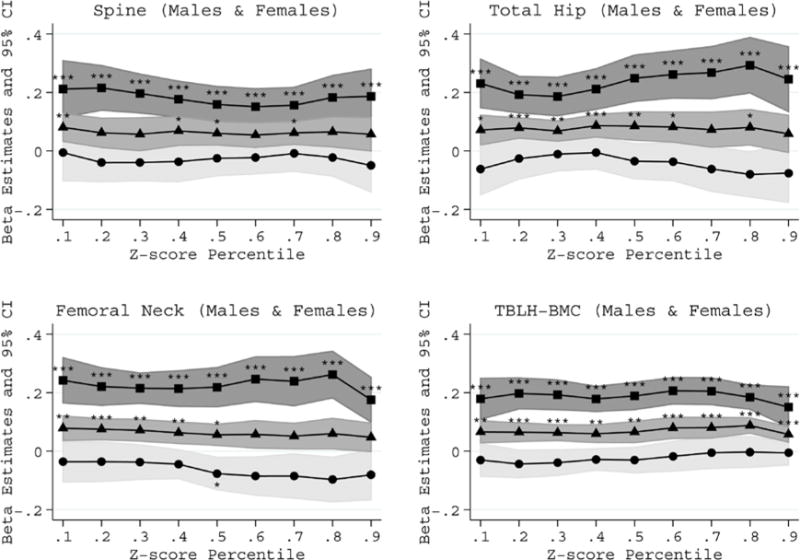
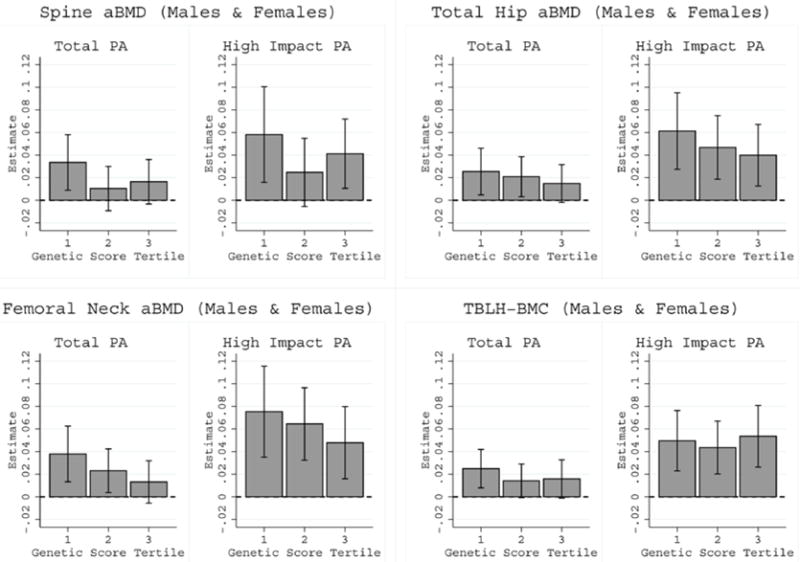
Both genetics and physical activity (PA) contribute to bone mineral density (BMD), but it is unknown if the benefits of physical activity on childhood bone accretion depend on genetic risk. We, therefore, aimed to determine if PA influenced the effect of bone fragility genetic variants on BMD in childhood. Our sample comprised US children of European ancestry enrolled in the Bone Mineral Density in Childhood Study (N = 918, aged 5 to 19 years, and 52.4% female). We used a questionnaire to estimate hours per day spent in total, high-, and low-impact PA. We calculated a BMD genetic score (% BMD lowering alleles) using adult genome-wide association study (GWAS)-implicated BMD variants. We used dual-energy X-ray absorptiometry to estimate femoral neck, total hip, and spine areal-BMD and total body less head (TBLH) bone mineral content (BMC) Z-scores. The BMD genetic score was negatively associated with each bone Z-score (eg, TBLH-BMC: estimate = -0.03, p = 1.3 × 10(-6) ). Total PA was positively associated with bone Z-scores; these associations were driven by time spent in high-impact PA (eg, TBLH-BMC: estimate = 0.05, p = 4.0 × 10(-10) ) and were observed even for children with lower than average bone Z-scores. We found no evidence of PA-adult genetic score interactions (p interaction > 0.05) at any skeletal site, and there was no evidence of PA-genetic score-Tanner stage interactions at any skeletal site (p interaction > 0.05). However, exploratory analyses at the individual variant level revealed that PA statistically interacted with rs2887571 (ERC1/WNT5B) to influence TBLH-BMC in males (p interaction = 7.1 × 10(-5) ), where PA was associated with higher TBLH-BMC Z-score among the BMD-lowering allele carriers (rs2887571 AA homozygotes: estimate = 0.08 [95% CI 0.06, 0.11], p = 2.7 × 10(-9) ). In conclusion, the beneficial effect of PA on bone, especially high-impact PA, applies to the average child and those genetically predisposed to lower adult BMD (based on GWAS-implicated BMD variants). Independent replication of our exploratory individual variant findings is warranted. © 2016 American Society for Bone and Mineral Research.
Keywords: BONE MINERAL DENSITY; CHILDREN; EXERCISE; GENETIC; PHYSICAL ACTIVITY.
© 2016 American Society for Bone and Mineral Research.
Conflict of interest statement
Figures
Comment in
-
2016 The Year That Was: Bone Strength.Pediatr Exerc Sci. 2017 Feb;29(1):23-25. doi: 10.1123/pes.2016-0279. Pediatr Exerc Sci. 2017. PMID: 28271807
References
-
- Golden NH, Abrams SA. Optimizing bone health in children and adolescents. Pediatrics. 2014;134(4):e1229–43. - PubMed
-
- Behringer M, Gruetzner S, McCourt M, Mester J. Effects of weight-bearing activities on bone mineral content and density in children and adolescents: a meta-analysis. J Bone Miner Res. 2014;29(2):467–78. - PubMed
Publication types
MeSH terms
Grants and funding
- UL1 TR001878/TR/NCATS NIH HHS/United States
- K12 DK094723/DK/NIDDK NIH HHS/United States
- K01 HL123612/HL/NHLBI NIH HHS/United States
- N01 HD013331/HD/NICHD NIH HHS/United States
- N01 HD013332/HD/NICHD NIH HHS/United States
- R01 HD058886/HD/NICHD NIH HHS/United States
- UL1 TR001425/TR/NCATS NIH HHS/United States
- UL1 TR000077/TR/NCATS NIH HHS/United States
- N01 HD013333/HD/NICHD NIH HHS/United States
- N01 HD013330/HD/NICHD NIH HHS/United States
- UL1 RR024134/RR/NCRR NIH HHS/United States
- N01 HD013329/HD/NICHD NIH HHS/United States
- T32 DK063688/DK/NIDDK NIH HHS/United States
- T32 DK065522/DK/NIDDK NIH HHS/United States
- K23 DK102659/DK/NIDDK NIH HHS/United States
- UL1 TR000003/TR/NCATS NIH HHS/United States
- N01 HD013328/HD/NICHD NIH HHS/United States
- P30 DK098722/DK/NIDDK NIH HHS/United States
LinkOut - more resources
Full Text Sources
Other Literature Sources
Medical
