


Tumor-Infiltrating Lymphocytes, Crohn's-Like Lymphoid Reaction, and Survival From Colorectal Cancer
- PMID: 27172903
- PMCID: PMC5017930
- DOI: 10.1093/jnci/djw027
Tumor-Infiltrating Lymphocytes, Crohn's-Like Lymphoid Reaction, and Survival From Colorectal Cancer
Abstract
Background: While clinical outcomes from colorectal cancer (CRC) are influenced by stage at diagnosis and treatment, mounting evidence suggests that an enhanced lymphocytic reaction to a tumor may also be an informative prognostic indicator.
Methods: The roles of intratumoral T lymphocyte infiltration (TIL), peritumoral Crohn's-like lymphoid reaction (CLR), microsatellite instability (MSI), and clinicopathological characteristics in survival from CRC were examined using 2369 incident CRCs from a population-based case-control study in northern Israel. Cox proportional hazards regression was used to estimate hazard ratios (HRs) and 95% confidence intervals (CIs) for CRC-specific and all-cause mortality in multivariable models adjusted for age, sex, ethnicity, grade, stage, and MSI. All statistical tests were two-sided.
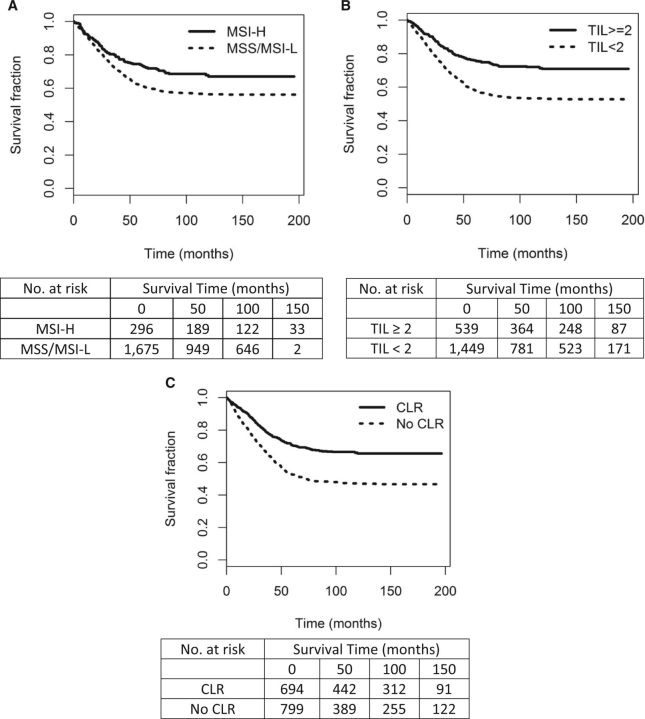
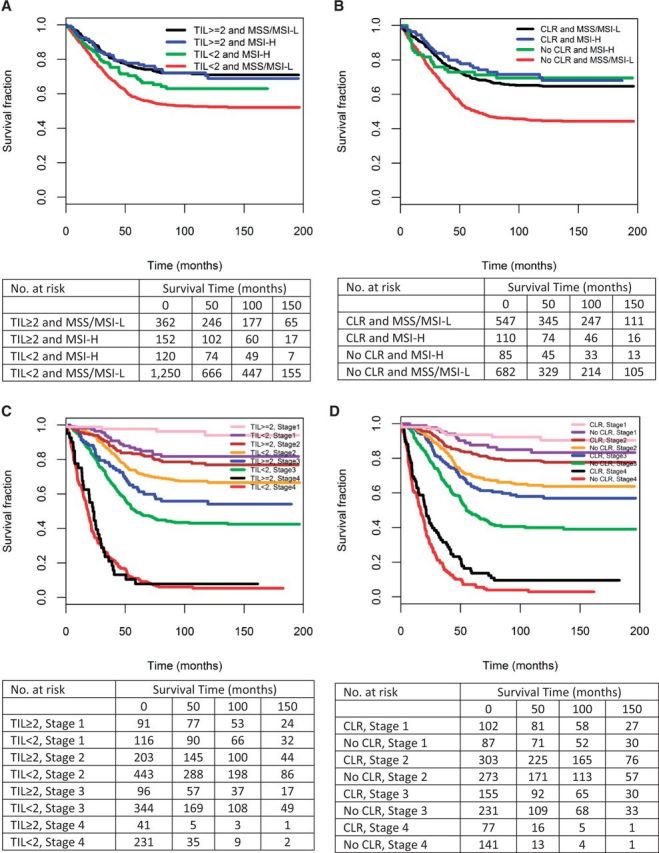
Results: Tumors with TIL/high-powered field (HPF) of 2 or greater were associated with a statistically significant increase in CRC-specific (P < .001) and overall survival (P < .001) compared with tumors with TIL/HPF of less than 2. Similarly, tumors with a prominent CLR experienced better CRC-specific (P < .001) and overall survival (P < .001) as compared with those with no response. High TILs (HR = 0.76, 95% CI = 0.64 to 0.89, P < .001) and a prominent CLR (HR = 0.71, 95% CI = 0.62 to 0.80, P < .001), but not MSI, were associated with a statistically significant reduction in all-cause mortality after adjustment for established prognostic factors.
Conclusions: TILs and CLR are both prognostic indicators for CRC after adjusting for traditional prognostic indicators.
© The Author 2016. Published by Oxford University Press. All rights reserved. For Permissions, please e-mail: journals.permissions@oup.com.
Figures
Comment in
-
Additional Support for the Introduction of Immune Cell Quantification in Colorectal Cancer Classification.J Natl Cancer Inst. 2016 May 12;108(8):djw033. doi: 10.1093/jnci/djw033. Print 2016 Aug. J Natl Cancer Inst. 2016. PMID: 27172904 Free PMC article. No abstract available.
References
-
- Ferlay J, Soerjomataram II, Dikshit R, et al. Cancer incidence and mortality worldwide: sources, methods and major patterns in GLOBOCAN 2012. Int J Cancer. 2015;136(5):E359–E386. - PubMed
-
- Samowitz WS, Curtin K, Ma KN, et al. Microsatellite instability in sporadic colon cancer is associated with an improved prognosis at the population level. Cancer Epidemiol Biomarkers Prev. 2001;10(9):917–923. - PubMed
-
- Elsaleh H, Iacopetta B. Microsatellite instability is a predictive marker for survival benefit from adjuvant chemotherapy in a population-based series of stage III colorectal carcinoma. Clin Colorectal Cancer. 2001;1(2):104–109. - PubMed
Publication types
MeSH terms
Grants and funding
LinkOut - more resources
Full Text Sources
Other Literature Sources
Medical
