


The Impact of Mild Cognitive Impairment on Gait and Balance: A Systematic Review and Meta-Analysis of Studies Using Instrumented Assessment
- PMID: 27172932
- PMCID: PMC5107359
- DOI: 10.1159/000445831
The Impact of Mild Cognitive Impairment on Gait and Balance: A Systematic Review and Meta-Analysis of Studies Using Instrumented Assessment
Abstract
Background: In addition to cognitive deficits, people with mild cognitive impairment (MCI) can experience motor dysfunction, including deficits in gait and balance. Objective, instrumented motor performance assessment may allow the detection of subtle MCI-related motor deficits, allowing early diagnosis and intervention. Motor assessment under dual-task conditions may increase diagnostic accuracy; however, the sensitivity of different cognitive tasks is unclear.
Objective: To systematically review the extant literature focusing on instrumented assessment of gait and balance parameters for discriminating MCI patients from cognitively intact peers.
Methods: Database searches were conducted in PubMed, EMBASE, Cochrane Library, PsycINFO and Web of Science. Inclusion criteria were: (1) clinically confirmed MCI; (2) instrumented measurement of gait and/or balance; (3) English language, and (4) reporting gait or balance parameters which could be included in a meta-analysis for discriminating between MCI patients and cognitively intact individuals based on weighted effect size (d).
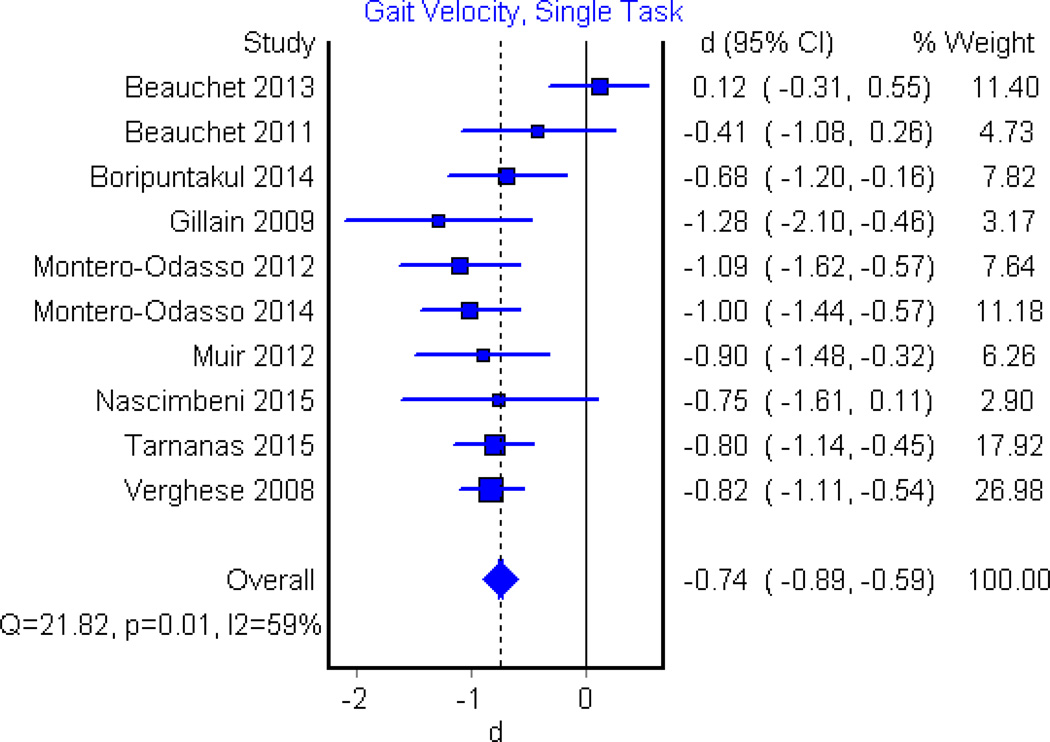
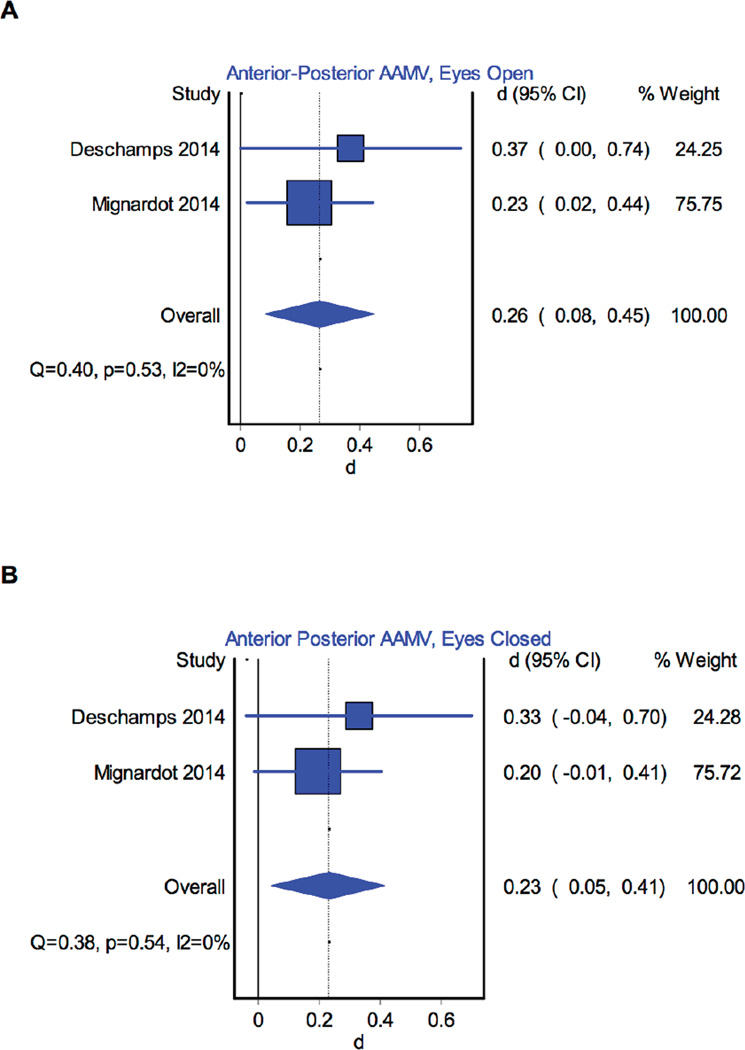
Results: Fourteen studies met the inclusion criteria and reported quantitative gait (n = 11) or postural balance (n = 4) parameters to be included in the meta-analysis. The meta-analysis revealed that several gait parameters including velocity (d = -0.74, p < 0.01), stride length (d = -0.65, p < 0.01), and stride time (mean: d = 0.56, p = 0.02; coefficient of variation: d = 0.50, p < 0.01) discriminated best between MCI and healthy controls under single-task conditions. Importantly, dual-task assessment increased the discriminative power of gait variables wherein gait variables with counting tasks appeared to be more sensitive (range d = 0.84-1.35) compared to verbal fluency tasks such as animal naming (range d = 0.65-0.94). Balance parameters identified as significant discriminators were anterior-posterior (d = 0.49, p < 0.01) and mediolateral (d = -0.34, p = 0.04) sway position in the eyes-open condition but not eyes-closed condition.
Conclusion: Existing studies provide evidence that MCI affects specific gait parameters. MCI-related gait changes were most pronounced when subjects are challenged cognitively (i.e., dual task), suggesting that gait assessment with an additional cognitive task is useful for diagnosis and outcome analysis in the target population. Static balance seems to also be affected by MCI, although limited evidence exists. Instrumented motor assessment could provide a critical opportunity for MCI diagnosis and tailored intervention targeting specific deficits and potentially slowing progression to dementia. Further studies are required to confirm our findings.
© 2016 S. Karger AG, Basel.
Conflict of interest statement
All authors report no conflict of interest or any financial support received.
Figures



References
-
- Huang C, Mattis P, Julin P. Identifying functional imaging markers of mild cognitive impairment in early alzheimer’s and parkinson’s disease using multivariate analysis. Clinical Neuroscience Research. 2007;6:367–373.
-
- Dierckx E, Engelborghs S, De Raedt R, De Deyn PP, Ponjaert-Kristoffersen I. Mild cognitive impairment: What’s in a name? Gerontology. 2007;53:28–35. - PubMed
-
- Brookmeyer R, Johnson E, Ziegler-Graham K, Arrighi HM. Forecasting the global burden of alzheimer’s disease. Alzheimer’s & dementia : the journal of the Alzheimer’s Association. 2007;3:186–191. - PubMed
-
- Petersen RC. Mild cognitive impairment as a diagnostic entity. Journal of Internal Medicine. 2004;256:183–194. - PubMed
Publication types
MeSH terms
Grants and funding
LinkOut - more resources
Full Text Sources
Other Literature Sources
Medical
Miscellaneous
