. 2016 May 13;11(5):e0155014.
doi: 10.1371/journal.pone.0155014. eCollection 2016.

A Method for Checking Genomic Integrity in Cultured Cell Lines from SNP Genotyping Data

Affiliations

A Method for Checking Genomic Integrity in Cultured Cell Lines from SNP Genotyping Data

Petr Danecek et al. PLoS One. .

Abstract

Genomic screening for chromosomal abnormalities is an important part of quality control when establishing and maintaining stem cell lines. We present a new method for sensitive detection of copy number alterations, aneuploidy, and contamination in cell lines using genome-wide SNP genotyping data. In contrast to other methods designed for identifying copy number variations in a single sample or in a sample composed of a mixture of normal and tumor cells, this new method is tailored for determining differences between cell lines and the starting material from which they were derived, which allows us to distinguish between normal and novel copy number variation. We implemented the method in the freely available BCFtools package and present results based on induced pluripotent stem cell lines obtained in the HipSci project.


Conflict of interest statement

Competing Interests: The authors have declared that no competing interests exist.

Figures

Fig 1
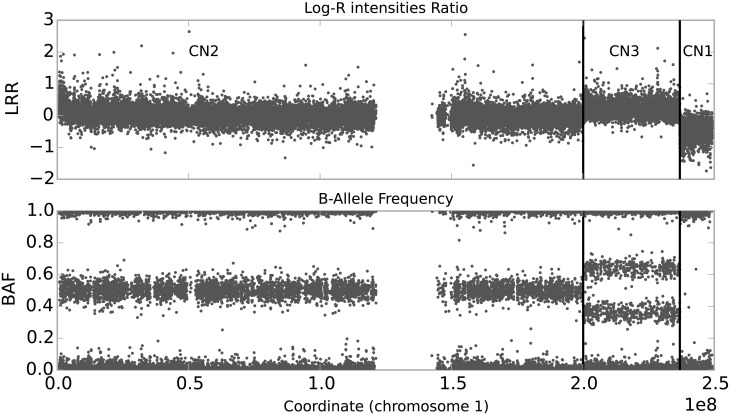
Fig 1. An example of an aberrant cell line with a duplication (CN3) and a deletion (CN1) on chromosome 1.
Each dot in the graphs represents a single marker, the gap in the middle corresponds to a centromere, which is not targeted by the chip. The top graph shows the LRR values, which are centered around 0 in diploid regions (CN2), elevated in duplicated regions (CN3), and lowered in deletions (CN1). The bottom graph shows the corresponding BAF values which cluster into three bands in diploid regions, into four in CN3 regions, and into two in CN1 regions, as explained further in the text.
Fig 2
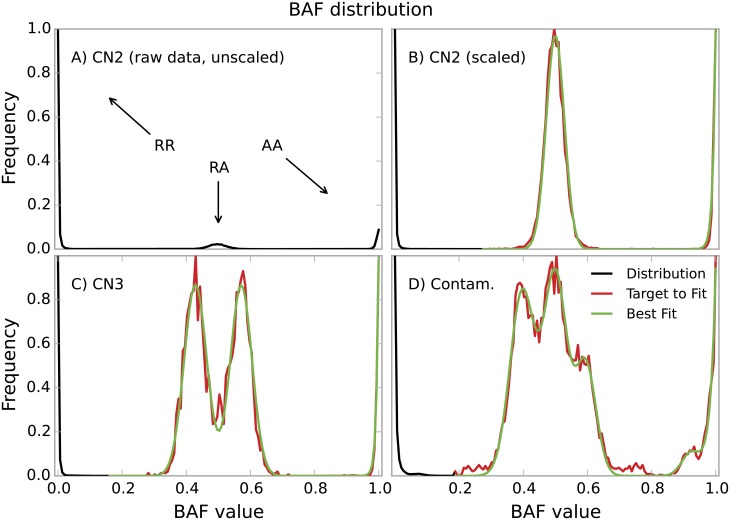
Fig 2. Input data for the polysomy method.
Unscaled (A) and scaled (B-D) distributions of BAF values typical for the copy number states 2-4. In (C) we infer that 33% of the cells are aneuploid copy number 3, and in (D) we infer a sample with 20% contamination. The black line is the complete BAF distribution over 0 to 1 of which only part is modelled (shown in red); the green line is the best fit to the red part of the distribution. The model does not include the RR peak and including the AA peak is optional.
Fig 3
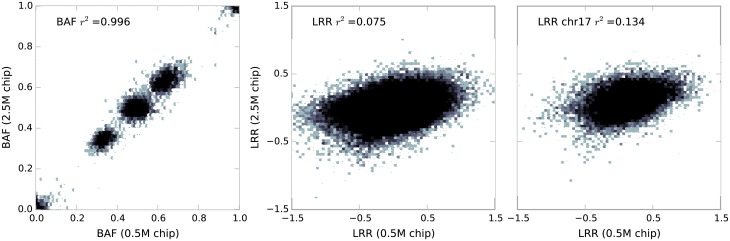
Fig 3. The correlation of BAF and LRR values obtained in the validation experiment using the default chip (0.5M sites) and the high density chip (2.5M sites) on sample HPSI0713i-virz_2_QC1Hip.
The central plot shows LRR correlation across the whole genome. The right hand plot shows LRR correlation across chromosome 17 which contains a large 40Mb duplication. The plots are 2-D histograms with hexagonal bins, logarithmic greyscale was used to indicate the number of markers in a bin.
Fig 4
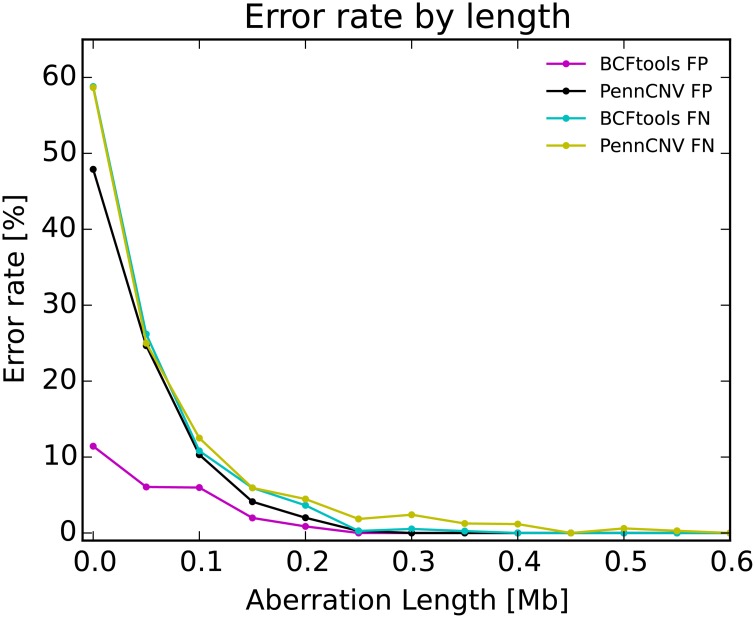
Fig 4. Error rate by length in simulated data.
Fig 5
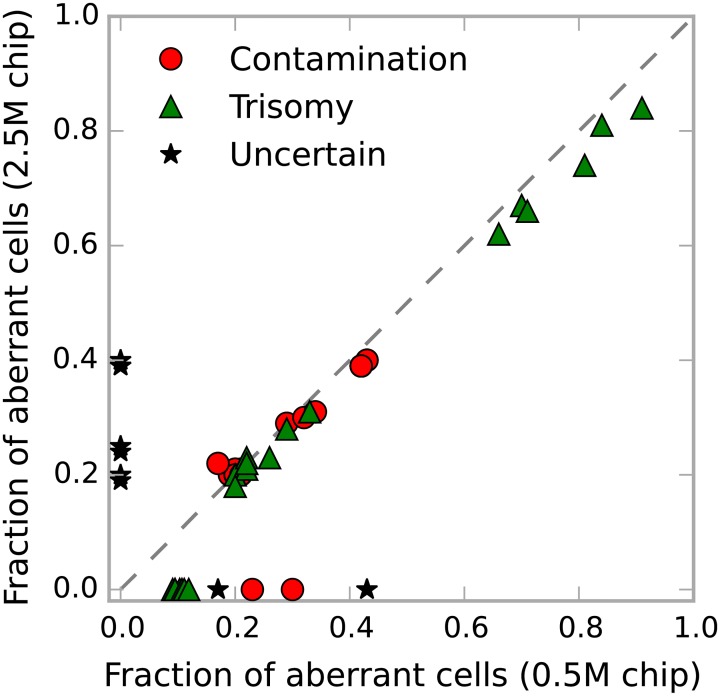
Fig 5. Reproducibility of polysomy results across different chips.
Fraction of contaminating cells in the sample (red circles) and the fraction of cells with trisomies (green triangles) as estimated from the default (0.5M sites) and higher density chip (2.5M sites). All outliers in this figure are unconfirmed contaminations and chromosomes failing goodness of fit criteria as explained in the text.

References

    1. Gore A, Li Z, Fung HL, Young JE, Agarwal S, Antosiewicz-Bourget J, Canto I, et al. Somatic coding mutations in human induced pluripotent stem cells. Nature. 2011;471:63–67. - PMC - PubMed
    1. Mayshar Y, Ben-David U, Lavon N, Biancotti JC, Yakir B, Clark AT, et al. Identification and Classification of Chromosomal Aberrations in Human Induced Pluripotent Stem Cells. Cell Stem Cell. 2010;7:521–531. 10.1016/j.stem.2010.07.017 - DOI - PubMed
    1. Liu P, Kaplan A, Yuan B, Hanna JH, Lupski JR, Reiner O. Passage number is a major contributor to genomic structural variations in mouse iPSCs. Stem Cells. 2014;32:2657–2667. 10.1002/stem.1779 - DOI - PMC - PubMed
    1. Ma H, Morey R, O’Neil RC, He Y, Daughtry B, Schultz MD, et al. Abnormalities in human pluripotent cells due to reprogramming mechanisms. Nature. 2014;511:177–183. - PMC - PubMed
    1. Bai Q, Ramirez JM, Becker F, Pantesco V, Lavabre-Bertrand T, Hovatta O, et al. Temporal analysis of genome alterations induced by single-cell passaging in human embryonic stem cells. Stem Cells Dev. 2014;. 10.1089/scd.2014.0292 - DOI - PMC - PubMed

Publication types