


Quantitative mapping of cerebrovascular reactivity using resting-state BOLD fMRI: Validation in healthy adults
- PMID: 27177763
- PMCID: PMC5148619
- DOI: 10.1016/j.neuroimage.2016.05.025
Quantitative mapping of cerebrovascular reactivity using resting-state BOLD fMRI: Validation in healthy adults
Abstract
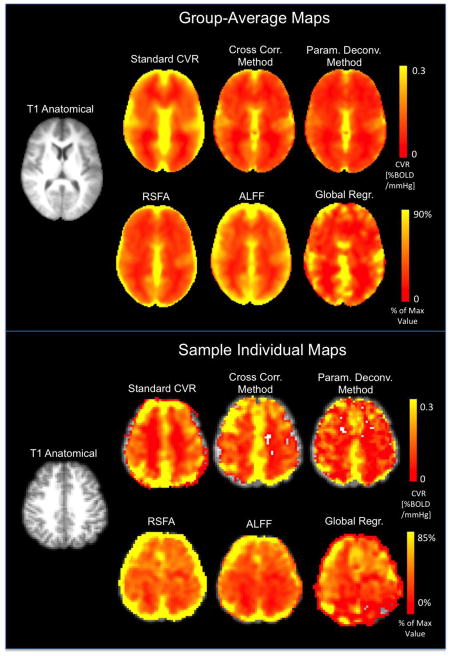
In conventional neuroimaging, cerebrovascular reactivity (CVR) is quantified primarily using the blood-oxygenation level-dependent (BOLD) functional MRI (fMRI) signal, specifically, as the BOLD response to intravascular carbon dioxide (CO2) modulations, in units of [%ΔBOLD/mmHg]. While this method has achieved wide appeal and clinical translation, the tolerability of CO2-related tasks amongst patients and the elderly remains a challenge in more routine and large-scale applications. In this work, we propose an improved method to quantify CVR by exploiting intrinsic fluctuations in CO2 and corresponding changes in the resting-state BOLD signal (rs-qCVR). Our rs-qCVR approach requires simultaneous monitoring of PETCO2, cardiac pulsation and respiratory volume. In 16 healthy adults, we compare our quantitative CVR estimation technique to the prospective CO2-targeting based CVR quantification approach (qCVR, the "standard"). We also compare our rs-CVR to non-quantitative alternatives including the resting-state fluctuation amplitude (RSFA), amplitude of low-frequency fluctuation (ALFF) and global-signal regression. When all subjects were pooled, only RSFA and ALFF were significantly associated with qCVR. However, for characterizing regional CVR variations within each subject, only the PETCO2-based rs-qCVR measure is strongly associated with standard qCVR in 100% of the subjects (p≤0.1). In contrast, for the more qualitative CVR measures, significant within-subject association with qCVR was only achieved in 50-70% of the subjects. Our work establishes the feasibility of extracting quantitative CVR maps using rs-fMRI, opening the possibility of mapping functional connectivity and qCVR simultaneously.
Keywords: Cerebrovascular reactivity; Deconvolution; End-tidal CO(2); Heart-rate variability; Hemodynamic response function; Non-invasive vascular mapping; Respiratory-volume variability; Resting-state fMRI.
Copyright © 2016 Elsevier Inc. All rights reserved.
Figures




References
-
- Asghar MS, Hansen AE, Pedersen S, Larsson HB, Ashina M. Pharmacological modulation of the BOLD response: a study of acetazolamide and glyceryl trinitrate in humans. J Magn Reson Imaging. 2011;34:921–927. - PubMed
-
- Bandettini PA, Wong EC. A hypercapnia-based normalization method for improved spatial localization of human brain activation with fMRI. NMR Biomed. 1997;10:197–203. - PubMed
-
- Birn RM, Diamond JB, Smith MA, Bandettini PA. Separating respiratory-variation-related fluctuations from neuronal-activity-related fluctuations in fMRI. NeuroImage. 2006;31:1536–1548. - PubMed
Publication types
MeSH terms
Substances
Grants and funding
LinkOut - more resources
Full Text Sources
Other Literature Sources
Medical
