Review
. 2017 Mar;74(Pt B):260-268.
doi: 10.1016/j.neubiorev.2016.05.004. Epub 2016 May 10.

Social factors and cardiovascular morbidity

Affiliations
Review

Social factors and cardiovascular morbidity

Eric John Brunner. Neurosci Biobehav Rev. 2017 Mar.

Abstract

Recent progress in population health at aggregate level, measured by life expectancy, has been accompanied by lack of progress in reducing the difference in health prospects between groups defined by social status. Cardiovascular disease is an important contributor to this undesirable situation. The stepwise gradient of higher risk with lower status is accounted for partly by social gradients in health behaviors. The psychosocial hypothesis provides a stronger explanation, based on social patterning of living and working environments and psychological assets that individuals develop during childhood. Three decades of research based on Whitehall II and other cohort studies provide evidence for psychosocial pathways leading to cardiovascular morbidity and mortality. Job stress is a useful paradigm because exposure is long term and depends on occupational status. Studies of social-biological translation implicate autonomic and neuroendocrine function among the biological systems that mediate between chronic adverse psychosocial exposures and increased cardiometabolic risk and cardiovascular disease incidence.


Figures

Figure 1
Figure 1
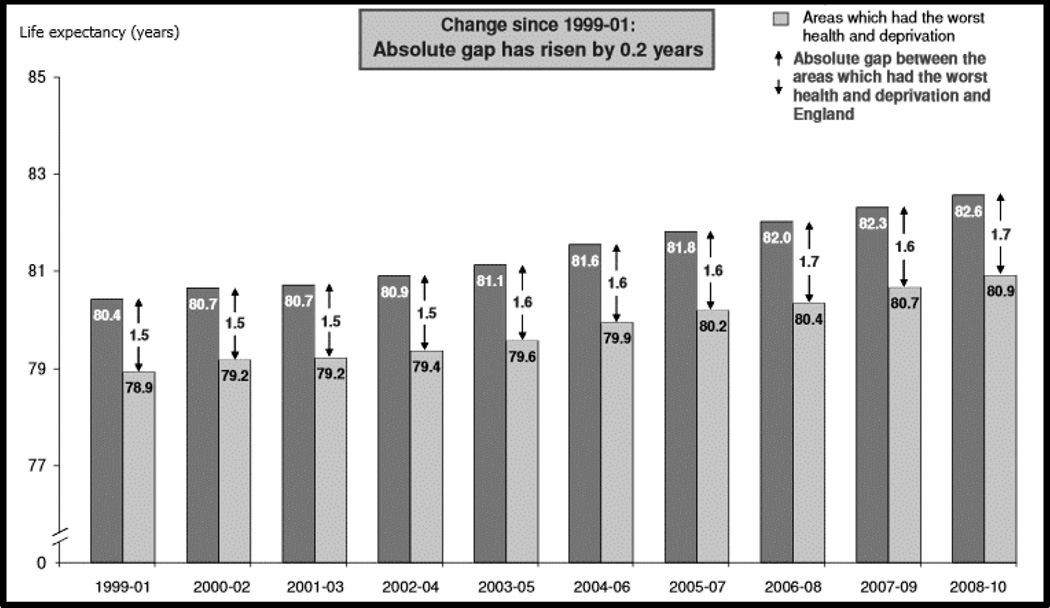
Life expectancy at birth in England and areas with worst health and deprivation. Women, 1999–2010 Source: UK Department of Health, Mortality Monitoring Bulletin, Life expectancy and all-age-all-cause mortality, and mortality from selected causes, overall and inequalities, October 2011. https://www.gov.uk/government/publications/mortality-monitoring-bulletin-life-expectancy-and-all-age-all-cause-mortality-and-mortality-from-selected-causes-overall-and-inequalities-update-to-include-data-for-2010 (accessed 8 January 2016)
Figure 2
Figure 2
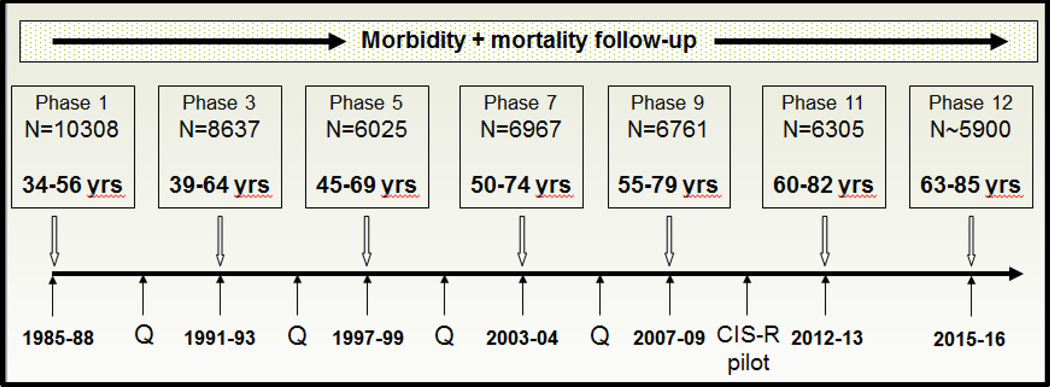
Whitehall II cohort study. Timeline, phases of contact, number of participants and age range. Contact phases above the timeline are clinical examinations with questionnaire. Q refers to questionnaire-only contact phases. CIS-R pilot refers to the pilot study of a computerized version of Clinical Interview Schedule-Revised.
Figure 3
Figure 3
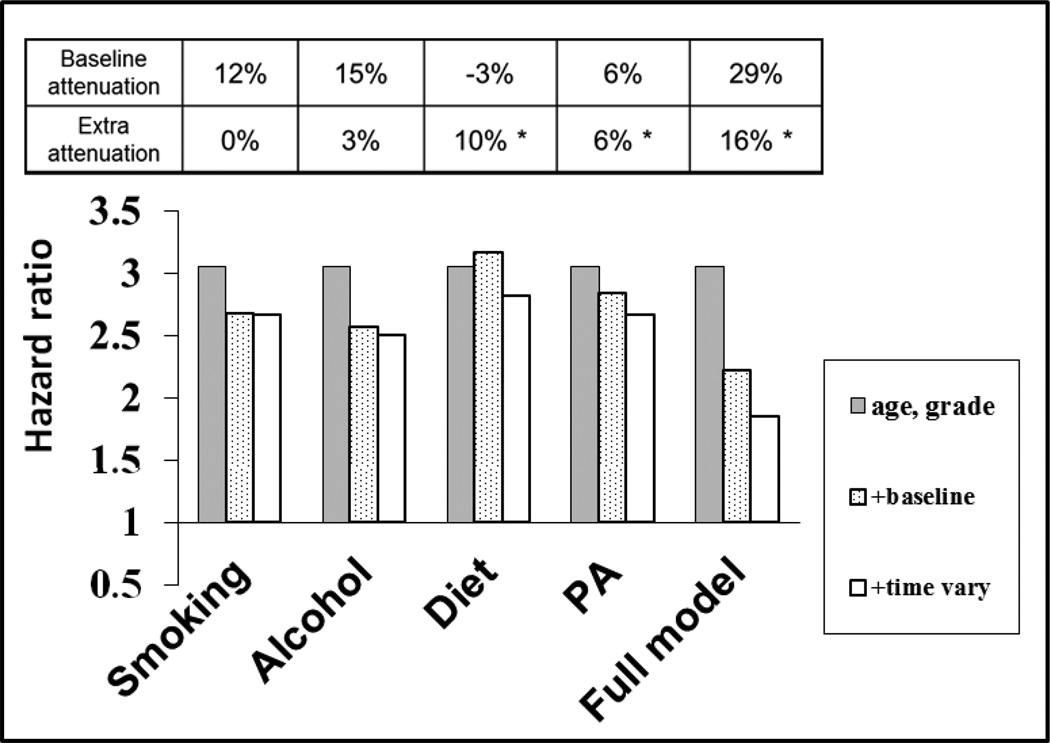
Socioeconomic gradient in CVD mortality and health behavioral explanations, Whitehall II study. The analysis compares models assuming baseline behavior continues unchanged with models in which behavior can vary over the follow-up time. Redrawn from Stringhini S, Sabia S, Shipley M et al JAMA 2010;303:1159-66. All models are adjusted for sex. The grey bars show the hazard ratio for cardiovascular disease mortality for the lowest compared with the highest socioeconomic status (3.05, 95% CI 1.94–4.78). The dotted bars show the hazard ratio additionally adjusted for one or all health behaviors at baseline. The open bars show the hazard ratio with further adjustment for health behavior(s) at 5, 10 and 15 years of follow-up. * increase in attenuation p<0.05 compared to the baseline adjusted model.
Figure 4
Figure 4
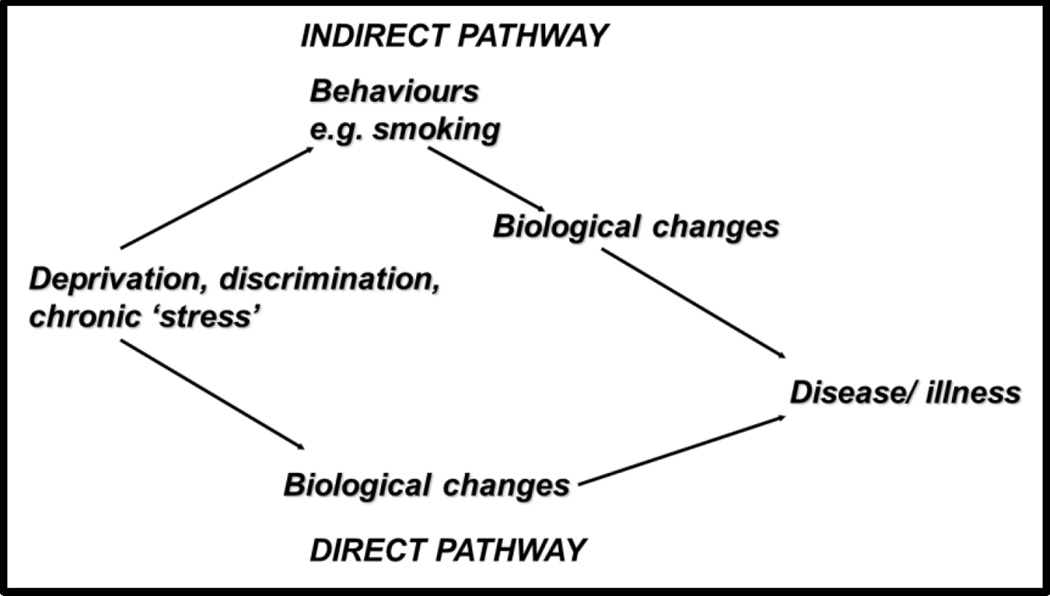
Schematic diagram of pathways linking psychosocial factors to disease. The indirect pathway involves one or more health behaviors. The direct pathway does not involve health behaviors in the usual sense, and instead is dependent on autonomic, neuroendocrine, inflammatory and/or other psychobiological mechanisms. Redrawn from E Brunner ‘Stress mechanisms in coronary heart disease’, in Stress and the Heart, eds: Stansfeld SA and Marmot MG, BMJ Books 2002.
Figure 5
Figure 5
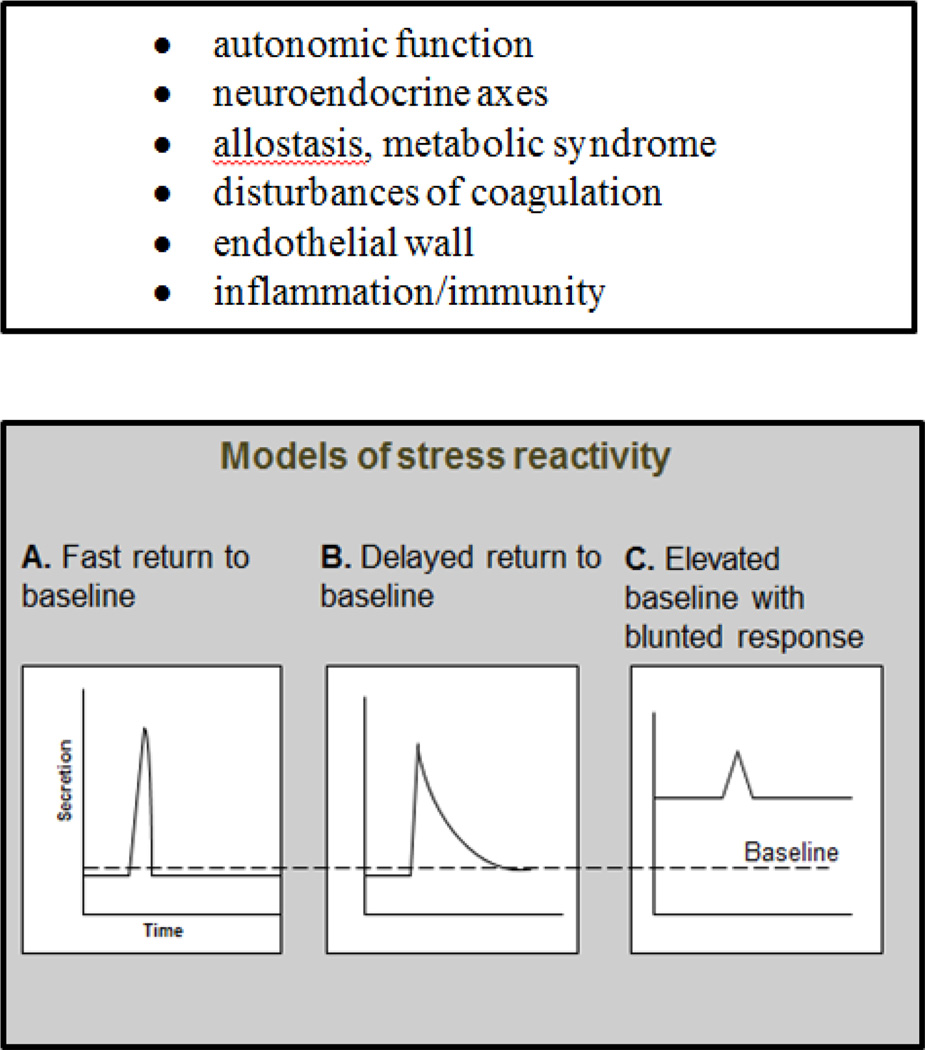
Candidate mediating biological systems linking chronic stress with increased cardiovascular risk and schematic models of changed short term stress reactivity Redrawn from E Brunner and M Marmot, Social organization, stress, and health, in Social determinants of health, eds Marmot M and Wilkinson RG, 2nd edition, Oxford University Press, 2006.
Figure 6
Figure 6
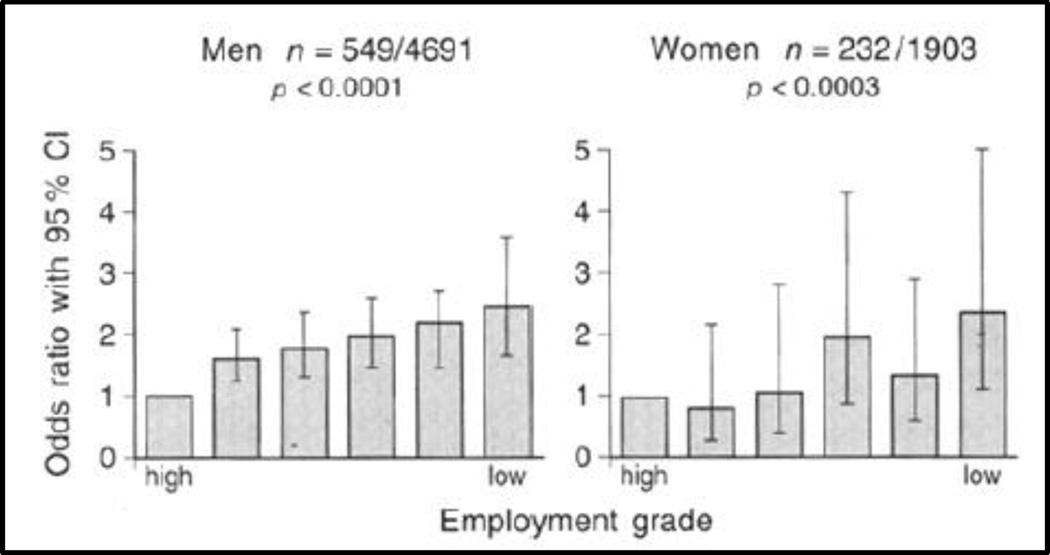
Odds ratios for metabolic syndrome by employment grade. Adjusted for age, and menopausal status in women. P values are test for trend across grade categories. Source: Diabetologia, Social inequality in coronary risk: central obesity and the metabolic syndrome. Evidence from the Whitehall II study, 40, 1997, 1346, EJ Brunner et al. With permission of Springer.
Figure 7
Figure 7
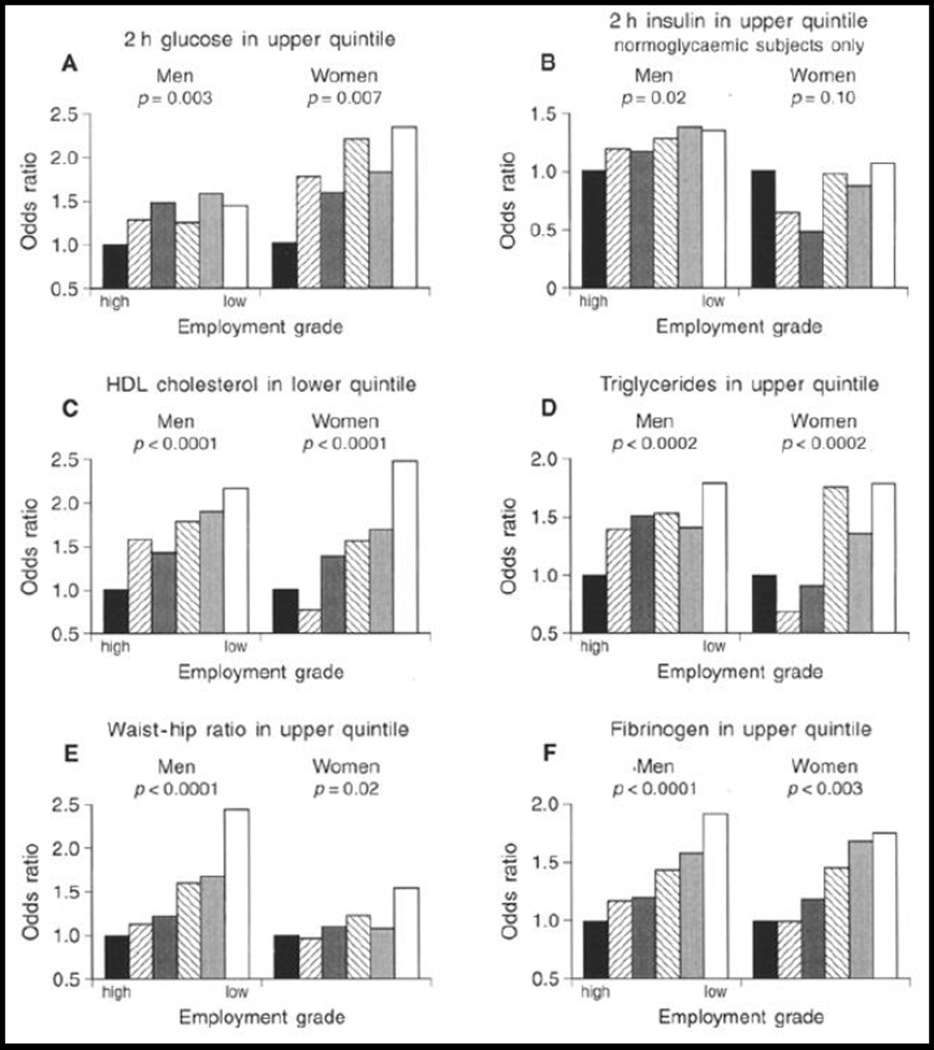
Odds ratios for occupying the top quintile of anthropometric and biochemical variables by employment grade. Adjusted for age, and menopausal status in women. P values are test for trend across grade categories. Source: Diabetologia, Social inequality in coronary risk: central obesity and the metabolic syndrome. Evidence from the Whitehall II study, 40, 1997, 1345, EJ Brunner et al. With permission of Springer.

References

    1. Avendano M, Kawachi I. Why do Americans have shorter life expectancy and worse health than do people in other high-income countries? Annual Reveiw Public Health. 2014;35:307–325. available from: PM:24422560. - PMC - PubMed
    1. Bajekal M, Scholes S, O'Flaherty M, Raine R, Norman P, Capewell S. Unequal trends in coronary heart disease mortality by socioeconomic circumstances, England 1982–2006: an analytical study. PLoS. One. 2013;8(3):e59608. available from: PM:23527228. - PMC - PubMed
    1. Bennett JE, Li G, Foreman K, Best N, Kontis V, Pearson C, Hambly P, Ezzati M. The future of life expectancy and life expectancy inequalities in England and Wales: Bayesian spatiotemporal forecasting. Lancet. 2015;386(9989):163–170. available from: PM:25935825. - PMC - PubMed
    1. Bosma H, Peter R, Siegrist J, Marmot MG. Two alternative job stress models and the risk of coronary heart disease. Am. J. Publ. Health. 1998;88:68–74. - PMC - PubMed
    1. BRADY JV, PORTER RW, CONRAD DG, MASON JW. Avoidance behavior and the development of gastroduodenal ulcers. J Exp. Anal. Behav. 1958;1:69–72. available from: PM:13872361. - PMC - PubMed