


Potential of MALDI imaging for the toxicological evaluation of environmental pollutants
- PMID: 27178109
- PMCID: PMC6197801
- DOI: 10.1016/j.jprot.2016.05.008
Potential of MALDI imaging for the toxicological evaluation of environmental pollutants
Abstract
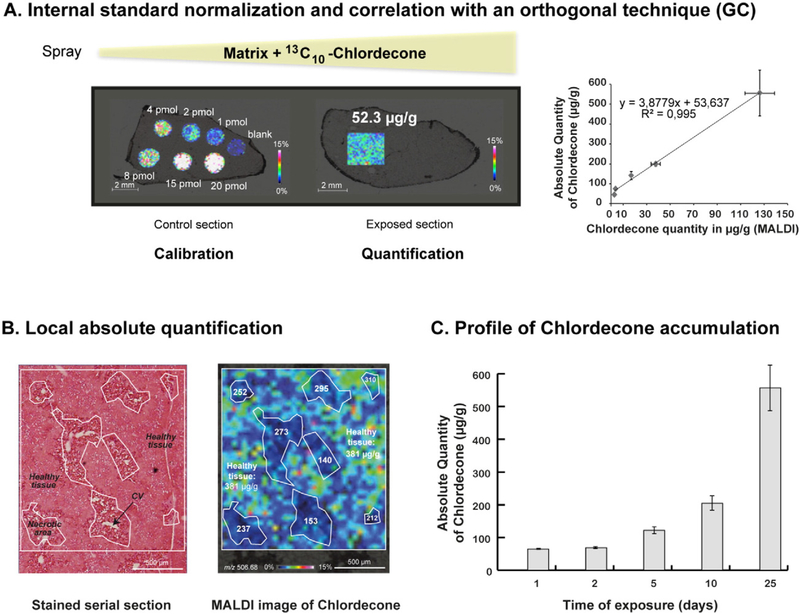
Risk assessment related to the exposure of humans to chemicals released into the environment is a major concern of our modern societies. In this context, toxicology plays a crucial role to characterize the effects of this exposure on health and identify the targets of these molecules. MALDI imaging mass spectrometry (IMS) is an enabling technology for biodistribution studies of chemicals. Although the majority of published studies are presented in a pharmacological context, the concepts discussed in this review can be applied to the toxicological evaluation of chemicals released into the environment. The major asset of IMS is the simultaneous localization and identification of a parent molecule and its metabolites without labeling and without any prior knowledge. Quantification methods developed in IMS are presented with application to an environmental pollutant. IMS is effective in the localization of chemicals and endogenous species. This opens unique perspectives for the discovery of molecular alterations in metabolites and protein biomarkers that could help for a better understanding of toxicity mechanisms. Distribution studies of agrochemicals in plants by IMS can contribute to a better understanding of their mode of action and to a more effective use of these chemicals, avoiding the current concern of environmental damage.
Keywords: Environmental pollutants; Imaging; MALDI; Mass spectrometry; Toxicology.
Copyright © 2016 Elsevier B.V. All rights reserved.
Figures



References
-
- Kabir ER, Rahman MS, Rahman I, A review on endocrine disruptors and their possible impacts on human health, Environ. Toxicol. Pharmacol. 40 (2015) 241–258. - PubMed
-
- Kravchenko J, Corsini E, Williams MA, Decker W, Manjili MH, Otsuki T, Singh N, Al-Mulla F, Al-Temaimi R, Amedei A, Colacci AM, Vaccari M, Mondello C, Scovassi AI, Raju J, Hamid RA, Memeo L, Forte S, Roy R, Woodrick J, Salem HK, Ryan EP, Brown DG, Bisson WH, Lowe L, Lyerly HK, Chemical compounds from anthropogenic environment and immune evasion mechanisms: potential interactions, Carcinogenesis 36 (Suppl. 1) (2015) S111–S127. - PMC - PubMed
-
- Thompson PA, Khatami M, Baglole CJ, Sun J, Harris S, Moon EY, Al-Mulla F, AlTemaimi R, Brown D, Colacci A, Mondello C, Raju J, Ryan E, Woodrick J, Scovassi I, Singh N, Vaccari M, Roy R, Forte S, Memeo L, Salem HK, Amedei A, Hamid RA, Lowe L, Guarnieri T, Bisson WH, Environmental immune disruptors, inflammation and cancer risk, Carcinogenesis 36 (Suppl. 1) (2015) S232–S253. - PMC - PubMed
Publication types
MeSH terms
Substances
Grants and funding
LinkOut - more resources
Full Text Sources
Other Literature Sources
