


ESR1 mutations affect anti-proliferative responses to tamoxifen through enhanced cross-talk with IGF signaling
- PMID: 27178332
- PMCID: PMC5510243
- DOI: 10.1007/s10549-016-3829-5
ESR1 mutations affect anti-proliferative responses to tamoxifen through enhanced cross-talk with IGF signaling
Erratum in
-
Erratum to: ESR1 mutations affect anti-proliferative responses to tamoxifen through enhanced cross-talk with IGF signaling.Breast Cancer Res Treat. 2017 Jun;163(3):639-640. doi: 10.1007/s10549-017-4250-4. Breast Cancer Res Treat. 2017. PMID: 28439737 Free PMC article. No abstract available.
Abstract
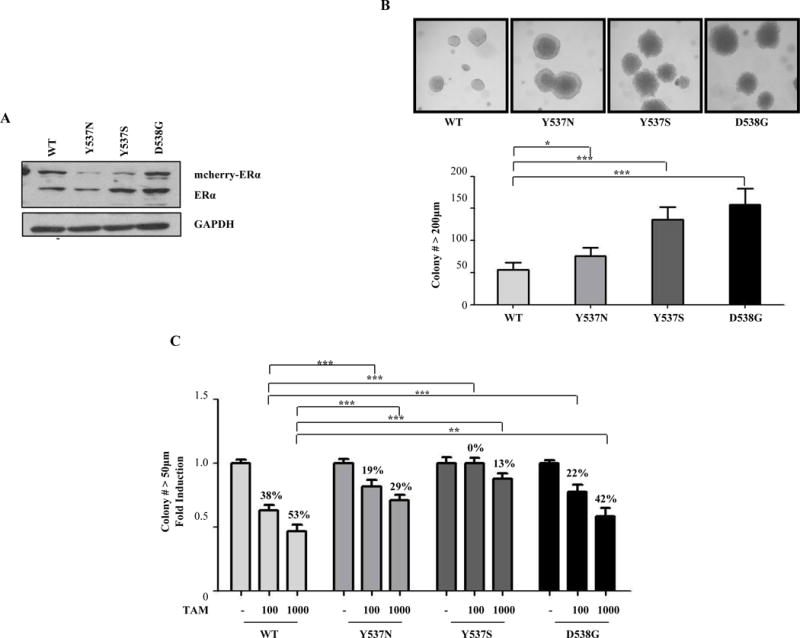
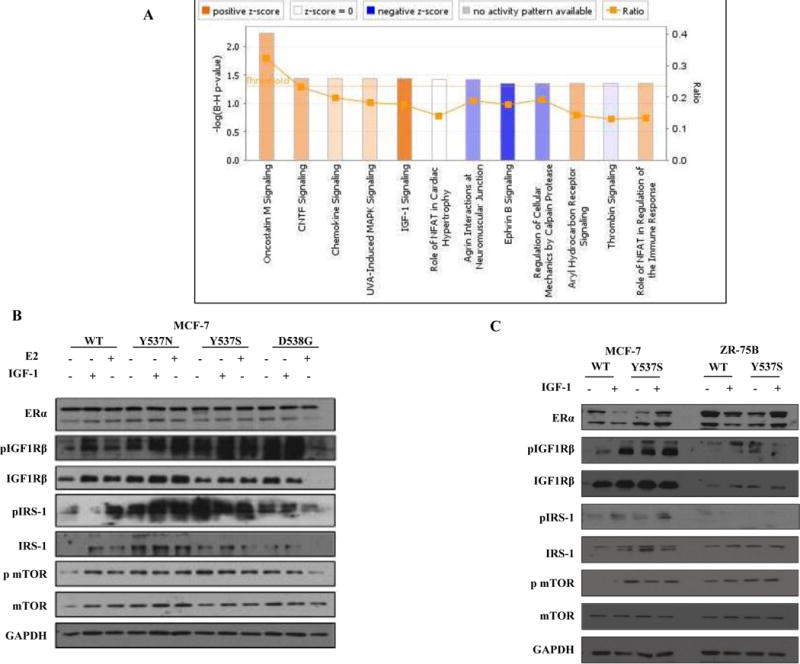
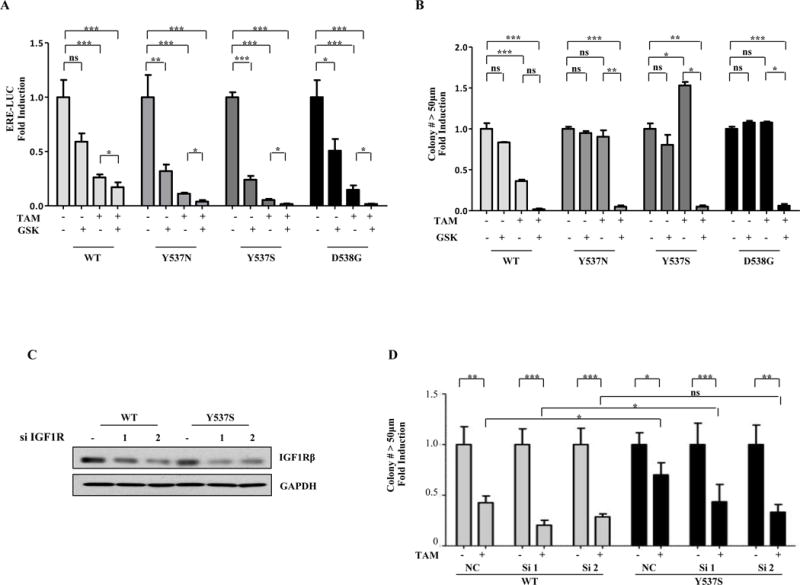
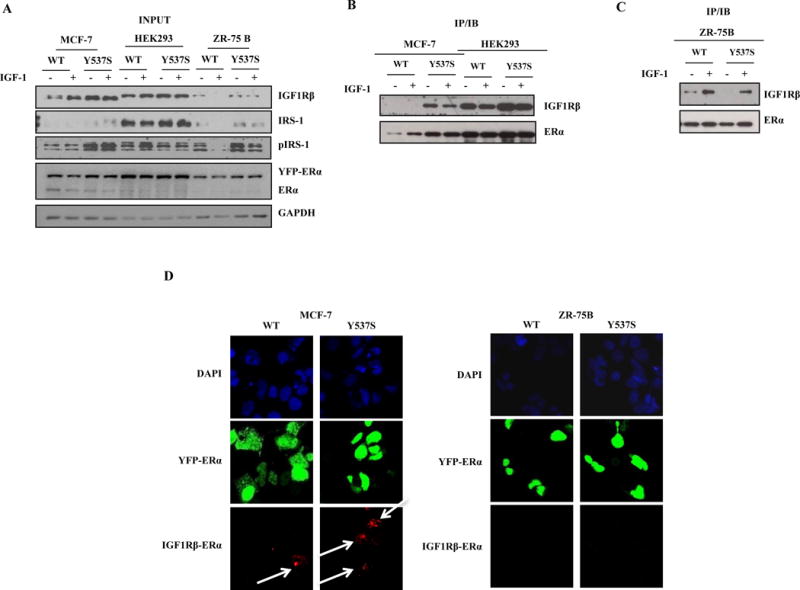
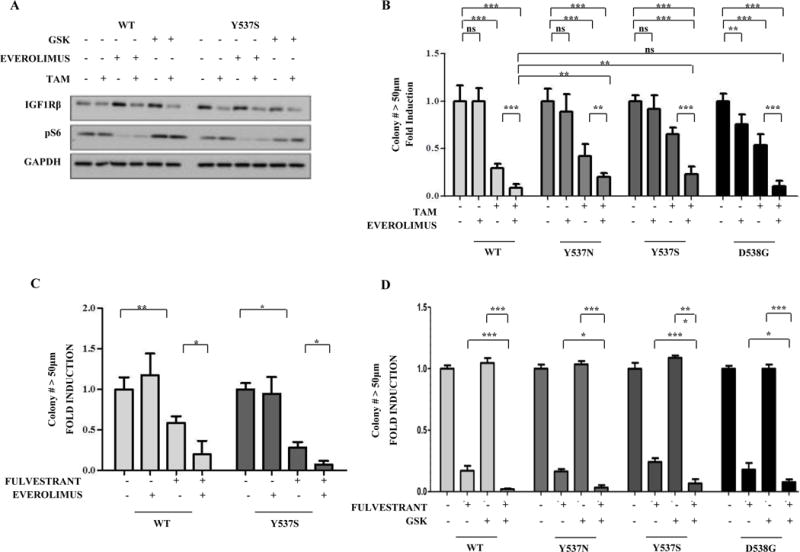
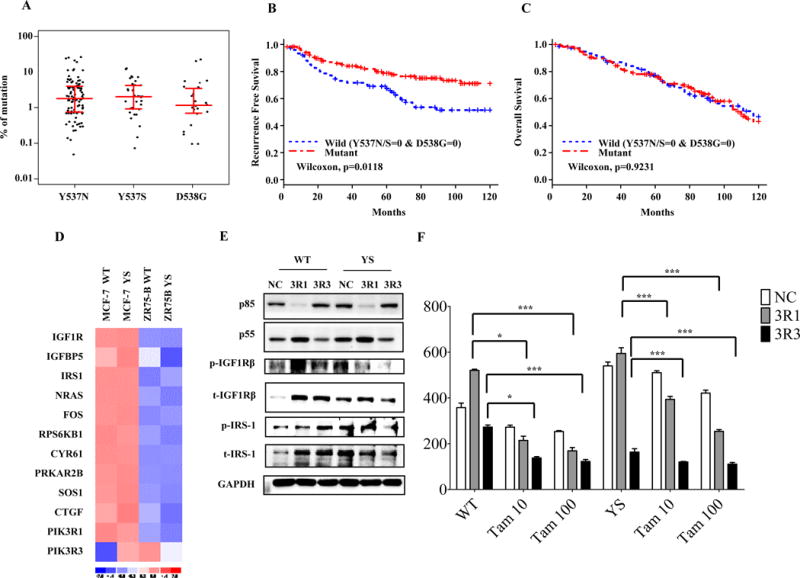
The purpose of this study was to address the role of ESR1 hormone-binding mutations in breast cancer. Soft agar anchorage-independent growth assay, Western blot, ERE reporter transactivation assay, proximity ligation assay (PLA), coimmunoprecipitation assay, silencing assay, digital droplet PCR (ddPCR), Kaplan-Meier analysis, and statistical analysis. It is now generally accepted that estrogen receptor (ESR1) mutations occur frequently in metastatic breast cancers; however, we do not yet know how to best treat these patients. We have modeled the three most frequent hormone-binding ESR1 (HBD-ESR1) mutations (Y537N, Y537S, and D538G) using stable lentiviral transduction in human breast cancer cell lines. Effects on growth were examined in response to hormonal and targeted agents, and mutation-specific changes were studied using microarray and Western blot analysis. We determined that the HBD-ESR1 mutations alter anti-proliferative effects to tamoxifen (Tam), due to cell-intrinsic changes in activation of the insulin-like growth factor receptor (IGF1R) signaling pathway and levels of PIK3R1/PIK3R3. The selective estrogen receptor degrader, fulvestrant, significantly reduced the anchorage-independent growth of ESR1 mutant-expressing cells, while combination treatments with the mTOR inhibitor everolimus, or an inhibitor blocking IGF1R, and the insulin receptor significantly enhanced anti-proliferative responses. Using digital drop (dd) PCR, we identified mutations at high frequencies ranging from 12 % for Y537N, 5 % for Y537S, and 2 % for D538G in archived primary breast tumors from women treated with adjuvant mono-tamoxifen therapy. The HBD-ESR1 mutations were not associated with recurrence-free or overall survival in response in this patient cohort and suggest that knowledge of other cell-intrinsic factors in combination with ESR1 mutation status will be needed determine anti-proliferative responses to Tam.
Keywords: Estrogen Receptor; Everolimus; Fulvestrant; IGF-1; Mutations.
Conflict of interest statement
Authors have nothing to disclose
Figures
References
-
- Tamoxifen for early breast cancer: an overview of the randomised trials. Early Breast Cancer Trialists’ Collaborative Group. Lancet. 1998;351:1451–1467. - PubMed
-
- Johnston SR. New strategies in estrogen receptor-positive breast cancer. Clinical cancer research : an official journal of the American Association for Cancer Research. 2010;16:1979–1987. - PubMed
-
- Jeselsohn R, Yelensky R, Buchwalter G, Frampton G, Meric-Bernstam F, Gonzalez-Angulo AM, et al. Emergence of constitutively active estrogen receptor-alpha mutations in pretreated advanced estrogen receptor-positive breast cancer. Clinical cancer research : an official journal of the American Association for Cancer Research. 2014;20:1757–1767. - PMC - PubMed
-
- Merenbakh-Lamin K, Ben-Baruch N, Yeheskel A, Dvir A, Soussan-Gutman L, Jeselsohn R, et al. D538G mutation in estrogen receptor-alpha: A novel mechanism for acquired endocrine resistance in breast cancer. Cancer research. 2013;73:6856–6864. - PubMed
MeSH terms
Substances
Grants and funding
LinkOut - more resources
Full Text Sources
Other Literature Sources
Medical
Molecular Biology Databases
Miscellaneous
