


Infectiousness of HIV-Seropositive Patients with Tuberculosis in a High-Burden African Setting
- PMID: 27181053
- PMCID: PMC5114446
- DOI: 10.1164/rccm.201511-2146OC
Infectiousness of HIV-Seropositive Patients with Tuberculosis in a High-Burden African Setting
Abstract
Rationale: Policy recommendations on contact investigation of HIV-seropositive patients with tuberculosis have changed several times. Current epidemiologic evidence informing these recommendations is considered low quality, and few large studies investigating the infectiousness of HIV-seropositive and -seronegative index cases have been performed in sub-Saharan Africa.
Objectives: We assessed the infectiousness of HIV-seropositive and -seronegative patients with tuberculosis to their household contacts and examined potential modifiers of this relationship.
Methods: Adults suffering from their first episode of pulmonary tuberculosis were identified in Kampala, Uganda. Field workers visited index households and enrolled consenting household contacts. Latent tuberculosis infection was measured through tuberculin skin testing, and relative risks were calculated using modified Poisson regression models. Standard assessments of interaction between latent tuberculosis infection, the HIV serostatus of index cases, and other variables were performed.
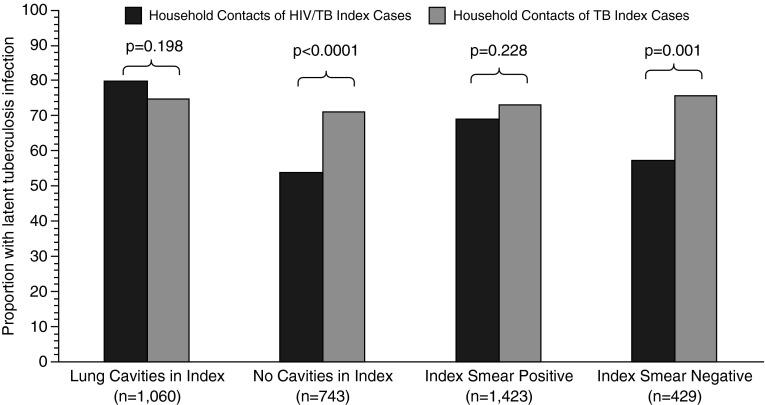
Measurements and main results: Latent tuberculosis infection was found in 577 of 878 (65.7%) and 717 of 974 (73.6%) household contacts of HIV-seropositive and -seronegative tuberculosis cases (relative risk, 0.89; 95% confidence interval, 0.82-0.97). On further stratification, cavitary lung disease (P < 0.0001 for interaction) and smear status (P = 0.02 for interaction) of tuberculosis cases modified the infectiousness of HIV-seropositive indexes. Cough duration of index cases did not display interaction (P = 0.499 for interaction).
Conclusions: This study suggests that HIV-seropositive tuberculosis cases may be less infectious than HIV-seronegative patients only when they are smear-negative or lack cavitary lung disease. These results may explain heterogeneity between prior studies and provide evidence suggesting that tuberculosis contact investigation should include HIV-seropositive index cases in high disease burden settings.
Keywords: HIV; Mycobacterium tuberculosis; household contacts; infectiousness; tuberculosis infection.
Figures
Comment in
-
Contact Investigation: A Priority for Tuberculosis Control Programs.Am J Respir Crit Care Med. 2016 Nov 1;194(9):1049-1051. doi: 10.1164/rccm.201605-1007ED. Am J Respir Crit Care Med. 2016. PMID: 27797611 Free PMC article. No abstract available.
References
-
- Lawn SD, Bekker LG, Middelkoop K, Myer L, Wood R. Impact of HIV infection on the epidemiology of tuberculosis in a peri-urban community in South Africa: the need for age-specific interventions. Clin Infect Dis. 2006;42:1040–1047. - PubMed
-
- Chaisson RE, Martinson NA. Tuberculosis in Africa: combating an HIV-driven crisis. N Engl J Med. 2008;358:1089–1092. - PubMed
Publication types
MeSH terms
Grants and funding
LinkOut - more resources
Full Text Sources
Other Literature Sources
