


doi: 10.1038/srep25824.
Concurrent Formation of Carbon-Carbon Bonds and Functionalized Graphene by Oxidative Carbon-Hydrogen Coupling Reaction
Affiliations
- PMID: 27181191
- PMCID: PMC4867571
- DOI: 10.1038/srep25824
Item in Clipboard
Concurrent Formation of Carbon-Carbon Bonds and Functionalized Graphene by Oxidative Carbon-Hydrogen Coupling Reaction
Sci Rep.
.
Abstract
Oxidative C-H coupling reactions were conducted using graphene oxide (GO) as an oxidant. GO showed high selectivity compared with commonly used oxidants such as (diacetoxyiodo) benzene and 2,3-dichloro-5,6-dicyano-p-benzoquinone. A mechanistic study revealed that radical species contributed to the reaction. After the oxidative coupling reaction, GO was reduced to form a material that shows electron conductivity and high specific capacitance. Therefore, this system could concurrently achieve two important reactions: C-C bond formation via C-H transformation and production of functionalized graphene.
Figures
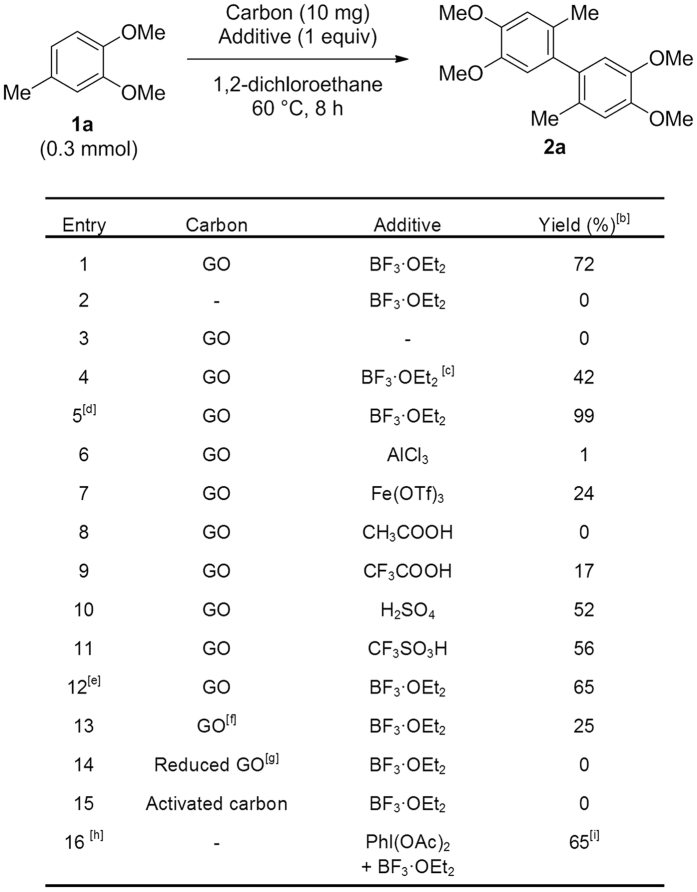
[a](a) Reaction condition: 1a (0.3 mmol), GO (oxygen content: 41.1 wt%, 10 mg), additive (0.3 mmol), 1,2-dichloroethane (0.2 mL) under Ar atomospher. (b) GC yield. (c) BF3·OEt2 (0.2 equiv), 24 h. (d) 20 mg of GO (oxygen content: 41.1 wt%) and 0.5 mL of 1,2-dichloroethane were used. (e) Reaction was performed under O2 atmosphere. (f) GO was prepared by Brodie’s method. (g) Reduced GO was prepared by reduction of GO with hydrazine. (h) Reaction condition: 1a (0.3 mmol), GO (oxygen content: 41.1 wt%, 10 mg), PhI(OAc)2 (0.3 mmol), BF3·OEt2 (0.3 mmol), 1,2-dichloroethane (0.2 mL) under Ar atmosphere. (i) Acetoxylated products of 1a were also formed.
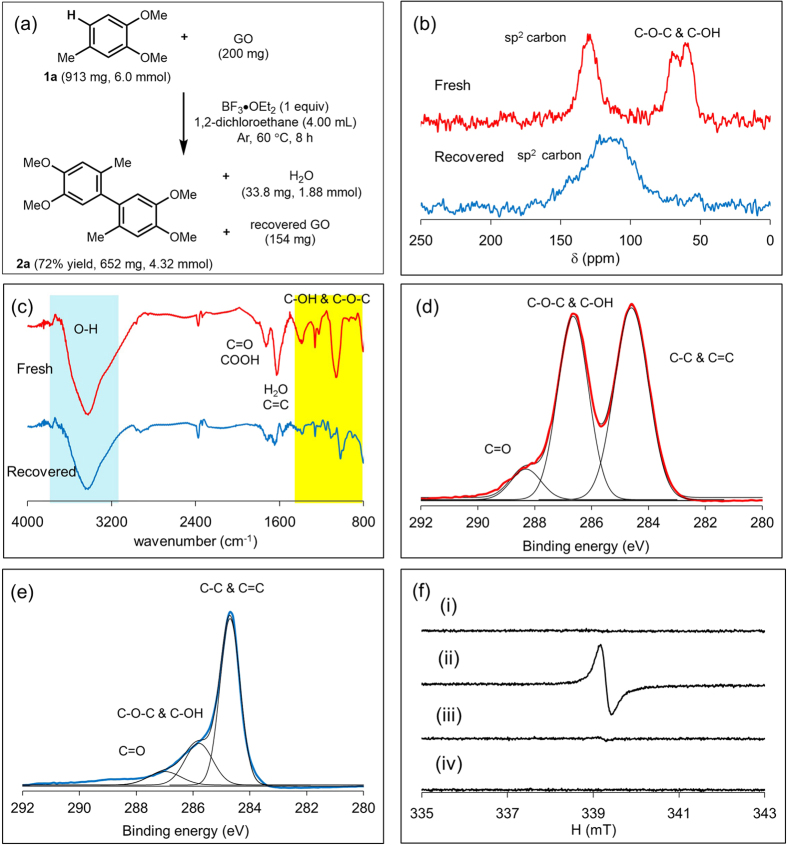
(a) Mass balance of the reaction, and characterization of fresh GO (oxygen content: 41.1 wt%), and recovered GO after the oxidative C–H coupling reaction; (b) solid state 13C NMR spectra, (c) IR spectra, (d) XPS C1s region of fresh GO, and (e) XPS C1s region of recovered GO. (f) ESR spectra of (i) GO (O: 50.7 wt%), (ii) GO with 3,4-dimethoxytoluene and BF3·OEt2, (iii) GO with 3,4-dimethoxytoluene, and (iv) GO with BF3·OEt2.
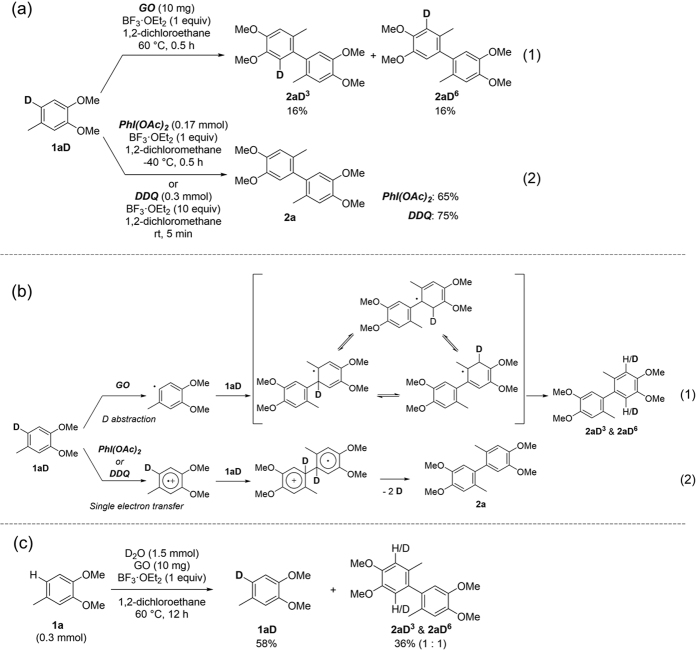
(a) Deuterium labelling experiment; (1) GO promoted the formation of 2aD3 and 2aD6 (both in 16% yield). (2) Phl(OAc)2 and DDQ promoted the formation of only 2a in 65% and 75% yield, respectively. (b) Proposed reaction mechanisms promoted by (1) GO, (2) Phl(OAc)2 or DDQ. (c) H/D exchange experiment with D2O. Only 1aD, 2aD3, and 2aD6 were observed in yields of 58%, 18%, and 18%, respectively.
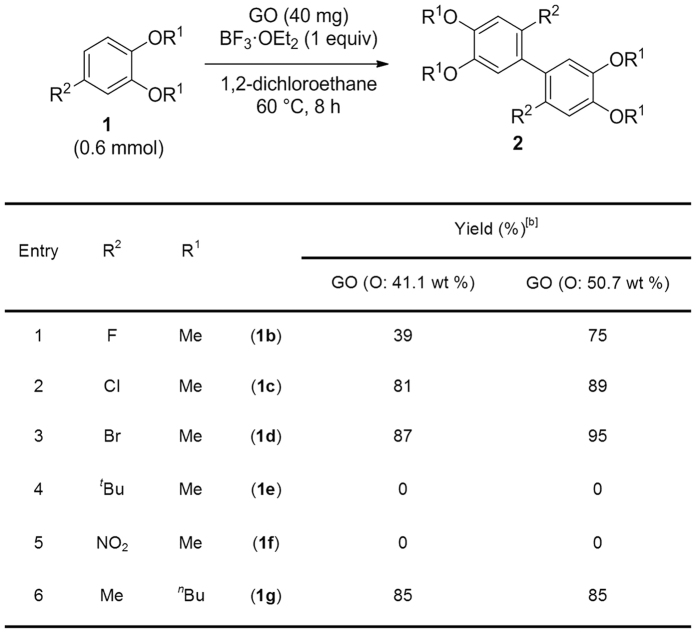
[a](a) Reaction condition: 1 (0.6 mmol), GO (40 mg), BF3·OEt2 (0.6 mmol), 1,2-dichloroethane (1.0 mL) under Ar atmosphere. (b) Isolated yield.
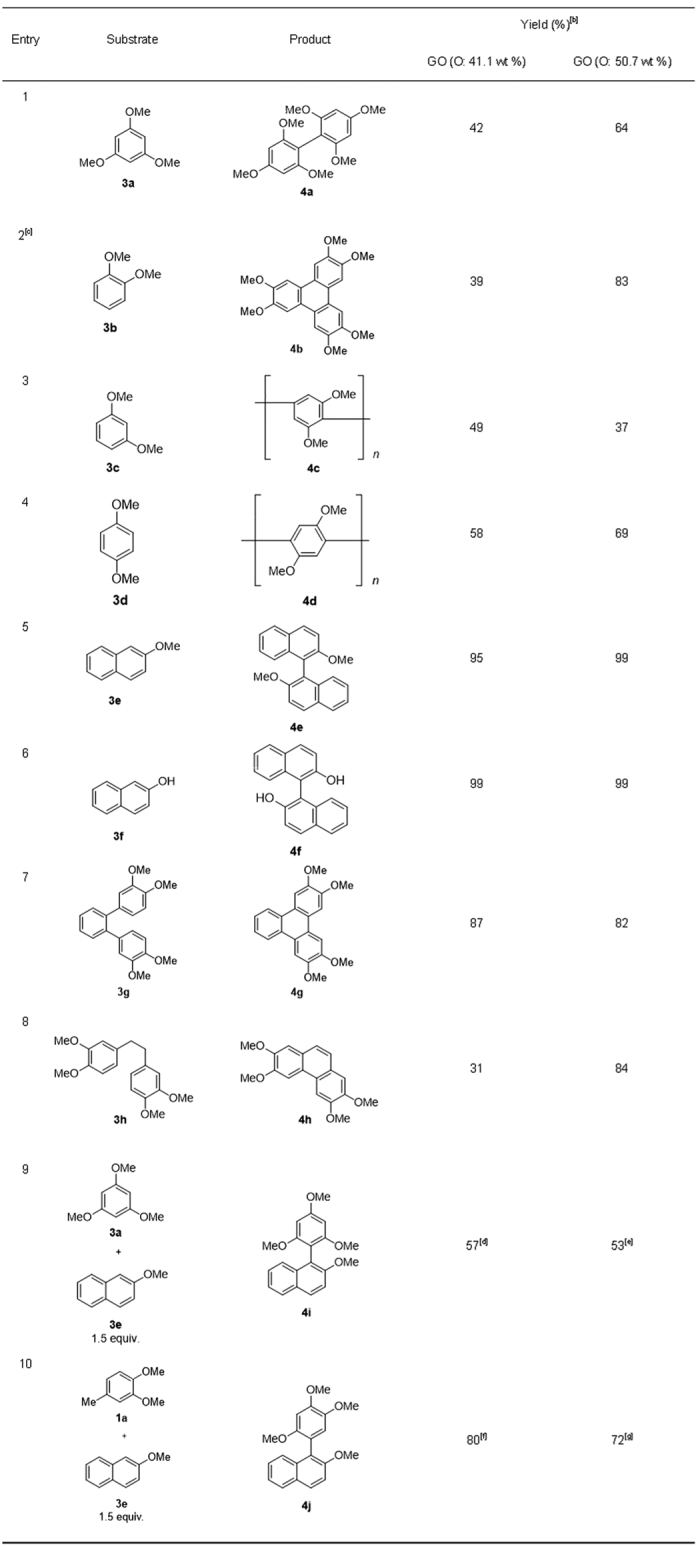
[a](a) Reaction condition: 1 (0.6 mmol), GO (40 mg), BF3·OEt2 (0.6 mmol), 1,2-dichloroethane (1.0 mL) under Ar atmosphere. (b) Isolated yield. (c) Reaction condition: 1,2-dimethoxybenzene (0.6 mmol), GO (100 mg), BF3·OEt2 (2.0 mL) under Ar atmosphere, 60 °C, 8 h. (d) Homocoupling product of 3a and 3e were produced in 1% and 11% yield. (e) Homocoupling product of 3a and 3e were produced in 1% and 6% yield. (f) Homocoupling product of 3a and 3e were produced in 19% and 29% yield. (g) Homocoupling product of 1a and 3e were produced in 19% and 31% yield.
References
-
- Kakiuchi F. & Chatani N. Catalytic methods for C–H bond functionalization: Application in organic synthesis. Adv. Synth. Catal. 345, 1077–1101 (2003).
-
- Godula K. & Sames D. C–H bond functionalization in complex organic synthesis. Science 312, 67–72 (2006). - PubMed
-
- Labinger J. A. & Bercaw J. E. Understanding and exploiting C–H bond activation. Nature 417, 507–514 (2002). - PubMed
-
- Shilov A. E. & Shul’pin G. B. Activation of C–H bonds by metal complexes. Chem. Rev. 97, 2879–2932 (1997). - PubMed
-
- Sarhan A. A. O. & Bolm C. Iron(III) chloride in oxidative C–C coupling reactions. Chem. Soc. Rev. 38, 2730–2744 (2009). - PubMed
LinkOut - more resources
Full Text Sources
Other Literature Sources
