Review
. 2016 Aug 28;428(17):3495-513.
doi: 10.1016/j.jmb.2016.04.032. Epub 2016 May 12.

Interferon-Inducible GTPases in Host Resistance, Inflammation and Disease

Affiliations
Review

Interferon-Inducible GTPases in Host Resistance, Inflammation and Disease

Danielle Pilla-Moffett et al. J Mol Biol. .

Abstract

Cell-autonomous immunity is essential for host organisms to defend themselves against invasive microbes. In vertebrates, both the adaptive and the innate branches of the immune system operate cell-autonomous defenses as key effector mechanisms that are induced by pro-inflammatory interferons (IFNs). IFNs can activate cell-intrinsic host defenses in virtually any cell type ranging from professional phagocytes to mucosal epithelial cells. Much of this IFN-induced host resistance program is dependent on four families of IFN-inducible GTPases: the myxovirus resistance proteins, the immunity-related GTPases, the guanylate-binding proteins (GBPs), and the very large IFN-inducible GTPases. These GTPase families provide host resistance to a variety of viral, bacterial, and protozoan pathogens through the sequestration of microbial proteins, manipulation of vesicle trafficking, regulation of antimicrobial autophagy (xenophagy), execution of intracellular membranolytic pathways, and the activation of inflammasomes. This review discusses our current knowledge of the molecular function of IFN-inducible GTPases in providing host resistance, as well as their role in the pathogenesis of autoinflammatory Crohn's disease. While substantial advances were made in the recent past, few of the known functions of IFN-inducible GTPases have been explored in any depth, and new functions await discovery. This review will therefore highlight key areas of future exploration that promise to advance our understanding of the role of IFN-inducible GTPases in human diseases.

Keywords: Crohn's disease; GBP; IRG; IRGM; Inflammasome.


Figures

Figure 1
Figure 1. Maximum-likelihood phylogeny based on conserved coding regions of interferon-stimulated GTPase family members in humans and mice
Branches for larger clades have been collapsed. Major families, including MX (blue), IRG (orange), GBP (purple), and VLIG (green), are indicated, with human K-Ras included as an outgroup. Structures of representative MX, IRG, and GBP family members are shown at right (PDB: 3SZR, 1TQ6, 1F5N).
Figure 2
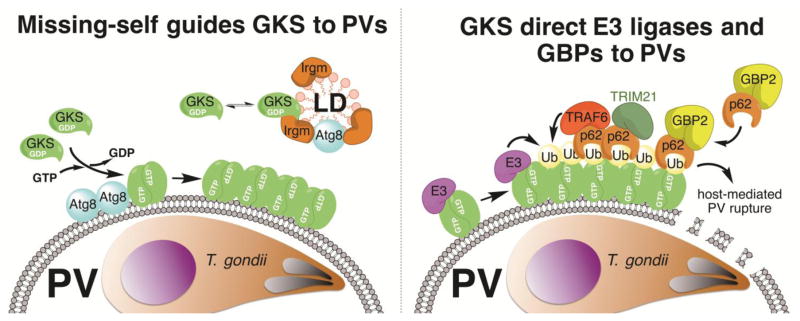
Figure 2. Targeting of GKS proteins and GBPs to T. gondii-containing parasitophorous vacuoles (PVs) in mouse cells
The GKS class of IRG proteins is guided towards PV membranes through a missing-self principle. Whereas Irgm1 and Irgm3 proteins residing on “self” lipid droplets (LDs) block GKS protein activation, the absence of these Irgm proteins from PVs results in the docking of GTP-bound GKS dimers to PV membranes. Lipidated members of the Atg8 family of ubiquitin-like proteins further promote GKS association with PVs (left panel). GKS proteins promote the recruitment of ‘pioneering’ ubiquitin E3 ligases (E3) and p62-interacting E3 ligases (TRAF6, TRIM21) to PVs, which promote the decoration of PVs with ubiquitin. GKS proteins themselves are possible ubiquitination substrates, as depicted in this figure, but further studies are required to test this hypothesis. The ubiquitin-binding protein p62 also escorts GBP2 to PVs (right panel). Additional p62-independent mechanisms of GBP recruitment exist (not shown).
Figure 3
Figure 3. Distinct models to account for the role of GBPs in inflammasome activation
Three non-mutually exclusive models provide a conceptual framework for the function of GBPs in inflammasome activation: 1) GBPs promote the lysis of S. typhimurium-containing vacuoles thereby releasing the pathogen into the host cell cytosol; 2) GBPs bind to and lyse cytosolic F. novicida prompting the spillage of bacterial DNA into the host cell cytosol; 3) GBPs accelerate the kinetics of caspase-11 and/or caspase-1 oligomerization.

References

    1. Randow F, MacMicking JD, James LC. Cellular self-defense: how cell-autonomous immunity protects against pathogens. Science. 2013;340:701–6. - PMC - PubMed
    1. Kawahara T, Quinn MT, Lambeth JD. Molecular evolution of the reactive oxygen-generating NADPH oxidase (Nox/Duox) family of enzymes. BMC Evol Biol. 2007;7:109. - PMC - PubMed
    1. Borden EC, Sen GC, Uze G, Silverman RH, Ransohoff RM, Foster GR, et al. Interferons at age 50: past, current and future impact on biomedicine. Nat Rev Drug Discov. 2007;6:975–90. - PMC - PubMed
    1. Platanias LC. Mechanisms of type-I- and type-II-interferon-mediated signalling. Nat Rev Immunol. 2005;5:375–86. - PubMed
    1. Horisberger MA, Staeheli P, Haller O. Interferon induces a unique protein in mouse cells bearing a gene for resistance to influenza virus. Proc Natl Acad Sci U S A. 1983;80:1910–4. - PMC - PubMed

Publication types