A comparison of R-EPOCH and R-CHOP as a first-line regimen in de novo DLBCL patients with high Ki-67 expression in a single institution
- PMID: 27183909
- PMCID: PMC5173055
- DOI: 10.18632/oncotarget.9271
A comparison of R-EPOCH and R-CHOP as a first-line regimen in de novo DLBCL patients with high Ki-67 expression in a single institution
Abstract
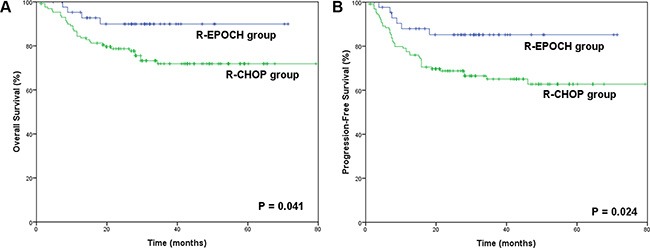
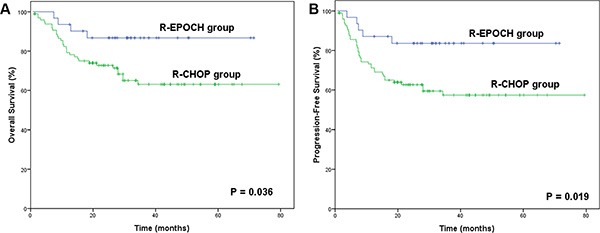
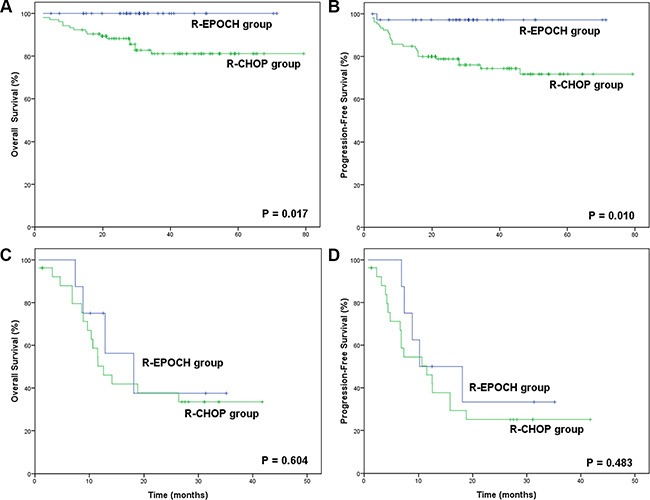
Diffuse large B-cell lymphoma (DLBCL) patients with high Ki-67 expression receive limited benefits from R-CHOP (rituximab, cyclophosphamide, doxorubicin, vincristine, and prednisone) therapy. This study aims to compare the R-EPOCH (etoposide, prednisone, vincristine, cyclophosphamide, and doxorubicin) and R-CHOP regimens as first-line therapy in DLBCL patients with high Ki-67 expression. Data from 44 untreated DLBCL patients with high Ki-67 expression receiving R-EPOCH therapy were matched with those from 132 untreated DLBCL patients with high Ki-67 expression receiving R-CHOP therapy based on the International Prognostic Index (IPI: age, Ann Arbor stage, performance status, LDH level, number of extranodal sites), gender, and Ki-67 expression. In the R-EPOCH group, 42/44 patients were eligible for response evaluation. A total of 35 patients (83.3%) achieved complete remission (CR); 6 patients (14.3%) achieved partial remission (PR); and one patient (2.4%) exhibited progressive disease (PD) after 2 cycles of therapy. Patients in the R-EPOCH group presented better survival outcomes than those in the R-CHOP group (3-year overall survival [OS]: 89.9% vs. 70.2%, p = 0.041; 3-year progression-free survival [PFS]: 86.6% vs. 59.7%, p = 0.024). The survival superiority of the R-EPOCH over the R-CHOP regimen persisted when considering only patients of low-to-intermediate IPI risk, but it was not observed in those of high IPI risk. Our data suggest that R-EPOCH could be superior to R-CHOP as a first-line regimen in DLBCL patients with high Ki-67 expression, especially in those of low-to-intermediate IPI risk.
Keywords: DLBCL; Ki-67 expression; R-CHOP; R-EPOCH.
Conflict of interest statement
The authors declare no conflicts of interest.
Figures
References
-
- Pileri SA, Agostinelli C, Sabattini E, Bacci F, Sagramoso C, Pileri A., Jr Falini B, Piccaluga PP. Lymphoma classification: the quiet after the storm. Semin Diagn Pathol. 2011;28:113–23. - PubMed
-
- Moskowitz C. Diffuse large B cell lymphoma: how can we cure more patients in 2012? Best Pract Res Clin Haematol. 2012;25:41–7. - PubMed
-
- Abid MB, Nasim F, Anwar K, Pervez S. Diffuse large B cell lymphoma (DLBCL) in Pakistan: an emerging epidemic? Asian Pac J Cancer Prev. 2005;6:531–4. - PubMed
-
- Harris NL, Jaffe ES, Diebold J, Flandrin G, Muller-Hermelink HK, Vardiman J. Lymphoma classification—from controversy to consensus: the R.E.A.L. and WHO Classification of lymphoid neoplasms. Ann Oncol. 2000;11:3–10. - PubMed
Publication types
MeSH terms
Substances
Supplementary concepts
LinkOut - more resources
Full Text Sources
Other Literature Sources
Research Materials