. 2017 Sep;22(9):1313-1326.
doi: 10.1038/mp.2016.75. Epub 2016 May 17.

Haploinsufficiency of the 22q11.2 microdeletion gene Mrpl40 disrupts short-term synaptic plasticity and working memory through dysregulation of mitochondrial calcium

Affiliations

Haploinsufficiency of the 22q11.2 microdeletion gene Mrpl40 disrupts short-term synaptic plasticity and working memory through dysregulation of mitochondrial calcium

P Devaraju et al. Mol Psychiatry. 2017 Sep.

Abstract

Hemizygous deletion of a 1.5- to 3-megabase region on chromosome 22 causes 22q11.2 deletion syndrome (22q11DS), which constitutes one of the strongest genetic risks for schizophrenia. Mouse models of 22q11DS have abnormal short-term synaptic plasticity that contributes to working-memory deficiencies similar to those in schizophrenia. We screened mutant mice carrying hemizygous deletions of 22q11DS genes and identified haploinsufficiency of Mrpl40 (mitochondrial large ribosomal subunit protein 40) as a contributor to abnormal short-term potentiation (STP), a major form of short-term synaptic plasticity. Two-photon imaging of the genetically encoded fluorescent calcium indicator GCaMP6, expressed in presynaptic cytosol or mitochondria, showed that Mrpl40 haploinsufficiency deregulates STP via impaired calcium extrusion from the mitochondrial matrix through the mitochondrial permeability transition pore. This led to abnormally high cytosolic calcium transients in presynaptic terminals and deficient working memory but did not affect long-term spatial memory. Thus, we propose that mitochondrial calcium deregulation is a novel pathogenic mechanism of cognitive deficiencies in schizophrenia.


Conflict of interest statement

The authors declare no conflict of interest.

Figures
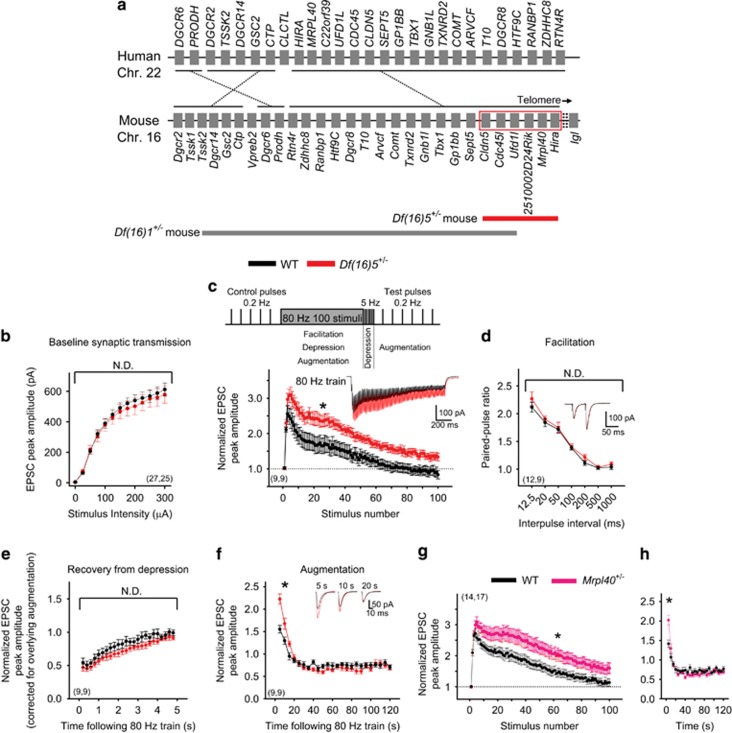
Figure 1
Figure 1
Abnormal short-term synaptic plasticity in Df(16)5+/− mice is caused by Mrpl40 haploinsufficiency. (a) Diagram depicting genes in the 22.q11.2 genomic region of the human chromosome 22 and the syntenic region of mouse chromosome 16. Red horizontal bar represents genomic regions hemizygously deleted in Df(16)5+/− mice, and gray horizontal bar represents genomic regions hemizygously deleted in Df(16)1+/− mice. Note that 2510002D24Rik, Mrpl40 and Hira genes are mapped outside the Df(16)1 microdeletion. (b) Input–output relations in Df(16)5+/− and wild-type (WT) littermates. (c) Short-term potentiation (STP, comprising facilitation, depression and augmentation) induced by the high-frequency (80 Hz) train. The first time point represents an average of five baseline excitatory postsynaptic currents (EPSCs) delivered at low frequency. The top inset shows the protocol for measuring STP, recovery from depression and augmentation in the same experiment. (d–f) Average facilitation tested by paired-pulse ratio in separate experiments (d), recovery from depression tested 5 s after the 80-Hz train (e) and augmentation tested 5–120 s after the 80-Hz train in Df(16)5+/− and WT mice (f). Insets show representative EPSC traces. (g, h) Mean STP of EPSCs induced by the 80-Hz train of synaptic stimulation of Schaffer collaterals (g) and augmentation (h) in Mrpl40+/− mice and their WT littermates. Numbers of neurons are shown in parentheses. N.D., not significantly different. Data are represented as mean±s.e.m. *P<0.05.
Figure 2
Figure 2
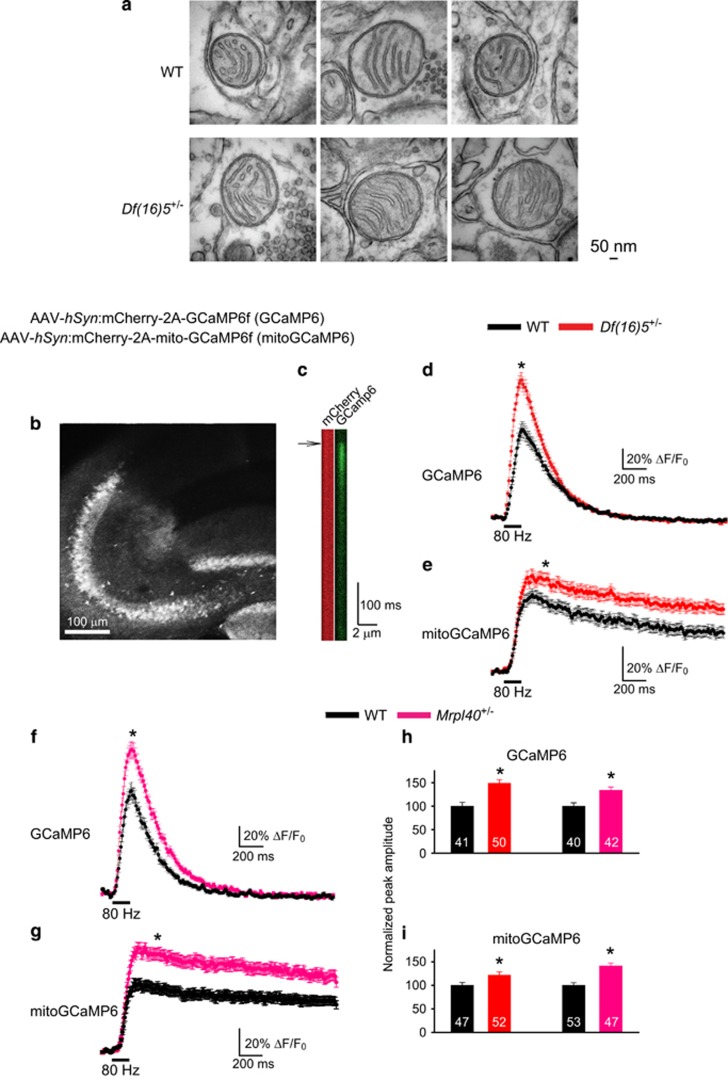
Normal mitochondrial structure but abnormal presynaptic cytosolic and mitochondrial calcium regulation in Df(16)5+/− and Mrpl40+/− mice. (a) Three representative transmission electron microscopy images of mitochondrial ultrastructure in the CA1 area of the hippocampus of wild-type (WT) and Df(16)5+/− mice. (b) The representative fluorescent image of mCherry after infection of the CA3 area with adeno-associated viruses (AAVs) encoding either GCaMP6 or mitoGCaMP6. (c) Line scan of mCherry and GCaMP6 fluorescence in a CA3 presynaptic terminal before and after the 80-Hz stimulation of Schaffer collaterals (arrow). (dg) Mean normalized cytosolic GCaMP6 (d, f) and mitoGCaMP6 (e, g) fluorescence in CA3 presynaptic terminals imaged in the CA1 area of the hippocampus, before and after 80-Hz stimulation in Df(16)5+/− and WT littermates (d, e) and Mrpl40+/− and WT littermates (f, g). (h, i) Normalized mean peak amplitudes of GCaMP6 (h) or mitoGCaMP6 (i) in Df(16)5+/− and WT littermates and Mrpl40+/− and WT littermates. Numbers of fluorescent puncta are shown inside columns. *P<0.05.
Figure 3
Figure 3
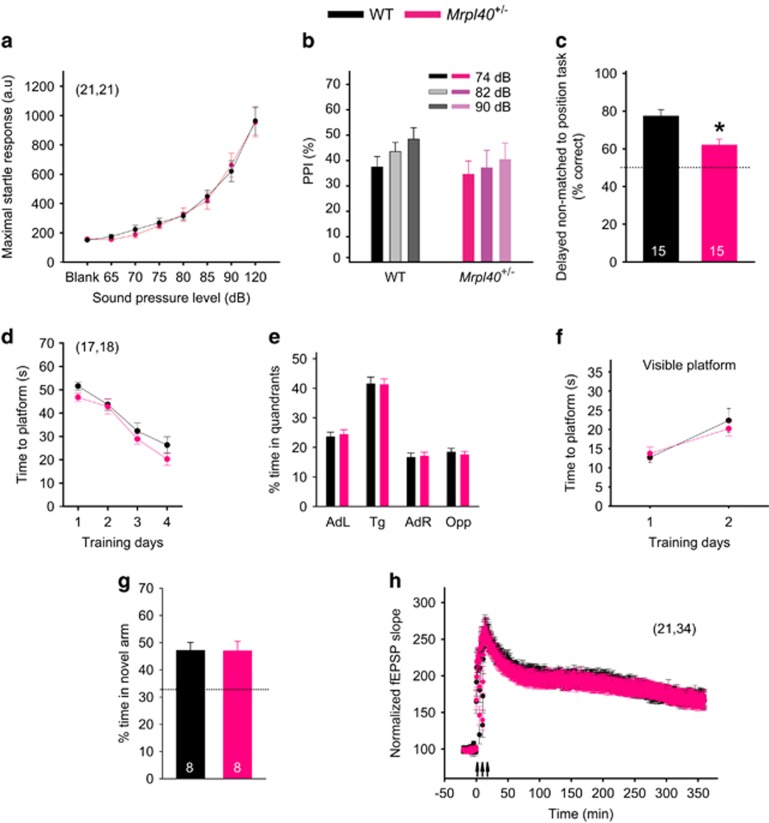
Deficient working memory and normal long-term spatial memory, long-term synaptic plasticity and acoustic startle in Mrpl40+/− mice. (a, b) Mean maximal startle responses as a function of sound intensity (a) and prepulse inhibition (PPI) (b) in Mrpl40+/− and wild-type (WT) littermates. (c) The mean numbers of correct choices made in the delayed non-matched-to-position task by Mrpl40+/− and WT littermates. (df) Morris water maze tasks. Average time to find a submerged platform during the learning phase (d), time spent in quadrants during the probe test performed 48 h after the last learning session (e) and time to travel to a visible platform (f) in Mrpl40+/− and WT littermates. Abbreviations: AdL, adjacent left quadrant; AdR, adjacent right quadrant; Opp, opposite quadrant; Tg, target quadrant. (g) Average percentage of time spent in the novel arm in the novel-recognition version of the Y-maze task by Mrpl40+/− and WT mice. (h) Long-term potentiation at CA3–CA1 synapses measured as mean field EPSP (fEPSP) as a function of time before and after tetanization of Schaffer collaterals with 200-Hz trains (arrows) in Mrpl40+/− and WT mice. Dashed lines in (c, g) indicate the level of performance expected by chance. Numbers of mice or slices are shown in parentheses or inside columns. *P <0.05.
Figure 4
Figure 4
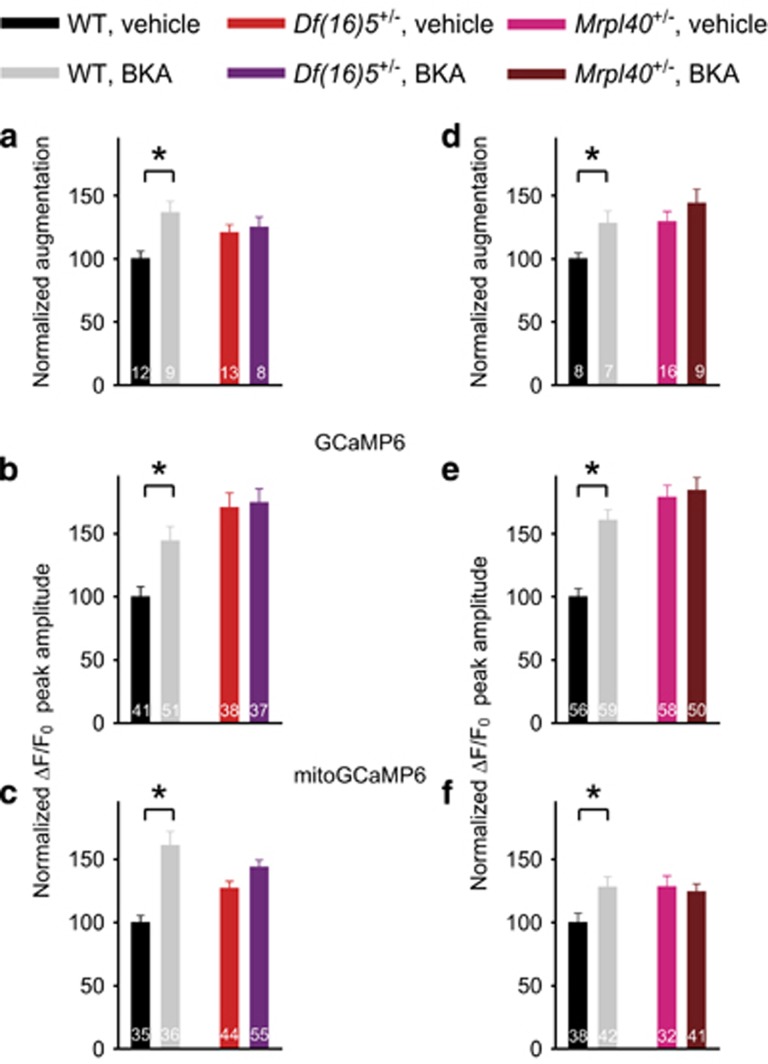
The mitochondrial permeability transition pore (mPTP) inhibitor bongkrekic acid (BKA) mimics the short-term potentiation (STP) and calcium transient phenotypes of Df(16)5+/− and Mrpl40+/− mice. (a–f) BKA effect on augmentation (a, d), peak GCaMP6 (b, e) and peak mitoGCaMP6 fluorescence intensities (c, f) in wild-type (WT) and Df(16)5+/− littermates (ac) or WT and Mrpl40+/− littermates (normalized to WT levels) (df). Numbers of neurons or fluorescent puncta are shown inside columns. *P<0.05.
Figure 5
Figure 5
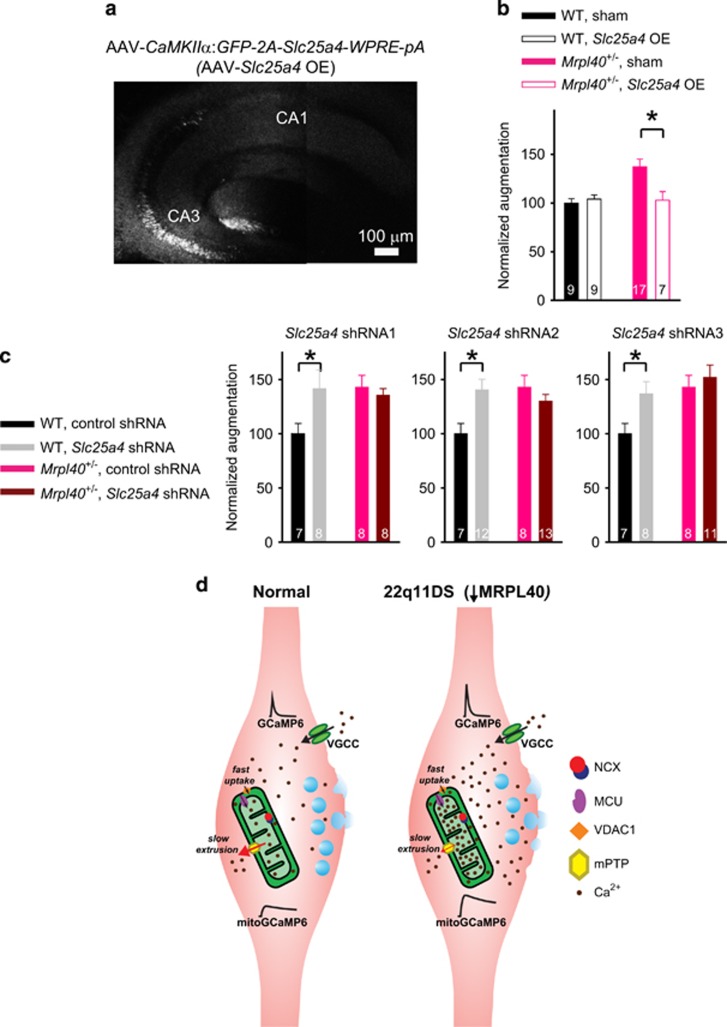
The mitochondrial permeability transition pore (mPTP) gain- or loss-of-function molecular manipulations rescue or mimic, respectively, the short-term potentiation (STP) phenotypes of Mrpl40+/− mice. (a) Overexpression of Slc25a4 and GFP in the CA3 area of the hippocampus. (b) Mean augmentation measured in sham- or Slc25a4 OE-injected WT and Mrpl40+/− mice. (c) Mean augmentation measured in control or Slc25a4 shRNA-injected WT and Mrpl40+/− mice. The data are shown for three different Slc25a4 shRNAs (shRNA1, shRNA2, shRNA3) and are normalized to respective WT control levels. Numbers of neurons are shown inside columns. *P <0.05. (d) Model of mPTP-dependent mechanisms of STP dysfunction in 22q11DS. MRPL40 haploinsufficiency in 22q11DS reduces mitochondrial Ca2+ extrusion through impaired mPTP. This leads to a Ca2+ build-up in the mitochondrial matrix and enhanced Ca2+ transients in the mitochondrial matrix and cytosol during high-frequency activity, which in turn leads to enhanced synaptic vesicle release in presynaptic terminals. MCU, mitochondrial Ca2+ uniporter; NCX, Na+/Ca2+ exchanger; VDAC1, voltage-dependent anion channel 1; VGCC, voltage-gated calcium channels; WT, wild type. Upper traces represent cytosolic Ca2+ transients (GCaMP6), and lower traces represent mitochondrial Ca2+ transients (mitoGCaMP6).

References

    1. Carpenter WT Jr, Buchanan RW. Schizophrenia. N Engl J Med 1994; 330: 681–690. - PubMed
    1. Nestler EJ, Hyman SE. Animal models of neuropsychiatric disorders. Nat Neurosci 2010; 13: 1161–1169. - PMC - PubMed
    1. Scambler PJ. The 22q11 deletion syndromes. Hum Mol Genet 2000; 9: 2421–2426. - PubMed
    1. Pulver AE, Nestadt G, Goldberg R, Shprintzen RJ, Lamacz M, Wolyniec PS et al. Psychotic illness in patients diagnosed with velo-cardio-facial syndrome and their relatives. J Nerv Ment Dis 1994; 182: 476–478. - PubMed
    1. Chow EW, Watson M, Young DA, Bassett AS. Neurocognitive profile in 22q11 deletion syndrome and schizophrenia. Schizophr Res 2006; 87: 270–278. - PMC - PubMed